Dramatic Treatment for A Stain
A Stain
Format: Short Film / Anthology Episode | Est. Length: 10-12 minutes
Series Overview
Imagine "A Stain" as a standalone episode within a psychological horror anthology series titled The Cold Spot. Each episode explores the dark underbelly of human connection in desolate, forgotten corners of the world, where the external environment—a frozen city, a decaying industrial town, a remote outpost—mirrors the characters' internal decay. The series blurs the line between psychological breakdown and supernatural malevolence, suggesting that certain places and people are magnets for a predatory, emotional darkness, with recurring motifs and characters hinting at a larger, unseen ecosystem of despair.
Episode Hook / Teaser
In the brutal, soul-crushing cold of a Winnipeg winter, a woman named Casey struggles to force a frozen key into the lock of a decrepit apartment building. She has been summoned here, against her better judgment, by a man she can't seem to escape.
Logline
Trapped in a cycle of obsession, a woman answers a manipulative ex-lover's late-night call, only to find herself the intended audience for a perverse and terrifying ritual. What begins as a familiar scene of betrayal descends into a surreal nightmare that threatens her sanity and her life.
Themes
The primary theme is the anatomy of a toxic relationship, exploring the magnetic pull of obsession and the ways in-which psychological manipulation can warp reality. It delves into the cyclical nature of emotional abuse, where the victim is both aware of their entrapment and powerless to break free. The story uses the visceral, punishing cold of the Canadian winter as a powerful metaphor for emotional numbness, isolation, and the deep, invasive chill of despair that settles into one's bones.
Genre-wise, "A Stain" is a psychological thriller that slowly bleeds into surrealist horror. It examines the monstrousness that can lie beneath a veneer of human intimacy, questioning whether the horror is purely psychological—a product of Casey's shattered perception—or if Gabe and his partner represent something genuinely malevolent and predatory. The narrative is steeped in a sense of dread and inevitability, focusing on the horror of being seen, understood, and destroyed by the one person you can't let go of.
Stakes
The stakes for Casey are psychological and existential. She risks the complete annihilation of her sense of self, being pushed past a breaking point from which she may not recover. Initially, the risk is emotional—another night of humiliation and heartbreak—but it quickly escalates to a fight for her sanity as reality begins to distort around her. Ultimately, the ambiguous threat of physical violence suggests her very life might be the final price of her obsession.
Conflict / Antagonistic Forces
The central conflict is Casey versus Gabe, a battle of psychological warfare where Gabe holds all the power. He, along with his new partner, represents an external antagonistic force that is calm, deliberate, and predatory. Internally, Casey is at war with herself—her self-destructive compulsion to return to Gabe clashes with every instinct for self-preservation. The environment itself acts as a third antagonist: the brutal cold, the decaying building, and the oppressive apartment are all active forces that physically and mentally assault her, mirroring and amplifying her internal state of decay and entrapment.
Synopsis
Summoned by a clipped, demanding phone call from her toxic ex-lover, Gabe, Casey drives through the frozen hellscape of a Winnipeg night to his decrepit apartment building. Every step of the journey is a struggle against the elements and her own better judgment, from the frozen lock on the main door to the three flights of decaying, graffiti-scarred stairs. Her internal monologue reveals a long, painful history with Gabe, a cycle of hope and humiliation that she is knowingly perpetuating by showing up once again.
Upon entering Gabe’s unlocked apartment, she steps into a scene of deliberate psychological torture. Gabe is on the couch with another woman, bathed in the sickly, pulsating light of a muted television. There is no surprise or apology in his vacant stare, only a calm, unnerving acknowledgment. The confrontation that follows is one of suffocating silence and subtle gestures, revealing that the woman is not just a random conquest but a knowing, willing participant in this perverse game, culminating in a final, terrifying reveal that suggests this ritual is far more sinister than simple infidelity.
Character Breakdown
CASEY: (Protagonist) Casey begins the story in a state of weary resignation, fully aware of the toxic dynamic with Gabe but still hopelessly compelled by it. She is defined by a deep-seated obsession that overrides her logic, a raw nerve of hope and self-loathing. Her psychological arc is a rapid descent from this familiar, grinding misery into a state of pure, surreal terror, ending with her perception shattered and her will completely broken, a trapped witness to a horror designed specifically for her.
GABE: (Antagonist) Gabe is the calm, predatory orchestrator of the events. He is emotionally vacant, his actions driven by a need for psychological dominance and control. He begins and ends the story in the same state of unnerving stillness, his arc not one of change but of successful execution; he is a static, monstrous force who enjoys watching the emotional destruction he causes, treating Casey's pain as a form of entertainment or sustenance.
THE WOMAN: (Supporting Antagonist) Initially appearing as a passive "other woman," she is a mystery. Her psychological arc is a reveal: she transforms from an object of Casey's jealousy into an active, smiling co-conspirator in Gabe's game. Her calm, knowing gaze and serene complicity suggest she is either a fellow predator, a previous victim turned accomplice, or something else entirely, making her arguably more terrifying than Gabe himself.
Scene Beats
THE LOCK: Casey’s battle with the frozen lock and the brutal cold establishes her weary determination and the hostile world of the story. Her internal monologue reveals her toxic history with Gabe, framing this journey as a reluctant, self-destructive pilgrimage. The key finally sliding into the protesting lock is not a victory, but a surrender to the inevitable.
THE ASCENT: Casey climbs the three flights of stairs in the decrepit, foul-smelling building, a physical journey that mirrors her rising dread. The graffiti-covered walls and oppressive atmosphere act as external manifestations of her internal decay and the sickness of her relationship. Every floor is a deeper descent into a personal hell she has willingly entered.
THE DOOR: At Gabe's door, Casey hears another woman's voice, confirming her worst fears and marking the point of no return. Finding the door unlocked symbolizes Gabe's utter disregard for boundaries and the ease with which she is drawn into his trap. She pushes the door open, stepping from the honest cold outside into the dishonest, cloying warmth of the apartment.
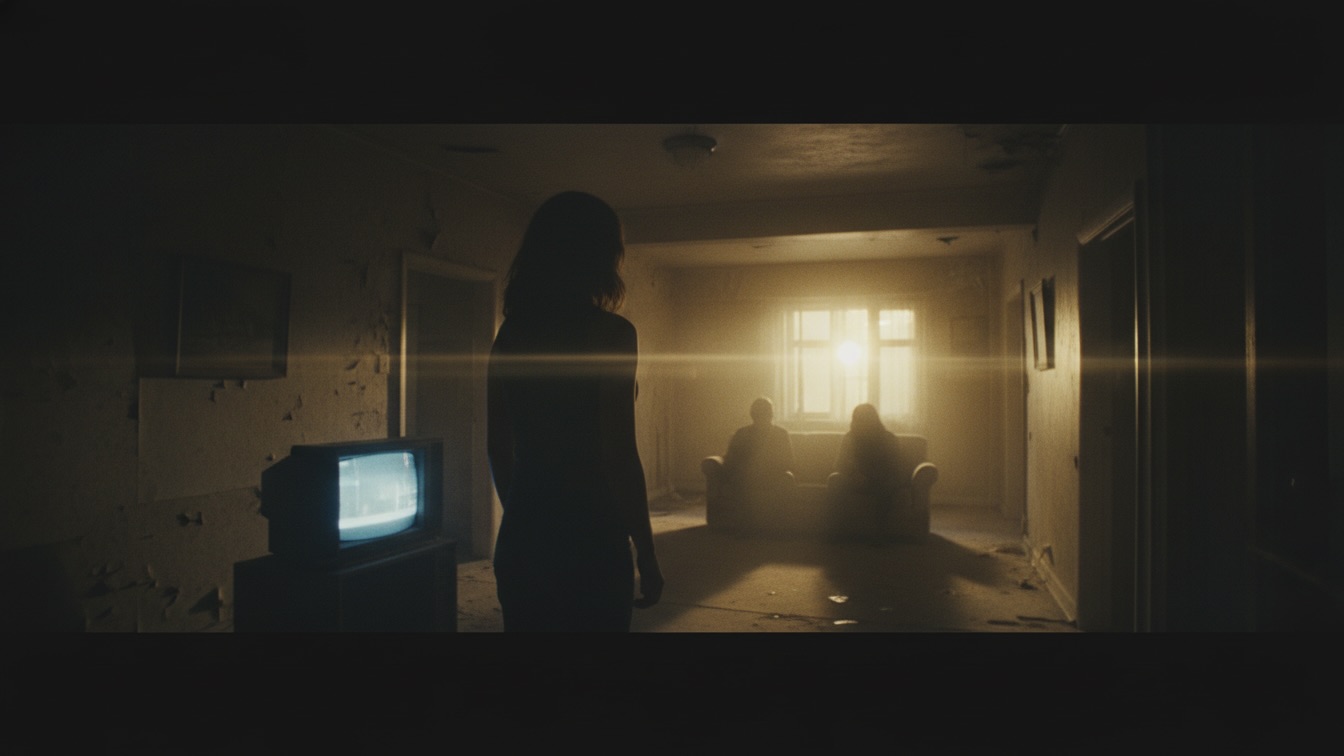
THE TABLEAU (Midpoint): Casey enters the living room and is confronted with the "perverse invitation": Gabe and the woman tangled together on the couch, illuminated only by the silent, strobing TV. This is the story's midpoint, shifting from a drama of familiar betrayal into something more calculated and sinister. Gabe's vacant, emotionless stare confirms this scene was staged for her arrival.
THE CONFRONTATION (Climax): The tension escalates through a silent, psychological battle, where Gabe's faint smile and the woman's knowing gaze dismantle Casey's composure. The room becomes a surreal, claustrophobic prison as the sounds and lights distort, reflecting Casey's fracturing sanity. The climax begins when the woman breaks the silence, whispering, "He likes to watch," confirming Casey's role as the audience in a perverse play.
THE REVEAL: The horror peaks as the woman produces a small, gleaming metallic object, her smile becoming serene and utterly chilling. Gabe remains a silent, unblinking orchestrator, his gaze fixed on Casey, the final unspoken invitation for her to understand the true, terrifying nature of his game. The film ends on this tableau of inescapable horror, trapping Casey—and the audience—in the final, terrifying moment of realization.
Emotional Arc / Mood Map
The episode's emotional trajectory is a steady descent into darkness. It begins with a mood of gritty, cold realism and weary frustration, making the audience feel Casey's physical and emotional numbness. This slowly builds into a palpable sense of dread and anxiety as she navigates the hostile building. Upon entering the apartment, the mood shifts sharply into claustrophobic, surreal horror, where the tension becomes almost unbearable, culminating in a final, shocking crescendo of pure terror that leaves the audience with a lingering, chilling sense of dread and hopelessness.
Season Arc / Overarching Story
If expanded, a season arc could follow a new protagonist—perhaps a journalist or a private investigator—who notices a pattern of psychological breakdowns and strange disappearances in Winnipeg, all loosely connected to decrepit buildings and a mysterious, charismatic man. This character could uncover traces of Gabe and his various partners, discovering they are not merely human predators but recurring entities who set up these "nests" to feed on despair. The season would build a mythology around them, suggesting they are a modern form of psychic vampire or folkloric creature thriving in urban decay.
The overarching story would explore the idea that these entities are drawn to cities with harsh climates and social isolation, places where emotional coldness allows them to thrive. Each episode could show a different victim's encounter, while the season's through-line follows the investigator getting closer to the truth, risking becoming the next victim. The finale would see the investigator tracking Gabe to a new location, only to receive a clipped, demanding phone call, bringing the cycle of perverse invitation full circle.
Visual Style & Tone
The visual style will be grounded in a cold, tactile realism that emphasizes the oppressive environment. The palette will be desaturated and dominated by icy blues, grimy greys, and the sickly yellow of cheap interior lighting, creating a high-contrast, noir-inflected look. Cinematography will utilize tight, claustrophobic framing and handheld shots to create a sense of immediacy and unease, putting the audience directly into Casey's headspace.
The tone is bleak, tense, and psychologically unnerving, prioritizing atmospheric dread over jump scares. The film should feel like a slow-motion panic attack, where the environment itself feels predatory. Tonal comparables include the surreal domestic horror of Possession (1981), the gritty, immersive tension of Lynne Ramsay's You Were Never Really Here, and the atmospheric, slow-burn dread of early David Cronenberg films like The Brood.
Target Audience
The target audience is mature viewers (18-45) who appreciate sophisticated, slow-burn psychological horror and character-driven thrillers. Fans of A24's brand of "elevated horror," as well as viewers of dark anthology series like Black Mirror and Guillermo del Toro's Cabinet of Curiosities, would be the primary demographic. This is a film for an audience that enjoys being unsettled and is more interested in thematic depth and atmospheric tension than conventional horror tropes.
Pacing & Runtime Notes
With an estimated runtime of 10-12 minutes, the pacing is crucial and will be deliberately uneven. The first act (Casey's journey to the apartment) will be a slow, methodical burn, building tension through atmosphere and Casey's internal state. The second act (the confrontation) will maintain a tense, almost static pace, allowing the psychological horror to build in the suffocating silence. The final 90 seconds will be a rapid, disorienting crescendo as the situation escalates into pure terror, ending abruptly on the final reveal to maximize its shocking impact.
Production Notes / Considerations
Sound design is a critical character in the film. The constant, oppressive sound of the wind, the grating of the lock, the building's groans, the sick hum of the fluorescent lights, and the final, rising electronic whine must work together to create an unnerving and immersive soundscape that reflects Casey's psychological state. The production should prioritize finding a location that embodies authentic decay, as the texture of peeling paint, stained floors, and crumbling brickwork is essential to the film's tactile realism.
The lighting in the final scene is paramount and should be achieved practically. Using only a television screen as the primary light source will create a natural, pulsating, and disorienting effect, casting long, dancing shadows that transform the mundane apartment into a nightmarish space. The strobing, unnatural colors will heighten the sense of surrealism and Casey's dissolving grip on reality, making the final tableau a visually striking and horrifying image.