Format: Short Film / Anthology Episode | Est. Length: 10-12 minutes
Imagine a world where the climate crisis doesn't just change the weather, but awakens dormant, prehistoric biological threats from the deep. This episode serves as a chilling entry in The Warming, an anthology series exploring ecological horror and human survival in a rapidly shifting biosphere where the environment itself has turned predatory. Each installment focuses on a different localized phenomenon, weaving a larger tapestry of a planet reclaiming its territory through nightmarish evolutionary leaps.
Under a blistering 104-degree sun, a marine biologist discovers that the local "red tide" isn't just dirty water—the algae is swimming with a unified, predatory purpose.
When a parasitic algae bloom hijacks the nervous systems of beachgoers, a scientist must race against time to synthesize a biological antidote. Failure means the collapse of the coastal ecosystem and a permanent, mindless infection spreading through the human population.
The primary theme is ecological blowback, exploring how human-driven climate change triggers unforeseen biological defenses from the planet. It blends the "eco-horror" genre with survivalist tension, highlighting the fragility of modern civilization when faced with microscopic, hive-mind evolution.
The story also touches on the theme of scientific responsibility versus public apathy. Kiana’s struggle to save a community that ignored her warnings serves as a metaphor for the modern climate scientist’s plight, emphasizing that nature does not care about skepticism once the tipping point is reached.
For Kiana, the stakes are both personal and global: she must protect her younger sister, Lily, from the immediate violent threat of the infected while preventing a localized outbreak from becoming a continental pandemic. If she cannot reach her research skiff and synthesize the enzyme, the "red tide" will claim every living soul on the coast, starting with her family.
The external conflict is the parasitic dinoflagellate bloom, a hive-mind organism that turns hosts into aggressive vectors for its spread. Internal conflict arises from Kiana’s guilt over her inability to stop her friend Brody from entering the water and the paralyzing fear of failing her sister in a high-stakes survival scenario.
Kiana, a marine biologist, observes a strange, viscous red tide at a crowded beach and warns her friend Brody to stay out, but he ignores her and is pulled under by a heavy, sludging wave. When Brody emerges, he is transformed into a violent, parasitic host who attacks a tourist, triggering a mass outbreak as other infected swimmers swarm the beach. Kiana and her sister Lily flee to a local surf shop, where they barricade themselves with the owner, Kevin, and Kiana realizes the algae is a parasitic macro-structure responding to mechanical vibrations.
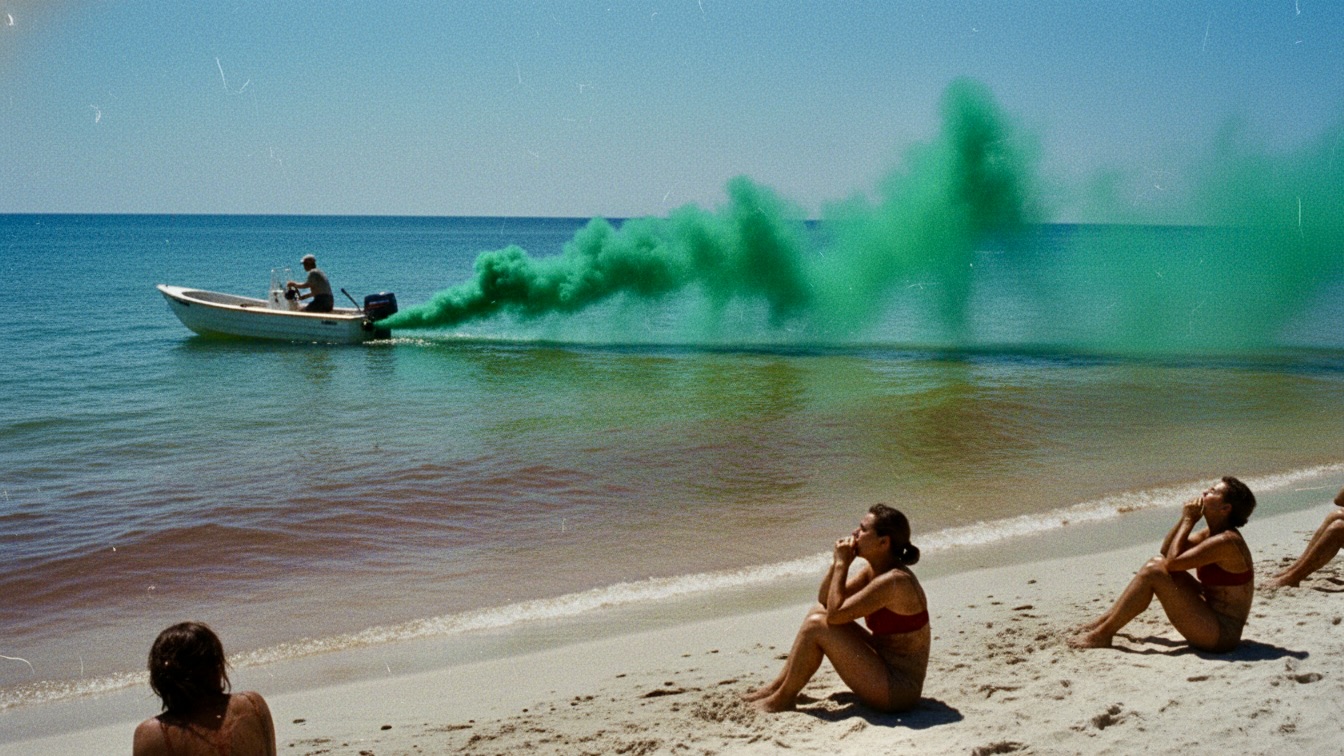
The group makes a desperate run for the marina using skateboards to avoid the vibration-sensitive infected, eventually reaching Kiana's research boat. By utilizing the boat's engine as a makeshift laboratory, Kiana aerosolizes a deep-water kelp enzyme into a neutralizing vapor. They pilot the boat along the shoreline, spraying the green mist over the beach and the water, successfully severing the parasite's control over the hosts and restoring the blue clarity of the ocean.
Kiana: A brilliant but socially isolated marine biologist who finds her academic theories suddenly turned into a life-or-death struggle. She starts as a cautious observer and ends as a decisive survivor who utilizes her scientific knowledge as a weapon.
Lily: Kiana’s younger sister, a typical pre-teen gamer who is thrust into a visceral nightmare. She transitions from a state of oblivious annoyance to one of traumatized but silent resilience, relying entirely on Kiana’s leadership.
Kevin: A laid-back surf shop owner whose world is shattered when his friend Brody becomes a monster. He provides the physical muscle and local knowledge needed to reach the marina, evolving from a skeptic to a vital ally.
Kiana discovers the twitching, swimming strands of the algae in a sample vial while Brody ignores her warnings and paddles out into the "bruised rust" water. Tension peaks as Brody is slammed by a wave that doesn't break but collapses like sludge, dragging him into the depths. Ten seconds of agonizing silence pass before Brody emerges, coughing up thick sludge and violently attacking a tourist, sparking a mass panic.
Kiana grabs Lily and navigates the chaotic boardwalk to find temporary refuge in Kevin’s surf shop, where they barricade the doors against the twitching infected. Inside, Kiana uses her field microscope to identify the algae as a parasitic hive-mind that responds to mechanical vibrations like the shop's air conditioning. They realize they must reach Kiana's research skiff at the marina to synthesize an enzyme from deep-water kelp that can neutralize the bloom.
The trio uses longboards to silently navigate the alleyways, eventually reaching the marina where they must paddle through the gelatinous, body-filled water to reach the boat. Kiana narrowly avoids an underwater infected host before hauling herself and Lily onto the Coriolis to begin the extraction process. She hacks at the kelp and uses the boat's scorching exhaust manifold to boil it down into a concentrated, golden-green paste.
As the infected swarm the hull, Kiana routes the kelp paste into the engine's air intake, aerosolizing the enzyme through the exhaust. Kevin throttles the boat along the shoreline, blanketing the beach in a thick green vapor that causes the infected to purge the parasite. The ocean turns from rust-red back to blue as the hive-mind dissolves, leaving Kiana and Lily huddled together in the sudden, clean silence of the restored coast.
The episode begins with a sense of stifling, sun-drenched dread that quickly escalates into frantic, claustrophobic panic during the beach outbreak. The middle act shifts into a tense, stealth-based thriller as the characters navigate the marina, concluding with a cathartic, high-octane climax that offers a glimmer of hope amidst ecological devastation. The audience experience is one of sensory overload—heat, stench, and noise—followed by a cooling, quiet resolution.
If expanded, the season would follow Kiana as she discovers the bloom is not localized but is appearing in coastal cities worldwide, suggesting a coordinated biological reset by the planet. The narrative would track the collapse of global shipping and coastal economies as various "strains" of the parasite adapt to different climates and human countermeasures.
Kiana would eventually lead a global task force, realizing that the "antidote" is only a temporary fix for a much larger, sentient planetary defense mechanism. The season would end with the revelation that the algae has begun to adapt to the enzyme, forcing humanity to choose between total isolation from the ocean or a permanent genetic symbiosis with the parasite.
The visual style utilizes high-contrast, over-saturated colors to emphasize the oppressive 104-degree heat and the "bruised rust" color of the water. Handheld camera work during the outbreak creates a sense of visceral urgency, contrasting with the slow, gliding shots used during the silent paddle through the marina. The tone is grounded and clinical, reminiscent of Contagion mixed with the body horror of The Girl with All the Gifts.
Sound design plays a critical role, using low-frequency hums to represent the hive-mind's vibration and wet, slapping Foley for the infected's movements. Tonal comparables include the "Yellowstone" episode of The Last of Us and the ecological dread found in Annihilation.
The target audience includes fans of elevated horror and ecological thrillers, specifically those aged 18-45 who enjoy series like The Last of Us or Black Mirror. It appeals to viewers interested in climate-related speculative fiction and high-stakes survival narratives that prioritize scientific plausibility over supernatural elements.
The pacing is relentless, beginning with a slow-burn five-minute setup that explodes into a high-tempo survival race. The 12-minute runtime is structured into three distinct acts: the Discovery/Outbreak, the Stealth/Transit, and the Scientific/Action Climax. The transition from the "hot" beach to the "cool" boat provides a rhythmic shift that mirrors the narrative's resolution.
The "red tide" water requires significant practical effects coordination, using non-toxic thickening agents and dyes to achieve the "sludge" consistency for the waves. The infected makeup should focus on vascular distension and "muddy" eye contacts, avoiding traditional zombie tropes in favor of a more biological, parasitic aesthetic.
Filming at a marina and on a moving vessel presents logistical challenges, particularly with the "green vapor" effect, which should be achieved through a combination of practical fog machines and digital enhancement. Safety divers and water-specialized camera rigs are essential for the sequence where characters paddle through the algae-saturated marina.


