The story begins on a sweltering day where Kiana, a focused researcher, monitors a disturbing red tide at a local beach. Despite her warnings about the abnormal viscosity and high temperature of the water, a local surfer named Brody dismisses her concerns and enters the ocean. His subsequent infection serves as the catalyst for a rapid biological outbreak, as the algae acts as a parasitic hive-mind that turns its hosts into violent, biting predators. Kiana quickly realizes the gravity of the situation and gathers her younger sister, Lily, to flee the escalating violence on the shoreline.
Seeking refuge, Kiana and Lily barricade themselves inside a surf shop owned by Kevin, who is initially skeptical of the unfolding horror. The group witnesses the terrifying speed and coordination of the infected through the shop windows, leading Kiana to deduce that the organisms are attracted to mechanical vibrations. After a tense period of hiding, she identifies a potential solution involving deep-water kelp enzymes stored on her research boat. The trio makes a desperate escape through back alleys and a marina filled with sludge to reach the vessel.
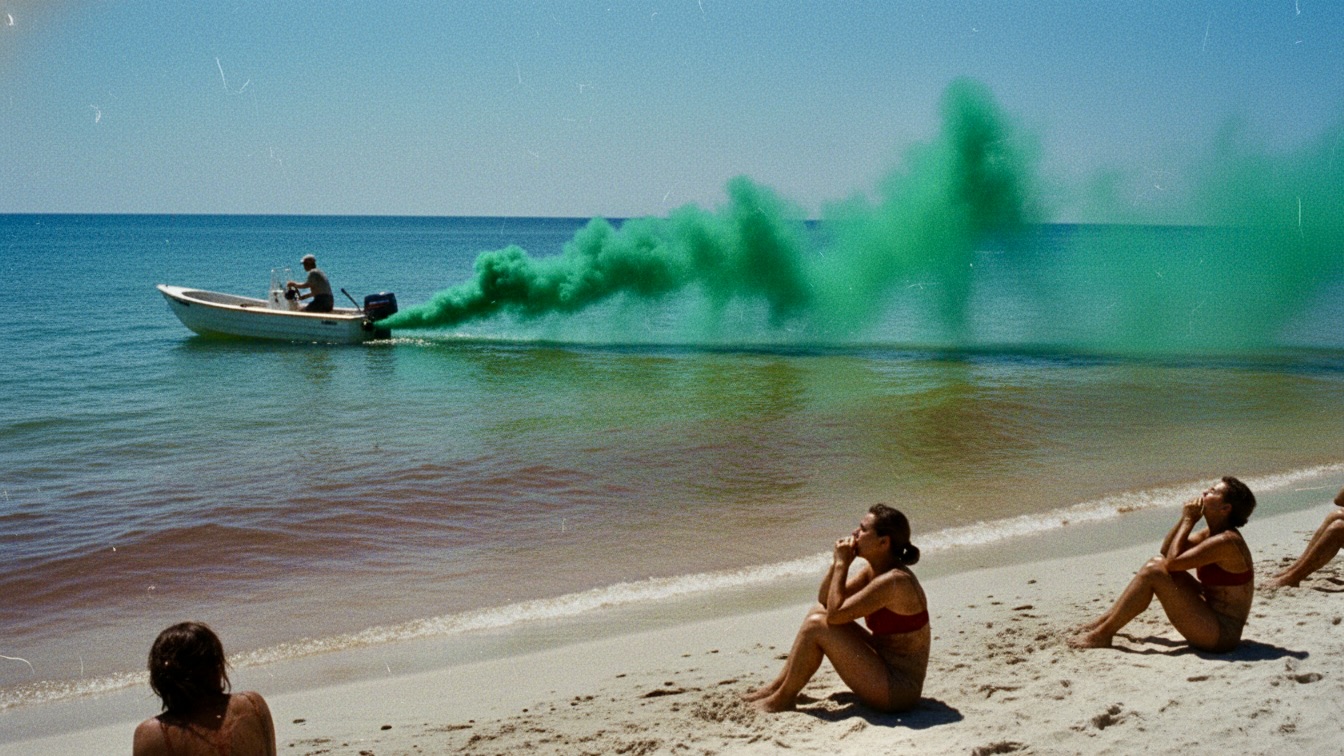
Once aboard the boat, Kiana utilizes the heat from the outboard motor to extract and aerosolize the kelp enzyme. By routing the mixture through the engine’s exhaust, she creates a curative vapor cloud that neutralizes the parasitic infection in those it touches. The story concludes with Kiana and her companions navigating the shoreline, successfully dispersing the antidote and restoring the ocean's natural state. The immediate threat is quelled, leaving Kiana exhausted but relieved as she holds her sister amidst the recovering landscape.
The narrative primarily explores the theme of ecological blowback and the consequences of human-induced climate change. The "bruised rust" color of the water and the extreme heat serve as a physical manifestation of a planet in distress, reacting violently to rising temperatures. This parasitic bloom is not merely a natural disaster but a biological response to the "warming oceans" that have awakened something dormant and predatory. The story suggests that nature possesses a terrifying capacity to reclaim its territory when pushed beyond its thermal limits.
Another significant theme is the conflict between scientific foresight and willful ignorance. Brody represents the hubris of the casual observer who relies on past experiences to dismiss present, evolving dangers. His refusal to acknowledge the "wrong" viscosity of the water leads directly to his loss of autonomy and humanity. In contrast, Kiana’s survival is predicated on her ability to observe, analyze, and respect the data she collects, highlighting the necessity of expertise in a crisis.
The concept of the hive-mind versus individual agency is also central to the story’s horror. The algae transforms individuals into a "parasitic macro-structure," stripping away their personalities and replacing them with a singular, infectious purpose. This loss of self is portrayed as a visceral, bodily invasion that can only be countered by a return to biological balance. The resolution, achieved through the use of giant bladder kelp, suggests that while nature provides the threat, it also holds the restorative tools necessary for survival.
Kiana is defined by her analytical mind and her fierce sense of responsibility toward her younger sister. As a scientist, she views the world through a lens of empirical data, which allows her to maintain a degree of psychological distance from the initial horror. Her ability to categorize the "localized dinoflagellate bloom" even as chaos erupts demonstrates a coping mechanism rooted in intellectual control. She does not succumb to panic because her mind is constantly searching for a mechanical or biological solution to the problem at hand.
Her motivation is twofold: the pursuit of scientific truth and the protection of Lily. Throughout the ordeal, her maternal instincts override her fear, driving her to make high-stakes decisions like the dash to the marina. She exhibits a high level of resilience, transitioning from a researcher to a tactician without losing her ethical grounding. By the end of the chapter, she is physically and emotionally spent, showing that her strength is not a lack of fear but a disciplined suppression of it for the sake of others.
Brody serves as the narrative’s cautionary tale, embodying a reckless masculinity that prizes physical prowess over intellectual caution. He is described through his physical attributes—his "red chest" and "faded boardshorts"—which reflect a life lived entirely on the surface of the environment he thinks he understands. His dismissal of Kiana as a "nerd" reveals a psychological defensive mechanism that protects his ego from the discomfort of being wrong. This arrogance eventually makes him the first victim of the very element he claimed to master.
His transformation into a twitching, predatory host is a tragic irony, as his body is hijacked by the very ocean he loved. Once infected, he loses all the characteristics that made him a "local," becoming a mindless vessel for the algae's expansion. His violent attack on the tourist marks the point of no return for his character and the shift in the story's tone. He represents the vulnerability of the human form when it fails to adapt to a changing and increasingly hostile environment.
Kevin undergoes a significant psychological shift from a detached bystander to a proactive survivor. Initially, he is preoccupied with the mundane concerns of his shop, such as the safety of his glass doors and the comfort of his air conditioning. His skepticism toward Kiana’s warnings highlights the common human tendency to deny a crisis until it is physically pressing against one's own windows. However, once the reality of the infection becomes undeniable, he demonstrates a practical, blue-collar resourcefulness.
He provides the physical tools for their escape, such as the skateboards and the fiberglass fin he uses as a weapon. While Kiana provides the "why" and the "how" of the cure, Kevin provides the "way" to navigate the physical world safely. His willingness to follow Kiana’s lead shows a lack of ego that contrasts sharply with Brody’s earlier behavior. He represents the adaptable everyman who, when faced with an existential threat, finds the courage to act despite his obvious terror.
Lily functions as the emotional heart of the story and the primary driver for Kiana’s urgency. As a child, her focus is initially narrowed to the digital world of her gaming console, symbolizing an innocence that is abruptly shattered by the outbreak. Her silence and physical clinging to Kiana throughout the chapter emphasize her total dependence on her older sister for survival. She is the witness to the horror, her "whimpering" and "white knuckles" grounding the high-concept sci-fi elements in a relatable, human vulnerability.
Psychologically, Lily represents the future generation that is most at risk from the environmental collapse described in the text. Her ability to skate to school becomes a vital survival skill, showing that even the youngest characters must contribute to the group’s collective safety. Her presence forces Kiana to remain grounded and focused, preventing the scientist from becoming lost in her own theories. By the end, her embrace of Kiana provides the emotional resolution needed after the high-octane climax.
The author employs a visceral and sensory-heavy prose style to heighten the sense of dread throughout the chapter. Phrases like "bruised rust color" and "thick, rust-colored water" create a persistent visual motif that links the algae to blood and decay. The sensory details are not limited to sight; the "stale beer" and "coconut surf wax" of the shop contrast sharply with the "sulfurous gas" and "smell of copper" at the marina. These descriptions ground the fantastical elements of the parasite in a grimy, tangible reality that makes the horror feel more immediate.
The pacing of the narrative is expertly handled, beginning with a slow, sweltering tension that explodes into frantic action. The transition from the "lazy and quiet" beach to a scene of "pure panic" is signaled by short, punchy sentences that mirror the characters' racing heartbeats. Once the characters reach the surf shop, the pace slows slightly to allow for exposition and psychological tension, before accelerating again during the escape to the boat. This rhythmic shifting prevents the reader from becoming desensitized to the violence while maintaining a constant undercurrent of urgency.
The narrative voice is clinical yet empathetic, reflecting Kiana’s own perspective as she navigates the crisis. Technical terms like "mechanical stimulation" and "macro-structure" are balanced by the raw, emotional descriptions of the infected’s "wet, clicking sound." This blend of scientific observation and horror tropes creates a unique tone that distinguishes the story from a standard zombie narrative. The focus on the "viscosity" and "surface tension" of the water turns the environment itself into a character, one that is increasingly alien and suffocating.


