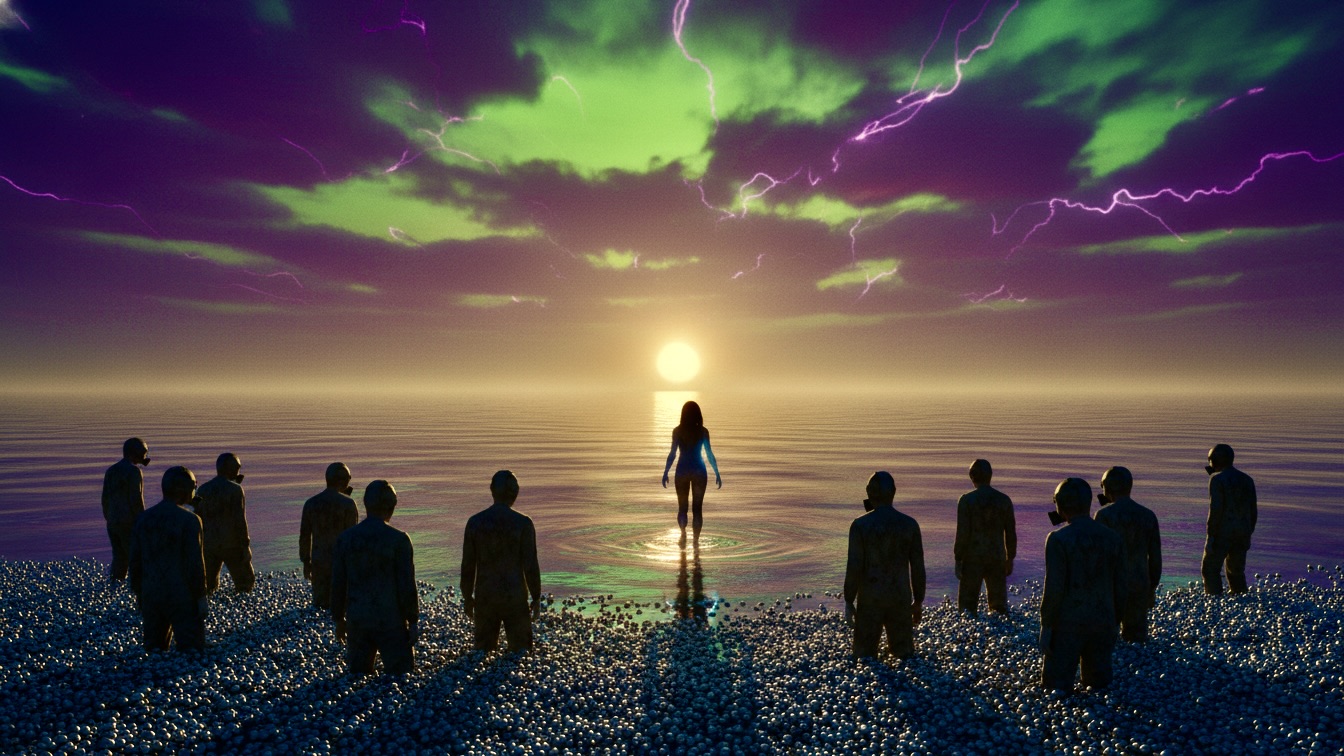
Format: Short Film / Anthology Episode | Est. Length: 10-12 minutes
Imagine this story as a standout chapter in a prestige sci-fi anthology series titled The Silver Archive, where each episode explores the quiet, crystalline end of humanity through a different lens. This narrative serves as the series' emotional anchor, showcasing the visual transition from our chaotic, biological world to a cold, perfect, and permanent metallic reality.
The series The Silver Archive chronicles a global event where an alien, self-replicating geometry begins "archiving" Earth, turning all organic and inorganic matter into a unified silver substance. Across multiple episodes, the show tracks the collapse of biological life and the emergence of a planetary consciousness, focusing on the philosophical struggle between the desire for individual survival and the peace of collective permanence. Each installment highlights a different stage of the transformation, from the initial infection to the final, silent world where humanity exists only as a memory stored in chrome.
A woman wakes in a flickering fallout shelter to find her right arm has turned into a heavy, dull sleeve of tin, while the sound of a thousand needles scratches at the steel door outside.
As a crystalline plague turns the world into a static silver archive, four survivors must trek across a metallic wasteland to reach a coast that may no longer exist. They must decide if the transformation is an ending or a cold, perfect new beginning.
The primary themes explore the tension between biological entropy and technological permanence, framing the apocalypse not as destruction but as a forced "upgrade." It delves into the philosophy of the "Archive"—the idea that life is being preserved at the cost of its agency and warmth, moving from a state of messy living to a state of perfect, static information.
The story also examines the human response to the inevitable, contrasting the violent denial of the old world with the transcendental acceptance of the new. It blends cosmic horror with speculative sci-fi, suggesting that the "Song" of the silver is a higher form of communication that humanity is simply too primitive to understand without changing its form.
For Henry, the stakes are her very humanity as the silver infection climbs her shoulder, threatening to overwrite her consciousness with a planetary "song." For the group, it is a race against dwindling oxygen and the encroaching "Shadow Mass" that seeks to finalize their conversion into static monuments. Failure means losing the ability to feel, breathe, and exist as a distinct individual before they can reach a potential sanctuary.
The primary external antagonist is the "Silver," a self-replicating crystalline process that consumes organic matter and geometry alike, manifesting as the "Shadow Mass" and the rhythmic "Song." Internal conflict arises from the group's clashing reactions to the end: Mitchell’s desperate, violent denial versus Henry’s growing, terrifying acceptance of the transformation. The environment itself acts as a passive antagonist, with silver grass acting as razors and a silent, metallic ocean blocking their final hope.
Henry awakens in a lead-lined bunker with a silver arm, learning from Captain Benes, Mitchell, and Buck that their companion Shaun has already been absorbed by the mountain. Realizing the silver is eating through the bunker’s hinges, the group dons oxygen masks and ventures into a world turned to chrome, where trees are metal explosions and the sky is a bruised violet. They trek toward a naval base on the coast, hoping salt water can short-circuit the growth, while Henry begins to hear a rhythmic "song" emanating from the ground.
As they navigate a highway of crystallized cars and encounter a massive, antlered "node" that beams signals into the green sky, the group’s morale shatters. Upon reaching the Atlantic, they find it has been turned into a flat, unmoving sheet of grey metal, rendering their escape impossible. Henry, fully embracing the change, removes her mask and leads the others into a peaceful, final surrender, merging their consciousness with the planet’s new, silent archive.
Henry: A pragmatic survivor whose Psychological Arc moves from desperate physical resistance to a spiritual, transcendental acceptance of the silver. Initially terrified by her metallic limb, she eventually realizes the transformation is a form of salvation from a dying, dirty world. By the end, she is the herald of the new world, leading the others into the "song" as she becomes the first to fully merge with the archive.
Captain Benes: A weary leader defined by duty and the refusal to quit, starting the story as a man focused on tactical survival and ending as a hollowed-out figure who has run out of ground. His arc is one of tragic persistence, holding onto the old world's rules until the very moment they become obsolete. He represents the fading authority of the human era, clinging to a map that no longer describes the territory.
Mitchell: The voice of human fear and denial, he begins as a defensive, aggressive protector of his own identity and ends in a state of paralyzed terror. He represents the "bug in the system," the part of humanity that refuses to be archived, until Henry’s touch offers him a terrifying but painless peace. His arc is a descent from combat-readiness to a total collapse of the ego.
Buck: A jittery but resourceful technician who provides the group's life support, his arc is a slow descent into exhaustion as his tools—watches, tanks, and trolleys—fail against the silver. He is the bridge between Benes's rigidity and Mitchell's panic, eventually following Henry's lead when the physical world ceases to function. He represents the failure of human technology in the face of a superior, alien geometry.
Beat 1 (The Awakening): Henry awakens in a flickering fallout shelter to discover her arm has been replaced by a heavy silver limb, while Captain Benes explains they are hiding from a crystalline plague that is currently eating through the bunker's hinges. The group realizes the lead walls are only a temporary shield against the "song" of the silver, forcing them to prepare for a desperate trek toward the coast. They don oxygen masks and brace themselves for the transition from the yellow light of the bunker to the electric violet of the transformed world outside.
Beat 2 (The Silver World): Stepping out into the ruins of their town, the survivors find a world turned to chrome where trees are frozen explosions of metal and the "Shadow Mass" pulses with a sentient, dark blue light. Henry notices her silver arm beginning to glow in rhythm with the ground, suggesting she is already being integrated into the planetary network. They navigate the silent, mirror-like streets of Main Street, witnessing a pickup truck that has melted into a delicate piece of silver jewelry.
Beat 3 (The Highway Graveyard): The group climbs a mountain of crystallized cars on the interstate, where Henry discovers a family frozen in pewter and realizes the silver isn't killing them, but "archiving" them in a state of perfect stillness. Mitchell’s fear boils over into aggression as he rejects the idea of being a "file" in a system, while the group’s oxygen supplies dwindle to critical levels. This midpoint encounter forces the characters to confront the reality that their biological identities are being systematically overwritten by a new, cold geometry.
Beat 4 (The Bridge Climax): At a massive suspension bridge turned into a glowing silver harp, they encounter a twenty-foot-tall deer node that beams signals into the neon green sky, signaling the final stages of the planet's transformation. As the deer's blue eyes fix on them, Henry experiences a moment of transcendental connection, seeing the bridge not as a path over a valley but as a link between two states of existence. They scramble past the humming cables, feeling the "song" vibrate through their bones as the Shadow Mass begins to move faster than the setting sun.
Beat 5 (The Shore Resolution): Reaching the Atlantic Ocean, the survivors discover the water has been turned into a flat, unmoving sheet of grey metal, effectively ending their hope for a biological sanctuary. Henry finally removes her mask and steps out onto the silver sea, feeling the dust enter her lungs not as a poison, but as a refreshing upgrade that joins her heart to the rhythm of the core. The others eventually follow her into the stillness, surrendering their fear to become part of a permanent, peaceful archive as the world finally falls silent.
The episode begins with claustrophobic dread and high-tension survivalism, characterized by the yellow, flickering light of the bunker. As the characters move outside, the mood shifts into a surreal, "luminous" horror—a mix of awe at the beauty of the silver world and the chilling realization of human obsolescence. The final act moves from the crushing weight of hopelessness at the shore to a serene, transcendental climax, leaving the audience with a sense of "sublime" ending rather than a tragic one.
If expanded, the season would follow different pockets of humanity—scientists in orbit, deep-sea divers, and urban survivors—all witnessing the "Silvering" from different perspectives. The overarching narrative would trace the origin of the signal and the slow realization that the Earth is being repurposed as a data-storage hub for a galactic civilization.
The season would escalate as the "Shadow Mass" begins to take more complex forms, mimicking human behavior to lure the remaining biological life into the archive. The finale would involve a choice: a small group of humans finds a way to "poison" the archive with human chaos, or they choose to let the human story be preserved in its most perfect, albeit frozen, form.
The visual style is defined by high-contrast "Bruised Violet" and "Electric Neon Green" skies against the hyper-reflective, monochromatic silver of the ground. The cinematography should use wide, anamorphic shots to emphasize the scale of the transformation, making the human characters look like tiny, organic stains on a perfect mirror.
The tone is "Ethereal Apocalypse," drawing influence from the visual stillness of Annihilation and the cold, mechanical dread of Tetsuo: The Iron Man. Sound design is critical, featuring a constant, low-frequency hum and the "Song"—a rhythmic, metallic clicking that slowly incorporates the sound of human heartbeats.
This project targets fans of elevated sci-fi and cosmic horror, specifically the 18-45 demographic that enjoys "New Weird" cinema. It appeals to viewers who appreciate philosophical stakes and atmospheric storytelling over traditional action-heavy disaster tropes, fitting well within the programming of platforms like HBO or A24.
The pacing is a "steady crawl," mimicking the inevitable expansion of the silver. The first three minutes are claustrophobic and fast-paced (the bunker escape), followed by a mid-section of atmospheric tension (the trek), culminating in a slow, meditative final three minutes where the dialogue drops away in favor of visual storytelling and the "Song."
The production requires heavy use of "Chrome" and "Liquid Mirror" CGI overlays on practical sets to achieve the look of the silvered world. Practical effects should be used for the characters' masks and the initial stages of the silver infection on Henry’s arm to maintain a sense of grounded reality.
The "Shadow Mass" should be rendered as a non-Newtonian fluid effect, moving with a jittery, frame-rate-defying motion to emphasize its alien nature. Soundscapes must be mixed in Dolby Atmos to allow the "Song" to physically surround the audience, creating a sensory experience of the planetary network.


