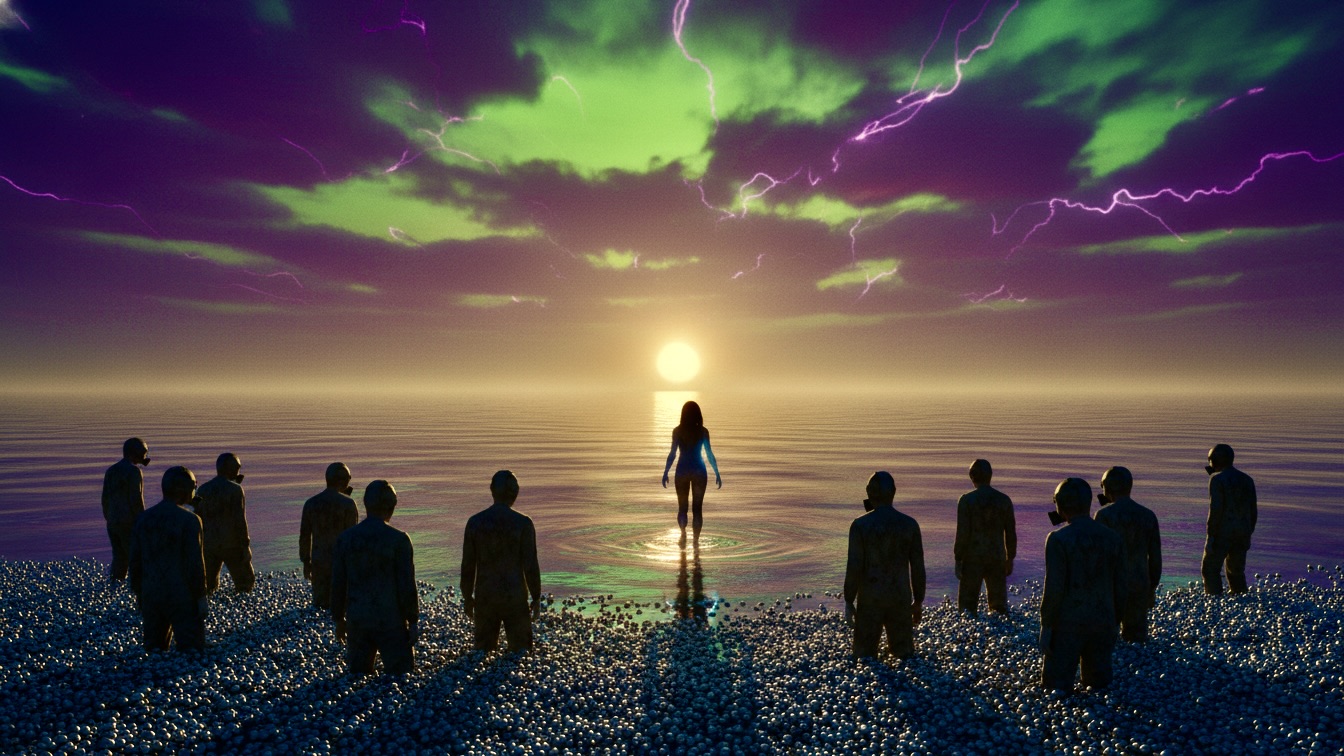
The story begins with Henry regaining consciousness in a cramped, lead-lined fallout shelter, where she discovers her right arm has been replaced by a heavy, non-responsive silver material. Alongside Captain Benes, Mitchell, and Buck, she navigates a world undergoing a terrifying metamorphosis into a crystallized, metallic landscape. The group flees the bunker as the silver "moss" begins to eat through the steel door, embarking on a desperate trek toward the coast in hopes that salt water might halt the crystalline growth.
As they travel through a silent, silver-dipped town and across a highway graveyard of metallic cars, the characters witness the complete erasure of biological life in favor of a permanent, archived state. Upon reaching the Atlantic Ocean, they find that even the sea has been rendered into a solid, unmoving sheet of metal. Facing the end of their human forms, Henry experiences a psychological breakthrough, realizing that the transformation is not death but a planetary upgrade. She leads the group in a final act of surrender, removing her mask and merging with the rhythmic, metallic pulse of the new world.
The primary theme of the narrative is the tension between biological transience and crystalline permanence, framed as a "planetary archive." The silver growth represents a technological or cosmic singularity that views human life as messy, dirty, and inefficient. By turning every living thing into metal, the process removes the possibility of decay, pain, and hunger, effectively "saving" the world like a digital file. This creates a philosophical conflict: is a life without change or suffering still a life, or is it merely a well-preserved statue?
Another significant theme is the loss of human agency in the face of an inevitable, systemic shift. The characters attempt to use old-world logic—relying on lead shielding, military formations, and chemistry—to combat a force that operates on an entirely different plane of existence. Their failure to stop the silvering suggests that humanity’s time as the dominant "system" has ended. The story posits that survival may not mean maintaining the status quo, but rather adapting to a new, unrecognizable form of consciousness.
The concept of the "Song" and the "Shadow Mass" introduces a theme of collective consciousness versus individual identity. Throughout the journey, Henry hears a rhythmic calculation that suggests the planet is communicating with itself. This implies that the transformation is a unifying event, stripping away the isolation of the human ego to create a singular, harmonious network. The transition from the "clack" of boots on metal to the "thump-thump" of a metallic heart signifies the birth of a new, collective rhythm that transcends individual mortality.
Henry serves as the emotional and psychological bridge between the old human world and the new metallic reality. Initially, she experiences profound body dysmorphia, viewing her silver arm as a foreign object that does not belong to her. This detachment is a psychological defense mechanism against the terror of her own obsolescence. However, as the journey progresses, she is the first to move past the "bug in the system" mentality to recognize the aesthetic and functional beauty of the change. Her transition from fear to acceptance marks a shift from a victim of the infection to a prophet of the new world.
Captain Benes embodies the archetype of the pragmatic leader whose identity is rooted in protection and survival. He views the silvering entirely as a tactical threat, using lead and masks to maintain a barrier between his team and the environment. His psychological struggle is defined by the failure of his leadership; he cannot shoot or outrun a fundamental change in the laws of physics. By the time he reaches the ocean, his stoicism collapses into a weary silence, representing the ultimate defeat of the human will to dominate nature through force.
Mitchell represents the voice of human resistance and the terror of losing biological autonomy. He is the most vocal about his desire to "stay a man," equating the silvering with a total loss of self. His reaction to the archived family in the van reveals a deep-seated fear of being reduced to a mere object or a "file." Psychologically, Mitchell is trapped in a state of mourning for the world that was, and his eventual surrender is the most traumatic, as it requires him to abandon his fundamental definition of what it means to be alive.
Buck serves as the logistical anchor for the group, focused on the immediate needs of the present to avoid confronting the horror of the future. He is the "helper" who manages the oxygen and the trolley, using labor as a way to stave off the psychological weight of their situation. While he is less prone to the existential outbursts of Mitchell, he is deeply affected by the silence of the new world. His silence at the end of the story suggests a character who has simply run out of ways to fix the unfixable, leading to a quiet, resigned acceptance.
The pacing of the story is expertly crafted to mirror the encroaching stillness of the silvering process. It begins with the frantic, claustrophobic energy of the bunker, where the scratching at the door creates a sense of immediate horror. As the characters move out into the world, the narrative slows down, lingering on the vast, frozen landscapes of the interstate and the bridge. This shift in speed reflects the characters' transition from active resistance to a state of witness, eventually culminating in the total stillness of the metallic ocean.
The tone is one of eerie, melancholic beauty, achieved through the use of vivid sensory details and "bruised" imagery. The author frequently uses metallic and industrial metaphors—"melted solder," "old pennies," and "liquid mercury"—to describe natural elements. This creates a sensory dissonance that makes the world feel both familiar and utterly alien. The contrast between the "electric violet" sky and the "dull pewter" of the deer emphasizes the unnatural, high-contrast nature of this new reality, reinforcing the theme of a world being redesigned by an outside force.
Narrative voice plays a crucial role in grounding the surreal events in a tangible, human perspective. By filtering the experience through Henry’s increasingly metallic perception, the story allows the reader to feel the "pins and needles" of the transformation. The shift in her internal monologue from describing the silver as a "toy" to describing it as "perfect" signals the narrative's move toward a transcendental conclusion. The final imagery of Henry "becoming the light" provides a poetic resolution to the horror, reframing the end of the world as a moment of profound, albeit cold, peace.


