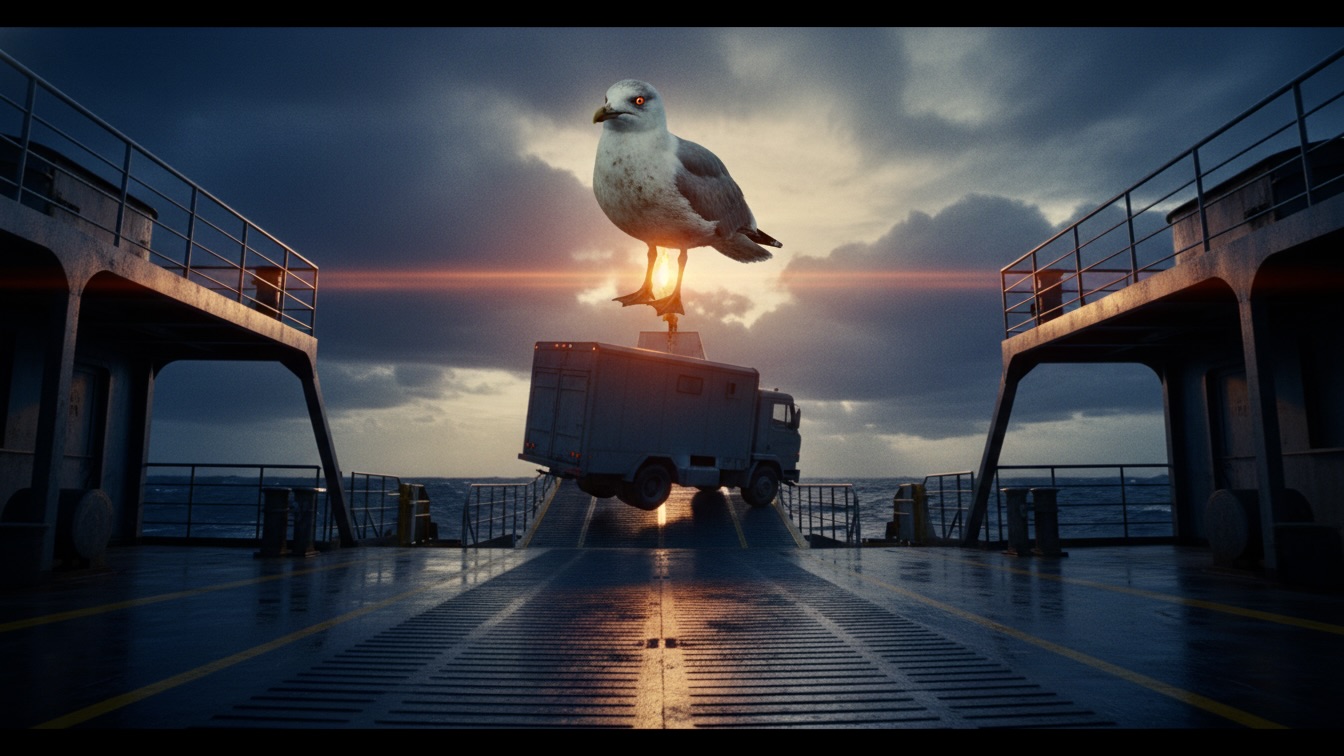
Format: Short Film / Anthology Episode | Est. Length: 10-12 minutes
Gold and Bloodthirsty Seagulls serves as a high-octane installment of The Saltwater Ledger, an anthology series exploring the intersection of blue-collar maritime labor and visceral, biological horror. Imagine a world where the mundane frustrations of a low-wage job are suddenly interrupted by the impossible, forcing workers to survive both corporate negligence and supernatural threats. The series utilizes a "Gritty Nautical" aesthetic, focusing on the rusted, salt-stained reality of those who keep the world's shipping lanes and ferries moving while the elite play with forces they cannot control.
Underpaid deckhand Casey Stanton is staring down the barrel of a hijacker's rifle during a Category 3 hurricane when the sky suddenly turns white with the wings of man-eating, mutated seagulls. The heist of a lifetime becomes a desperate fight for survival as the predators prove far more interested in the cargo than the criminals are.
An exhausted ferry deckhand must navigate a violent heist and a swarm of mutated seagulls during a coastal hurricane. To survive the night, she must outsmart a theatrical mastermind and discard a fortune in government gold.
The primary theme is the "Disposable Worker," highlighting the absurdity of risking one's life for a minimum-wage position while caught between the greed of criminals and the indifference of management. Casey’s journey from apathetic compliance to defiant survivalism mirrors the struggle of the modern working class against systems that view them as collateral damage.
The secondary theme is "Ecological Blowback," where human interference—specifically the radioactive isotopes used to track the gold—triggers a violent and uncontrollable response from nature. The seagulls are not just monsters; they are a direct consequence of high-level security measures gone wrong, turning a standard heist into a biological catastrophe.
For Casey, the stakes are her immediate life and her refusal to die for a company that pays her sixteen dollars an hour. For the hijackers, the stakes are a three-hundred-million-dollar payday that is rapidly turning into a death sentence. For the ship itself, the stakes are total destruction, as the massive birds threaten to tear the vessel apart to reach the frequency-emitting gold in the hold.
The external conflict is a three-way battle for control between the tactical hijackers, the relentless swarm of mutated seagulls, and the escalating Category 3 hurricane. Internally, Casey struggles with her own cynicism and the temptation to let the hijackers be destroyed by their own greed. The primary antagonist, Silks, represents the arrogance of the "mastermind" who fails to account for the unpredictable nature of the environment he seeks to exploit.
Casey Stanton, a weary deckhand on the Stormhaven ferry, is caught in a heist orchestrated by "Silks," a theatrical criminal seeking government gold during a hurricane reroute. The situation turns from a standard hijacking to a creature feature when a radioactive isotope in the gold attracts a swarm of giant, mutated seagulls. These predators shatter the bridge windows and begin picking off the tactical team, forcing Casey to retreat into the ship’s maintenance corridors.
Casey forms an unlikely alliance with Gary, the hijackers' tech expert, and leads him to the cargo hold to neutralize the threat. In a final confrontation on the car deck, Casey uses the ship’s massive foghorn to disorient the birds and breaks the chains on the armored transport truck. As the truck rolls into the Atlantic, the swarm follows the gold into the depths, leaving Casey to survive the storm and finally demand a raise from her oblivious manager.
Casey Stanton (Protagonist): A cynical, competent deckhand who has spent too many years cleaning up after tourists. She begins the story in a state of "Apathetic Endurance," but ends in "Active Defiance," realizing her worth exceeds her hourly rate. Her arc is defined by her transition from a victim of the heist to the only person capable of solving the avian crisis.
Silks (Antagonist): A self-styled criminal mastermind who prioritizes "aesthetic" and "logistics" over actual situational awareness. He begins the story with "Delusions of Grandeur" and ends in "Feral Paranoia" as his plan is dismantled by nature. He serves as a foil to Casey’s grounded, practical survivalism.
Gary (Supporting): The hijackers' middle-aged IT specialist who is woefully unprepared for physical combat. He provides the technical exposition regarding the gold’s tracking frequency and serves as a comedic, high-stakes burden for Casey to protect.
Captain Miller (Supporting): The veteran ferry captain who provides the initial resistance to the hijackers and the crucial acoustic assistance during the climax.
The episode opens with Casey enduring the heat and humidity of a ferry deck during a hurricane evacuation, only to be held at gunpoint by Silks’ tactical team. She is forced onto the deck as the hijackers seize the bridge, but the tension shifts when a giant, mutated seagull smashes through the reinforced bridge glass. This inciting incident establishes the birds as the primary threat, as they begin a coordinated, violent assault on the armed men.
Casey retreats into the ship's interior, discovering the hijackers' IT man, Gary, hiding in a locker and clutching a tablet that reveals the gold's tracking frequency. They witness the birds snatching a tactical guard from the deck, proving the predators can lift full-grown men into the storm. Casey realizes the only way to stop the swarm is to reach the cargo hold and dump the "clean" gold that is acting as a beacon.
The midpoint occurs as Casey and Gary reach the car deck, where they find a guano-covered Silks descending into madness while guarding the armored truck. Casey initiates the stern ramp opening, allowing the hurricane winds to blast into the hold and creating a chaotic battlefield. She manages to reach the bridge intercom, signaling Captain Miller to trigger the ship's pneumatic foghorn to disorient the attackers.
The climax features the deafening roar of the foghorn shattering the birds' coordination while Casey and Gary struggle to unchain the six-ton transport truck. Silks attempts to stop them with a machete, but the pitching ship and the weight of the vehicle work against him. The truck plunges into the Atlantic, and the entire swarm of mutated gulls dives after it, disappearing into the churning gray waves.
In the resolution, Casey sits in the ferry cafeteria, wrapped in a blanket and covered in bird remains as the Coast Guard arrives to arrest the survivors. When her manager approaches to complain about the mess on the deck, Casey finally snaps. She demands a raise, vacation, and therapy, threatening to throw the bureaucrat overboard if he mentions a single piece of unauthorized debris.
The episode begins with a mood of "Gritty Realism" and blue-collar exhaustion, quickly pivoting into "High-Stakes Tension" during the heist. Once the birds attack, the emotional trajectory spikes into "Visceral Terror" and "Chaos," maintaining a frantic pace until the climax. The story concludes on a note of "Cathartic Irony," as the audience shares Casey's satisfaction in finally standing up to the bureaucratic forces that govern her life.
If expanded into a full season, the narrative would follow Casey as she becomes a reluctant whistleblower against the "Meridian Group," the corporation responsible for the radioactive isotopes and the resulting mutations. Each episode would feature a different maritime disaster—ranging from ghost ships to deep-sea mining accidents—linked by a conspiracy to weaponize local wildlife.
Casey’s character evolution would see her moving from a ferry deckhand to an underground investigator of maritime anomalies. The thematic escalation would focus on the "Privatization of the Ocean," exploring how corporate greed creates ecological "dead zones" where the rules of biology no longer apply, forcing a ragtag crew of sailors to police the deep.
The visual style is "Industrial Nautical Horror," characterized by high-contrast lighting, rusted steel textures, and the oppressive, bruised-plum palette of a hurricane sky. The camera work should be handheld and kinetic during the bird attacks to simulate the pitching of the ship, contrasted with static, wide shots that emphasize the isolation of the ferry in the vast, churning Atlantic.
The tone is a blend of the claustrophobic dread found in Alien and the dark, cynical humor of The Bear. Tonal comparables include The Lighthouse for its atmospheric maritime intensity and Tremors for its creature-feature pacing and blue-collar heroics.
The target audience is Adults 18-45 who gravitate toward genre-bending horror, survival thrillers, and "Eat the Rich" narratives. It appeals to fans of anthology series like Love, Death & Robots or Black Mirror, as well as viewers who enjoy creature features with a grounded, realistic protagonist.
The pacing is "Relentless," utilizing a 10-12 minute runtime to ensure there is no narrative bloat. The first two minutes establish the heist, the next five minutes focus on the avian escalation and the descent into the ship, and the final three minutes deliver a high-intensity climax and resolution. This structure ensures a constant state of escalating tension with minimal downtime.
Practical effects should be prioritized for the mutated seagulls to give them a sense of physical weight and "gross-out" realism, specifically regarding their serrated beaks and greasy feathers. The use of a gimbal set for the car deck climax is essential to simulate the ferry's movement in the hurricane, adding a layer of environmental hazard to the physical confrontation.
The sound design is a critical production element, as the "high-frequency pitch" and the "pneumatic foghorn" are central to the plot. The contrast between the screeching birds and the low-frequency roar of the ship's horn should be used to create a physically immersive experience for the audience, emphasizing the sonic warfare occurring on the deck.


