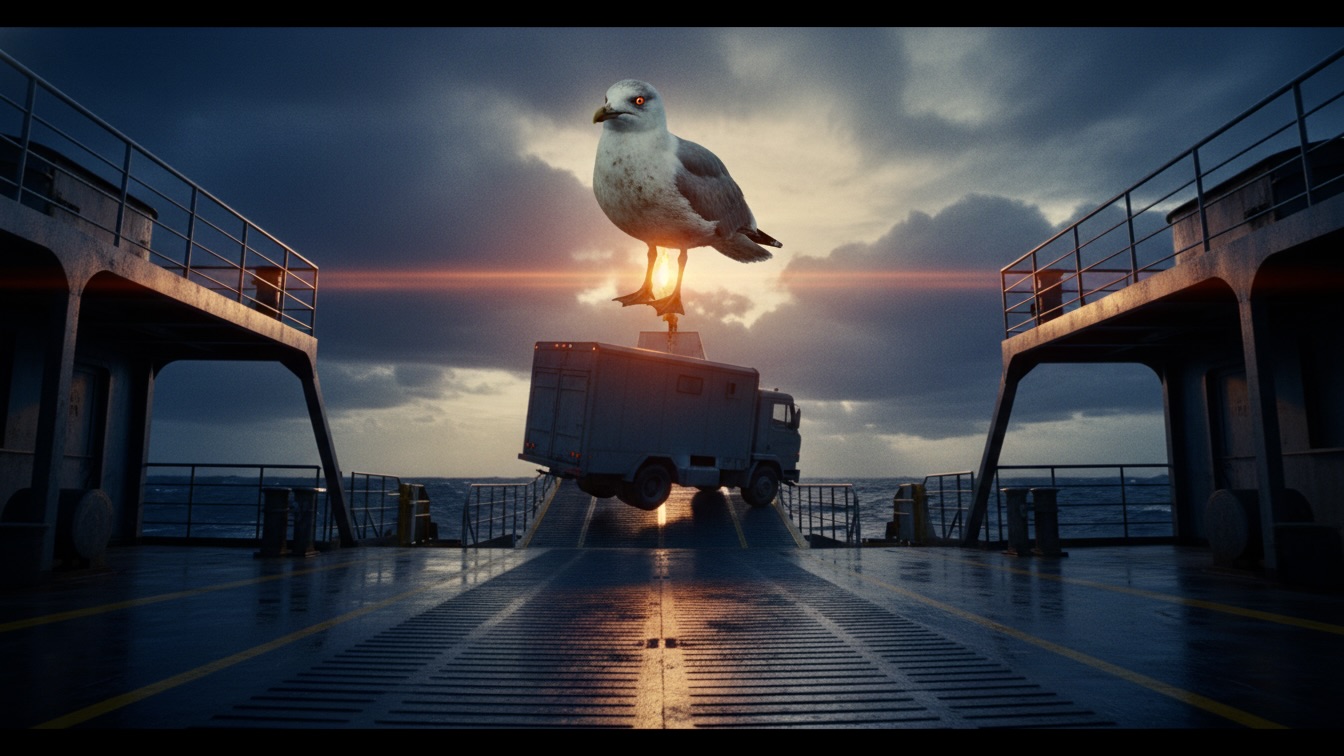
The story begins on the sweltering deck of the Stormhaven ferry, where Casey Stanton, a weary deckhand, endures the oppressive heat and the arrival of a Category 3 hurricane. The mundane misery of her shift is violently interrupted by a tactical team led by a man named Silks, who hijacks the vessel to steal an armored truck filled with three hundred million dollars in government gold. As the hijackers consolidate power on the bridge, they discover that the gold is emitting a high-frequency tracking signal. This frequency inadvertently attracts a swarm of massive, mutated seagulls that begin a savage assault on the ship and its crew.
Trapped in the chaos, Casey encounters Gary, the hijackers' IT specialist, who has fled the carnage on the upper decks. Realizing that the birds are driven by the gold's signal, Casey decides to jettison the cargo to save the ship. She leads Gary to the cargo hold, where they confront a deteriorating and guano-covered Silks. After a tense standoff, Casey uses the ship’s foghorn to disorient the avian predators, providing just enough time to unchain the armored truck. The vehicle rolls into the Atlantic, drawing the entire flock of monsters down into the depths with it. In the aftermath, a traumatized but resolute Casey demands a raise and therapy, refusing to return to her menial labor without significant compensation.
A primary theme of the narrative is the stark contrast between the absurdity of late-stage capitalism and the visceral reality of survival. Casey’s constant mental tally of her sixteen-dollar-and-fifty-cent hourly wage serves as a grounding mechanism against the high-stakes melodrama of the heist. The gold, representing immense wealth and government power, becomes a literal death sentence rather than a prize. This suggests that in the face of environmental or biological catastrophe, traditional structures of value and labor become not only useless but hazardous.
The story also explores the theme of nature’s grotesque retaliation against human interference. The seagulls are not merely animals; they are mutated, "steroid-using" monstrosities triggered by a man-made frequency. This reflects a deep-seated psychological anxiety regarding the loss of control over the natural world. While Silks believes he can master "logistics" and "poetry" to command the sea, nature responds with a chaotic, bloody force that cares nothing for his carefully laid plans. The birds act as a leveling force that strips away the hijackers' tactical pretenses.
Finally, the narrative examines the concept of performance versus pragmatism. Silks is obsessed with the aesthetic of the "mastermind," using theatrical language and tailored gear to project power. In contrast, Casey’s power stems from her intimate knowledge of the ship and her refusal to be intimidated by the "theatrical bros." Her survival is a result of her ability to see the situation for what it is—a dangerous mess that needs cleaning—rather than a stage for a grand heist. This suggests that true competence is often found in the overlooked "blue-collar" workers who actually keep the world’s machinery running.
Casey is a protagonist defined by profound professional burnout and a cynical, survivalist wit. Psychologically, she exhibits a form of detached stoicism, likely developed as a defense mechanism against a thankless, low-paying job. She does not view herself as a hero, but rather as a person who is simply too tired to be afraid of men with guns. Her internal monologue reveals a woman who has been pushed to the edge of her patience by "maritime standards" and tourist litter, making her uniquely suited to handle a surreal crisis.
Her decision to take charge is driven less by altruism and more by a desire to end the inconvenience of the situation. She treats the mutant birds and the hijackers with the same weary annoyance she might feel toward a spilled hotdog or a clogged drain. This lack of fear allows her to think clearly when the "professionals" panic. By the end of the story, her demand for a raise and therapy indicates a shift in her self-worth. She has transitioned from a passive laborer to a woman who recognizes her own indispensability in a chaotic world.
Silks is a classic example of a narcissistic personality whose ego is tied to a perceived sense of intellectual and tactical superiority. He views his criminal enterprise as "artistry" and "poetry," indicating a need to romanticize his actions to justify his violence. He is obsessed with the "logistics" of the world, believing that he can control every variable through planning and aesthetic precision. This obsession with image is his greatest weakness, as it leaves him unprepared for the messy, unplannable reality of a biological attack.
When the seagulls begin to dismantle his team, Silks undergoes a psychological collapse. The transition from a polished mastermind to a man "covered in bird shit" and swinging a machete at shadows represents the total disintegration of his carefully constructed persona. He loses the ability to lead because he cannot adapt to a scenario where he is not the most sophisticated person in the room. His final state of muttering about logistics while in handcuffs shows a man who has retreated into a delusional mental loop to avoid facing his absolute failure.
Gary serves as the pragmatic foil to Silks’ delusions, representing the "worker bee" within the criminal hierarchy. He is motivated by self-preservation and a clear-eyed understanding of his own limitations, such as his asthma and bad back. Unlike Silks, Gary is willing to abandon his ego and collaborate with a deckhand because he recognizes that his survival depends on practical action rather than bravado. His character highlights the absurdity of the heist, as he is an IT professional caught in a literal nightmare.
Psychologically, Gary is the most relatable character, as he expresses the fear and physical discomfort that a normal person would feel in such a situation. His willingness to help Casey unchain the truck shows a pivot from corporate-criminal loyalty to a more fundamental human alliance. While he is still a criminal, he lacks the predatory nature of his associates. His presence allows the reader to see the heist from the perspective of someone who is just "doing a job," albeit a highly illegal and dangerous one.
The narrative voice is characterized by a "blue-collar noir" tone, blending gritty realism with dark, absurd humor. The author uses sensory details to ground the more fantastical elements of the story, such as the "bruised plum" sky and the "smell of hot copper" from the birds. These descriptions create a visceral atmosphere that makes the arrival of the giant seagulls feel like a natural extension of the storm's violence. The pacing is expertly handled, starting with a slow, sweltering tension that rapidly accelerates into high-octane horror as the birds break through the bridge windows.
The dialogue is sharp and cynical, particularly in the interactions between Casey and the hijackers. By giving the villain "theatrical" dialogue and the protagonist "flat, unimpressed" responses, the author reinforces the theme of performance versus reality. The use of the ship's foghorn as a turning point provides a powerful auditory climax that mirrors the physical pressure of the storm. This sensory-heavy approach ensures that the reader feels the vibration of the engines and the sting of the rain, heightening the stakes of the survival struggle.
Furthermore, the narrative makes excellent use of juxtaposition to highlight the absurdity of the situation. The image of a tactical team being defeated by "aggressive poultry" is inherently ridiculous, yet the author describes the violence with enough visceral detail to keep it terrifying. This balance of the macabre and the mundane is a hallmark of the story's style. It allows the narrative to function as both a thrilling action piece and a satirical commentary on the value of human labor in the face of overwhelming, chaotic forces.


