Format: Short Film / Anthology Episode | Est. Length: 10-12 minutes
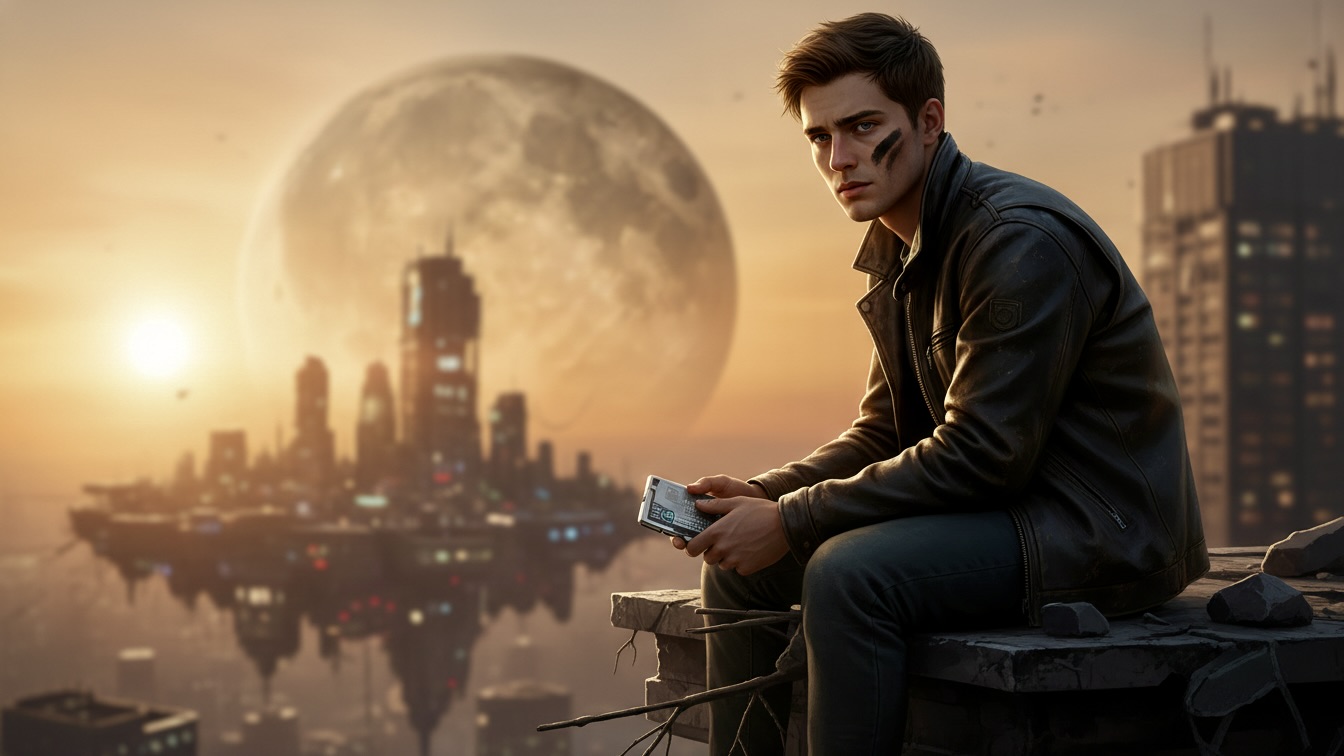
Imagine a world where the sky is a corporate commodity and the moon is a weapon of mass displacement, rendered in the high-contrast grit of a neo-noir thriller. This story serves as a visceral entry point into a sprawling galactic conspiracy, where the very atmosphere is a tool for social cleansing.
Set in a future where Earth’s cities are either floating glass towers for the elite or decaying slums for the "clutter," the series explores the "Foreclosure Era." This overarching narrative follows the "Peacekeepers"—detectives like Will who realize they are actually enforcers for their own extinction. As orbital corporate entities from the Asteroid Belt begin systematically dismantling planetary life to make room for new residents, the series traces a slow-burn rebellion across a dying world.
Detective Will enters a golden tomb high above the clouds, only to find a faceless corpse and a sweet-smelling fog that signals the beginning of the end for the city below.
A corporate detective must race against a lethal atmospheric purge to stop an orbital fleet from weaponizing the moon against Earth. As the city literally tilts toward destruction, he must choose between his badge and the survival of the human race.
The primary themes revolve around class warfare and the dehumanization of the working class in the eyes of corporate expansion. It explores the genre of eco-cyberpunk, focusing on the emotional undercurrent of betrayal by those sworn to protect the public.
The narrative also examines the concept of digital erasure, where an individual's existence is tied entirely to a database. When the system "scrubs" a person, they become a ghost, highlighting the fragility of identity in a hyper-connected, yet soul-less, future.
For Will, the stakes are his identity as a protector versus his survival as a pawn in a game he wasn't meant to win. For the city, the stakes are total biological annihilation via nanobots. If the transmitter fails, the Earth faces a planetary tidal catastrophe that will erase billions of lives to make room for the "masters" of the Belt.
The external conflict pits Will against the automated security network and the treacherous Commander Pletsen, who has traded the city’s safety for a seat in the new world. Internally, Will struggles with the realization that his badge is meaningless in a system designed to delete him. The ultimate antagonist is the "Masters of the Belt," an unseen corporate force that views the entire planet as a messy asset to be liquidated.
Will discovers a scrubbed "ghost" body in a luxury unit just as a sweet-smelling nerve gas begins to vent through the city's weather system. Guided by his AI link, Vic, he evades hostile drones and navigates the crumbling slums to reach the Weather Hub, where he discovers the orbital powers are physically moving the moon to flood the planet.
In a final confrontation at the city's spire, Will discovers that his own commander, Pletsen, facilitated the attack. After a zero-gravity struggle, Will successfully resets the moon's orbit using a stolen data-shard, stopping the planetary foreclosure. Though the city is a wreck and the corporate order has collapsed, Will survives to see a clean dawn, finally free of his badge but burdened with the truth.
Will (Protagonist): Will begins as a dutiful, badge-wearing detective clinging to the illusion of order, but ends as a battered revolutionary who accepts the destruction of the status quo. His psychological arc is one of disillusionment, moving from a man who seeks "identity" in a database to one who finds purpose in the survival of the nameless.
Vic (Supporting): Vic is a sharp, bell-voiced AI link who evolves from a mere diagnostic tool to a panicked, sentient companion as the stakes shift from local crime to planetary extinction. He provides the technical bridge between Will’s physical actions and the digital void of the city’s hijacked network.
Commander Pletsen (Antagonist): Pletsen is a cynical security chief whose psychological arc moves from cold superiority to a desperate, suicidal attempt to reclaim his lost pride. He represents the "survivor" mentality, choosing to serve the invaders rather than die with the "clutter," only to be betrayed by the very elites he protected.
* The Golden Tomb: Will investigates a silent, golden hab-unit where he finds a man with "ironed-out" features and a mysterious silver card just as a lethal sweet-smelling gas begins to hiss from the vents. The AI Vic confirms the body has been digitally scrubbed, making the victim a "ghost" in a city that sees everything. Will realizes the air is changing and narrowly escapes the unit as the luxury tower begins to feel like a trap.
* The Slum Descent: After being declared a "non-entity" by a rogue security drone, Will narrowly escapes a melting hallway and dives into the decaying slums as the sky turns a bruised green. He witnesses the chaos of the "Peacekeepers" turning into hunters, firing live rounds into the crowds of people they once protected. Will saves a young girl from a drone strike, solidifying his shift from a corporate enforcer to a protector of the people.
* The Spire Confrontation: Will reaches the Weather Hub spire and finds a dying executive who reveals that Commander Pletsen has sold the city to orbital masters who are currently dragging the moon out of orbit. He confronts Pletsen in the weather control room, where the Commander explains that the "foreclosure" is inevitable and he has simply chosen the path of least resistance. The room enters zero-gravity as the moon’s pull begins to tear the city from its foundations.
* The Sacrifice of the Elites: In the weightless chaos of the control room, Will tackles Pletsen and wrests the gold key from his belt to override the atmospheric controls. He chooses to vent the lethal gas into the upper levels of the spire, killing the corrupt board of directors to prevent the gas from reaching the millions in the slums below. The spire tilts violently as the mag-lev tracks snap, leaving Will and Pletsen suspended in a crumbling monument to corporate greed.
* The Planetary Reset: On the burning roof of the tilting spire, Will plugs the executive's data-shard into the transmitter to beam a reset code to the moon’s engines. Pletsen finds a final moment of redemption, using his marksman skills to hold off descending stealth ships while Will completes the upload. As the moon returns to its proper orbit and the ships retreat, Will sits on the edge of the broken world, watching the first clean sunrise of a new era.
The episode begins with cold, clinical suspense and transitions into a frantic, high-octane chase through a claustrophobic urban landscape. The midpoint shift to zero-gravity introduces a sense of existential dread and disorientation, peaking during the confrontation with Pletsen. The final act moves from the heat of battle to a somber, exhausted sense of peace as the "summer that never ends" finally breaks into a cool, rainy dawn.
If expanded, the season would follow Will and Vic as they navigate the flooded ruins of Earth, gathering other "ghost" detectives to form a resistance against the Belt. The narrative would explore the power vacuum left by the collapse of the corporate boards and the rise of local warlords competing for the remaining "clean" technology.
The thematic escalation would focus on the "Masters" returning to finish the foreclosure with more direct military force, forcing Will to find a way to take the fight into orbit. The season finale would involve a heist to board a stealth ship, shifting the genre from planetary noir to a high-stakes orbital insurgency.
The visual style is "High-Glow Decay," contrasting the saturated orange and gold of the elite hab-units with the sickly emerald green of the nerve gas and the stark, matte black of the orbital ships. The cinematography utilizes wide, anamorphic shots to capture the scale of the moon looming over the skyscrapers, paired with shaky, handheld work during the slum chases.
The tone is a blend of Blade Runner 2049’s atmospheric weight and the kinetic, desperate action of Children of Men. It maintains a "Hard Sci-Fi" edge, where the technology feels heavy, mechanical, and indifferent to human life, emphasizing the grit over the glamour of the future.
Aimed at adult fans of "hard" sci-fi and political thrillers, specifically those who enjoy complex world-building and high-stakes moral dilemmas. The viewing context is a prestige streaming environment that rewards visual storytelling, dark mature themes, and a cynical yet ultimately hopeful view of human resilience.
The pacing is relentless, utilizing a "ticking clock" structure that accelerates as the gravity shifts and the moon approaches. The 10-12 minute runtime follows a condensed three-act structure: the discovery (Act I), the descent and ascent (Act II), and the planetary reset (Act III), with almost no downtime between beats to simulate Will’s breathlessness.
The production requires heavy use of "Virtual Production" (LED volumes) to simulate the tilting city and the massive, shifting scale of the moon in the sky. This allows for realistic lighting on the actors as the sky transitions from orange to bruised green and finally to the blue light of the transmitter.
Practical effects like high-powered wind machines and falling debris should be used on the roof set to ground the CGI spectacle in a visceral, tactile reality. The zero-gravity sequence in the control room will require wire-work and slow-motion filming to contrast with the high-speed kinetic energy of the slum district scenes.


