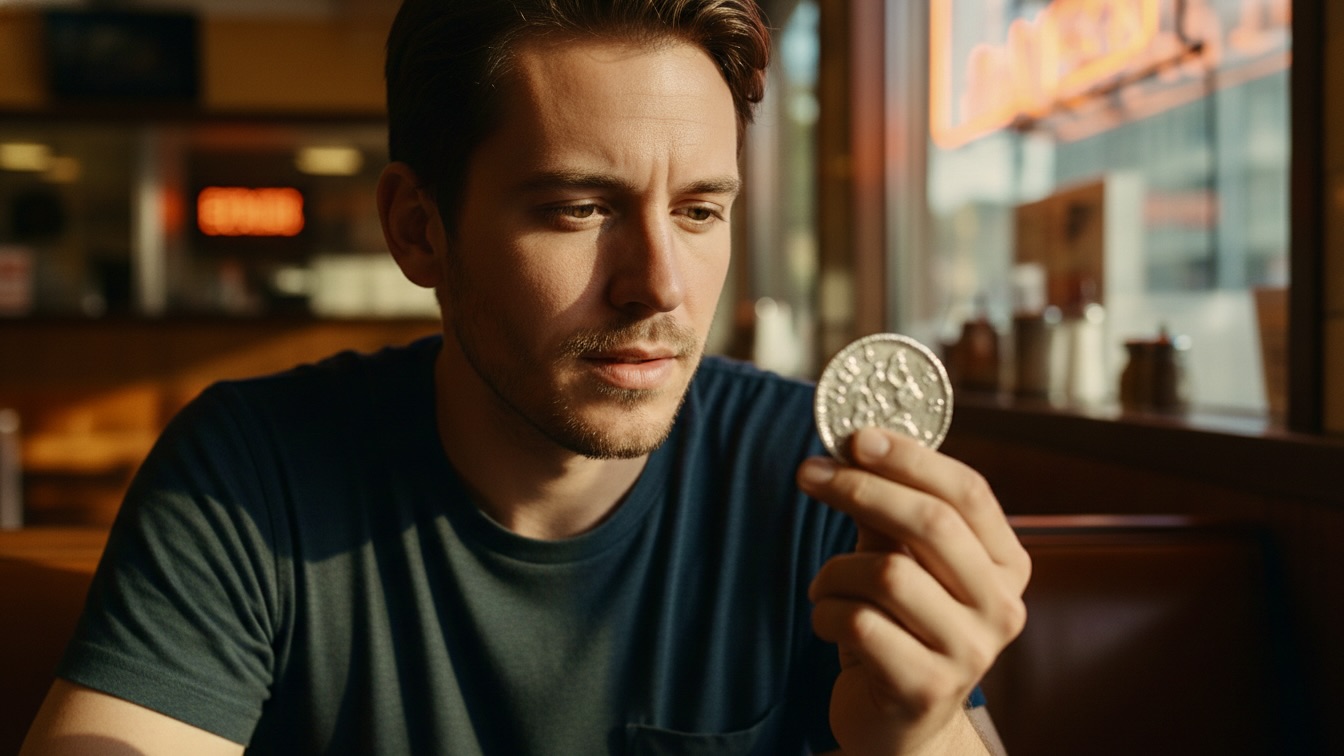
Eddie Spinner finds a silver coin that bypasses Vancouver surveillance and uncovers a network of illegal community trust.
The heat in Vancouver wasn't the dry kind that people liked to brag about. It was the kind that sat on your chest, making every breath feel like a chore. Eddie Spinner sat in a booth at a diner that had seen better decades, watching the condensation drip down a glass of lukewarm water. His phone buzzed on the table. A notification from the Revenue Agency. He didn't open it. He knew what it said. Another 'safety audit' of his stagnant business account. Another reminder that the government didn't like people who didn't have a clear digital trail.
Sarah sat across from him. She was twenty-four, but she looked like she hadn't slept since the Emergencies Act had been expanded back in May. She was a barista at a place that charged nine dollars for a latte, and yet she was currently broke. Not because she didn't have money, but because her money was stuck in a digital purgatory. Her hands were shaking as she pushed a small, heavy object across the cracked laminate table toward him.
"I can't pay you with the app," she said. Her voice was low, barely audible over the hum of a faulty air conditioner. "They gray-listed me. Everything's frozen. I donated fifty bucks to that defense fund for the park protesters, and boom. Access denied. I can't even buy a bus pass."
Eddie looked down. It wasn't a loonie. It wasn't a toonie. It was a coin, about the size of a fifty-cent piece, but it was thicker. The edges were sharp, hand-pressed. On one side was a stylized mountain range. On the other, a simple, hammered '100'. It didn't have a serial number. It didn't have a microchip. It didn't have a portrait of a dead monarch.
"What is this?" Eddie asked. He picked it up. It was heavy. Real silver. He felt the cool metal against his sweaty palm, and for a second, the heat in the diner seemed to pull back. It was a physical weight in a world that was becoming increasingly weightless.
"It's ghost money," Sarah whispered. "The people at the community center. They’re calling it the Silver Ledger. You can use it at the butcher on Commercial, or the hardware store in East Van. They take it at the farmer's market. It’s worth a hundred bucks. No tracking. No 'Economic Safety' protocols. Just... silver."
Eddie turned the coin over. "You’re paying me in pirate treasure, Sarah? I have rent. My landlord doesn't take pirate treasure. He wants a direct deposit through the portal."
"Your landlord is a prick, Eddie. But you know people. You know the ones who are hurting worse than me. I need you to find out who's making these. If the Feds find the source, we’re all done. My sister... she works for the bank. She says they’re already looking for a 'physical anomaly' in the local economy. They know people are trading something they can't see on a screen."
Eddie leaned back, the vinyl of the booth sticking to his shirt. He looked at the coin again. It was beautiful in its simplicity. No data. No metadata. No location pings. It was just an object. In 2026, an object was a revolutionary act. He thought about his own bank account, the red flags that popped up every time he took a cash job. The government called it 'Safety.' Eddie called it a leash.
"Who gave this to you?" Eddie asked.
"A guy at the swap meet. He said there’s a place in Gastown. A basement. You have to go when the tide is high because the sensors in the sewers get glitchy when they’re submerged. That’s how they get the metal in and out."
"You want me to protect the Mint Master," Eddie said. It wasn't a question. He was already thinking about how much silver was in his hand. If this was real, if it was widespread, it was the biggest threat to the 'Economic Safety' Act since its inception. It wasn't a hack. It wasn't a crypto-scam. It was a return to the dirt.
"I want you to make sure they don't get caught," Sarah said. "If they go down, we lose everything. We lose the only way we have left to help each other without asking for permission."
Eddie sighed, pocketing the coin. The weight of it in his jeans felt different than a phone. It didn't vibrate. It didn't demand his attention. It just sat there, solid and certain. "Fine. I'll look into it. But if I get bagged for 'fostering economic hate,' you’re coming to visit me in the detention center."
Sarah didn't laugh. "They don't do visits for that anymore, Eddie. They just delete your digital identity until you're a ghost. We're already halfway there."
She stood up, pulling her hoodie tight despite the heat. She looked like every other kid in Vancouver—anxious, tired, and ready to disappear. She didn't say goodbye. She just walked out into the bright, oppressive sunlight of the street, leaving Eddie alone with a lukewarm glass of water and a silver coin that felt like a bomb in his pocket.
The Gastown basement was exactly what Eddie expected: a damp, concrete box that smelled like old salt and wet rot. The tide was coming in, and the sound of water rushing through the ancient drainage pipes behind the walls was a rhythmic, thumping presence. It was a humid Tuesday, the kind of day where the air felt like it was made of wool. Eddie adjusted his jacket, feeling the silver coin Sarah had given him pressing against his hip. He was at a 'swap meet' that didn't look like any market he'd ever seen. There were no stalls, no neon signs, no QR codes to scan for 'product transparency.'
Instead, there were people. Dozens of them, mostly young, standing in small circles or leaning against the peeling pillars. They were swapping jars of preserved peaches for hand-knitted sweaters, or tools for bags of flour. It was quiet. No one was shouting prices. No one was checking their phones. In fact, most phones were tucked away in signal-blocking pouches. The air was thick with the hushed murmur of transactions that didn't exist in any federal database.
"You looking for the source?" a voice asked.
Eddie turned. An elderly woman sat in the corner on a crate of old machine parts. She wore a thick apron stained with grease and something that looked like graphite. Her hair was a shock of white, tied back with a piece of frayed twine. She didn't look like a revolutionary. She looked like someone's grandmother who had spent too much time in a garage.
"I'm looking for the Mint Master," Eddie said, keeping his voice low.
"You found her," she said. She didn't offer a name. Names were data points. "I'm Martha. But around here, I'm just the person who remembers how to use a press."
Eddie pulled out the silver coin. "This is causing a lot of trouble, Martha. The Feds are looking for the 'anomaly.' They don't like it when the math doesn't add up on their end."
Martha let out a dry, rattling laugh. "The math is fine. It’s their ego that’s bruised. They think they own the concept of value. But value is just trust. I trust that you want this silver, and you trust that I’ll take it back for something else later. We don't need a server in Ottawa to tell us that's okay."
"They're calling it economic hate, Martha. That's a heavy label. They use it to justify the raids."
"They call anything they can't tax 'hate,'" she replied, leaning forward. Her eyes were sharp, devoid of the cataract-fog of age. "I'm not breaking laws, Eddie. I'm restoring the barter system the Charter used to protect before everything became a subscription service. We aren't building a weapon. We're building a floor. Something for people to stand on when their bank accounts vanish because they liked the wrong post or donated to the wrong cause."
Before Eddie could respond, a sharp, electronic chirp cut through the basement's humidity. It was a sound he knew well—a federal 'Compliance' drone, or rather, the signal interference that preceded one. The murmurs in the room died instantly. People began moving toward the exits, not in a panic, but with a practiced, fluid urgency.
"They're early," Martha said, standing up with surprising agility. "The tide hasn't peaked. The sensors must have picked up the heat from the smelting pot."
Suddenly, the heavy steel door at the top of the stairs was kicked open. The sound echoed like a gunshot in the cramped space. Bright, clinical white light flooded down the stairwell, cutting through the dim, yellow glow of the basement.
"Compliance Officers! Stay where you are!" a voice boomed. It was Agent Robertson. Eddie recognized the tone—that perfect, bureaucratic blend of boredom and authority. "This is an unauthorized economic gathering under Bill C-9. All physical assets are subject to immediate seizure."
"Run, Eddie," Martha whispered, shoving a small, leather-bound book into his hands. "The Silver Ledger. It’s not just the coins. It’s the names. Not the digital ones. The real ones. The people who know how to survive. Get it out of here."
"What about you?" Eddie asked, gripping the book. It felt old, the leather cracked and smelling of cedar.
"I'm seventy-eight. What are they going to do? Delete my TikTok? Go!"
Eddie didn't wait. He knew the layout of these old Gastown buildings. He dived behind a stack of crates as the first flash-bang went off. The sound was a physical blow, a wall of pressure that turned his vision into a white, vibrating blur. He didn't think; he just moved. He slid through a narrow gap in the brickwork that led to the old storm drains. The water was waist-high, cold, and smelled of salt and urban runoff.
He could hear the shouting above him, the heavy boots of the Compliance Officers thudding on the concrete. They were using scanners, looking for the heat signatures of the silver. Eddie pressed the ledger against his chest, praying the leather was waterproof. He waded through the dark, his breath coming in ragged, shallow gasps. The claustrophobia was a physical weight, the low ceiling of the sewer pressing down on him.
He turned a corner, the water splashing against the mossy walls. He saw a glimmer of light ahead—an old maintenance grate that led to a back alley. He scrambled up the rusted iron rungs, his muscles screaming. He emerged into the humid Vancouver night, the air feeling suddenly, miraculously thin. He was drenched, shivering despite the heat, and holding a book that could get him twenty years in a federal work camp.
He leaned against a brick wall, his heart hammering against his ribs. He looked down at the ledger. It wasn't just a book. It was a network. It was a receipt for a community that had decided to stop asking for permission to exist. And now, he was the only one holding the keys to the kingdom.
Eddie’s apartment was a studio in a building that was mostly Airbnb units for tourists who didn’t mind the occasional siren. He sat on his floor, the Silver Ledger open in front of him. The pages were vellum, handwritten in ink that didn't smudge. It wasn't a list of transactions; it was a list of skills. Baker. Plumber. Medic. Mechanic. Each name had a physical location attached, usually a landmark rather than an address. Third tree past the fountain. The blue door with the cracked window.
His phone rang. It was his sister, Chloe. He hesitated before answering. Chloe worked at one of the Big Five banks, in the 'Risk Assessment' department. She was the one who pulled the trigger on the gray-lists.
"Eddie, where are you?" she asked. She sounded stressed, the sharp clacking of a keyboard audible in the background.
"Home. Why?" Eddie said, his voice flat. He was still picking sewer grit out from under his fingernails.
"There was a raid in Gastown. The Feds are looking for a 'high-value asset' that went missing during the sweep. A book. Or a drive. They aren't sure. But they’ve flagged your ID. They saw your face on a street cam three blocks from the site."
Eddie felt a chill that had nothing to do with the dampness of his clothes. "I was just out for a walk, Chloe. Is walking illegal now?"
"Don't be like that. You know the protocols. Anything 'off-book' is considered a threat to national stability. They’re freezing more accounts tonight, Eddie. Thousands of them. It’s a sweep. If you have anything to do with this silver coin nonsense, you need to dump it. Now."
"Why are you doing it, Chloe?" Eddie asked. He looked at the names in the ledger. Mina—Midwife. Leo—Electrician. These were people, not 'assets.'
"Doing what? My job?" Chloe’s voice rose an octave. "I’m keeping the system from collapsing. If people start trading unregulated currency, the inflation will kill us all. We need oversight. We need safety."
"Safety for who? Sarah the barista? She can't buy food because she donated to a legal fund. Is that safety?"
"She broke the rules!" Chloe snapped. "The rules are there for a reason. If you don't like the rules, you change them through the proper channels. You don't start minting pirate money in a basement."
"The proper channels are blocked by a paywall, Chloe. You know that. You’re the one who sets the price for entry."
"I'm just following orders, Eddie. I don't make the policy. I just execute the flagging algorithms. If the system says someone is a risk, they’re a risk. It’s math. It’s not personal."
"It’s the most personal thing there is," Eddie said, his voice dropping to a whisper. "You’re deleting people. You’re turning them into ghosts because a piece of software told you to. How do you sleep?"
There was a long silence on the other end. Eddie could hear her breathing, a jagged, uneven sound.
"I sleep because I have a roof over my head and a pension," she finally said. "And if you don't get rid of whatever you’re holding, I won't be able to protect you. They’re coming to your place, Eddie. The warrant is already in the queue. Get out of there."
She hung up. Eddie didn't move for a moment. He looked at the ledger. He knew he should burn it. He should toss the silver coin into the Burrard Inlet and go back to being a low-rent PI who looked for lost cats and cheating spouses. But then he thought of Martha’s face. He thought of the way the silver felt in his hand—real, heavy, and honest.
He grabbed his bag and tossed the ledger inside. He needed more than just a place to hide; he needed to understand why this was happening. He remembered something Martha had said about the BC Archives. Something about pre-digital records.
He spent the next few hours navigating the city through alleys and backstreets, avoiding the main intersections where the surveillance cameras were densest. The humidity was breaking, replaced by a thick, rolling fog that drifted in from the ocean. It was a Vancouver classic—the 'June Gloom' that arrived in July. It was the perfect cover.
He reached the Archives building just as the sun was starting to bleed through the gray clouds. The building was a brutalist concrete block, largely ignored in the age of the cloud. Most of the records had been digitized and then 'curated' by the government, but the physical stacks still existed in the basement, moldering away in the dark.
Eddie used a set of lockpicks he’d kept since his early days. The lock was old, a simple tumbler system that didn't report back to a central server. He slipped inside, the air in the building cool and still. It smelled of dust and slow decay.
He found the section on 'Provincial Treasury 1920-1945.' He began pulling boxes, his hands moving quickly through the manila folders. He wasn't looking for money. He was looking for a precedent. And then he found it. A series of emergency charters from the Great Depression. Local 'scrip' issued by municipalities when the banks failed. It was legal. It was documented. The government had forgotten about it because it wasn't in the digital database. It had been 'de-prioritized' during the Great Migration to the cloud.
He realized then that Martha wasn't just minting money. She was reviving a legal loophole that the current 'Economic Safety' Act hadn't technically repealed. It was a ghost in the machine. A piece of history that proved the community had the right to support itself when the central system failed.
But as he turned to leave, the high-pitched whine of a drone filled the quiet halls of the archives. Red light began to pulse against the concrete walls. They hadn't followed him. They had anticipated him.
"Eddie Spinner," Agent Robertson’s voice echoed through the building’s intercom system. "We know you’re in there. We have the building surrounded. Come out with the Ledger, and we can discuss a leniency agreement. Don't make this a criminal matter."
Eddie looked at the exit. He looked at the ledger. He knew Robertson was lying. There was no leniency for people who held the keys to a parallel world. He took a deep breath, the dust of the archives filling his lungs, and prepared to run.
The fog outside the Archives was so thick it felt like a physical barrier. Eddie burst through the side exit, the cold air hitting his face like a slap. He didn't head for the street. He headed for the park. Stanley Park was a sprawling, thousand-acre tangle of old-growth forest and sea-wall, and in this weather, it was a graveyard for high-tech surveillance. The drone’s thermal sensors would struggle with the shifting moisture levels and the dense canopy of the cedars.
He could hear the whine of the drone above him, a persistent, angry insect. It was trying to lock onto his heat signature, but Eddie was moving fast, staying under the heavy branches. He felt a strange surge of adrenaline. For the first time in years, he didn't feel like a pawn. He felt like a player.
He reached a clearing near the hollow tree. He stopped, his chest heaving. He pulled out the silver coin and held it up. The drone hovered ten feet above him, its red eye blinking. It was waiting for a clear shot, or perhaps waiting for the ground team to catch up.
"You want this?" Eddie yelled into the fog. "It’s just metal! It’s just a rock! You can't kill a rock!"
He didn't wait for a response. He took the Silver Ledger and tucked it into a waterproof bag he’d stashed near a trail marker. He wasn't going to let them have it. He had a better idea. He’d spent the walk from the Archives sending out one final, desperate burst of messages through an old, encrypted mesh-net he’d used back in his activist days. It didn't use the internet. It used radio waves, hopping from one node to another. It was slow, but it was invisible.
The Silver Ledger is open, he’d messaged. Tomorrow at noon. Victory Square. Bring your spine.
He led the drone on a chase for another twenty minutes, weaving through the brush until he reached the cliffs overlooking the water. He could see the lights of the North Shore flickering through the mist. He heard footsteps behind him—heavy, disciplined. Agent Robertson and his team.
"End of the line, Spinner," Robertson said, stepping out of the fog. He looked remarkably dry, his tactical gear pristine. He held a high-output scanner in one hand and a sidearm in the other. "Give me the book, and we can go home. It’s too humid for this."
"I don't have it," Eddie said, holding up his empty hands. "I gave it back to the people it belongs to."
Robertson’s face darkened. "You think you're a hero? You're a nuisance. You're a glitch in a system that keeps millions of people fed and safe. You’re trying to burn down the house because you don't like the wallpaper."
"The house is already on fire, Robertson. You’re just the only one who hasn't smelled the smoke yet."
Robertson stepped forward, but he was interrupted by his earpiece. His expression shifted from irritation to genuine confusion. Then to alarm.
"What?" Robertson barked into his comms. "Where? How many?"
He looked at Eddie, his eyes narrowing. "What did you do?"
"I didn't do anything," Eddie said, a grin spreading across his face. "I just reminded people that they don't need your permission to buy a loaf of bread."
At that moment, all across Vancouver, the 'coordinated donation' began. Thousands of people, from baristas to bank clerks, walked into local shops and handed over silver coins. They didn't use their phones. They didn't tap their cards. They just traded. In Victory Square, a crowd of five thousand gathered, each person holding a small, silver-pressed token.
The 'Compliance' algorithms went into a tailspin. The system was designed to flag individual anomalies, not a city-wide collapse of digital participation. The servers in Ottawa were overwhelmed by the sheer volume of 'zero-data' transactions being reported by confused merchants. The government couldn't arrest five thousand people for the crime of using silver. They couldn't freeze accounts that weren't being used.
Robertson’s drone suddenly dipped, its lights flickering. The signal was being jammed by hundreds of small, handheld devices the crowd was using—old tech, repurposed. The high-tech surveillance net was being torn apart by the sheer weight of physical presence.
"We’ll find the source, Spinner," Robertson hissed, but he was already backing away, his team retreating as the fog began to lift and the first rays of the morning sun hit the park. "This doesn't change anything."
"It changes everything," Eddie called out.
He waited until they were gone before he sat down on a mossy log. The weight on his chest—the claustrophobia of the last few months—was gone. He felt a sudden, sharp clarity. He could breathe. Truly breathe.
He walked back into the city as the sun began to bake the pavement. He went to the diner where he’d met Sarah. She was there, sitting in the same booth. She looked different. The panic was gone. She was holding a cup of coffee that she’d paid for with a silver coin.
Eddie sat down and slid her original coin across the table.
"Keep it," he said. "This isn't just money, Sarah. It’s a receipt for your spine."
She looked at the coin, then at him. "Is it over?"
"No," Eddie said, looking out the window at the bustling street. For the first time, he saw people looking at each other, not their screens. He saw a man trade a silver coin for a newspaper. He saw a community starting to wake up. "It’s just beginning. The market is finally starting to breathe."
As the summer sun hit the glass towers of Vancouver, the digital leashes felt a little looser. The city was still there, but the power had shifted. It hadn't gone to a new government or a new app. It had gone back to the hands that held the silver. Eddie leaned back, feeling the warmth on his face, and for the first time in a long time, he wasn't afraid of the future.
“As the sun rose, Eddie realized that while they had won the day, the government was already rewriting the code for a much colder winter.”


