Format: Short Film / Anthology Episode | Est. Length: 10-12 minutes
Imagine a world where the digital noise we ignore becomes a physical rot, a series where the ghosts in the machine finally step out of the screen and into our reality. This story serves as a visceral entry into a speculative anthology, blending the nostalgic summer-camp aesthetic with the jarring, modern horror of a world that has forgotten how to unplug.
The Glitch is an anthology series exploring the physical manifestation of digital waste and the thinning veil between the virtual and the physical. Each episode follows different individuals encountering "Static Entities"—predatory glitches born from excessive connectivity and signal noise—forcing characters to rediscover primal grounding techniques to survive in an increasingly digitized landscape.
A sweltering afternoon at a "no-phone" summer camp turns deadly when Art’s hidden, vibrating smartphone begins to synchronize with a terrifying crackling sound emanating from the nearby blackberry bushes.
When a tech-addicted boy sneaks his phone into a digital-free summer camp, he accidentally summons a predatory glitch-entity that feeds on electronic signals. To survive, he must abandon his device and master the art of physical grounding before he is erased by the static.
The primary theme is the conflict between digital distraction and physical presence, highlighting how modern connectivity can alienate individuals from their environment and themselves. It explores "technological waste" as a modern folklore element, where the invisible signals we rely on become a literal, predatory force that thrives on the "noise" of human obsession.
The secondary theme focuses on mindfulness and grounding as survival mechanisms. By utilizing "fractals" and somatic breathing techniques, the characters prove that the complexity of nature is the only antidote to the chaotic, artificial noise of the digital age, suggesting that reality itself is a frequency that must be maintained.
For Art, the stakes are existential; the Static Man doesn't just kill, it "erases" and blurs the physical form of its victims, threatening to turn him into the very digital noise he is addicted to. His friends, Mia and Toby, are in immediate physical danger due to Art’s choice to break the camp rules, placing the weight of their lives directly on his conscience as they face a monster they cannot fight with traditional weapons.
The external conflict is the Static Man, a jagged, faceless manifestation of digital interference that pursues the children with relentless, glitchy speed and the power to dissolve matter. Internally, Art struggles with his compulsive need for digital validation and the intense guilt of knowing his secret phone brought this "glitch" into their world, forcing him to choose between his digital tether and his physical survival.
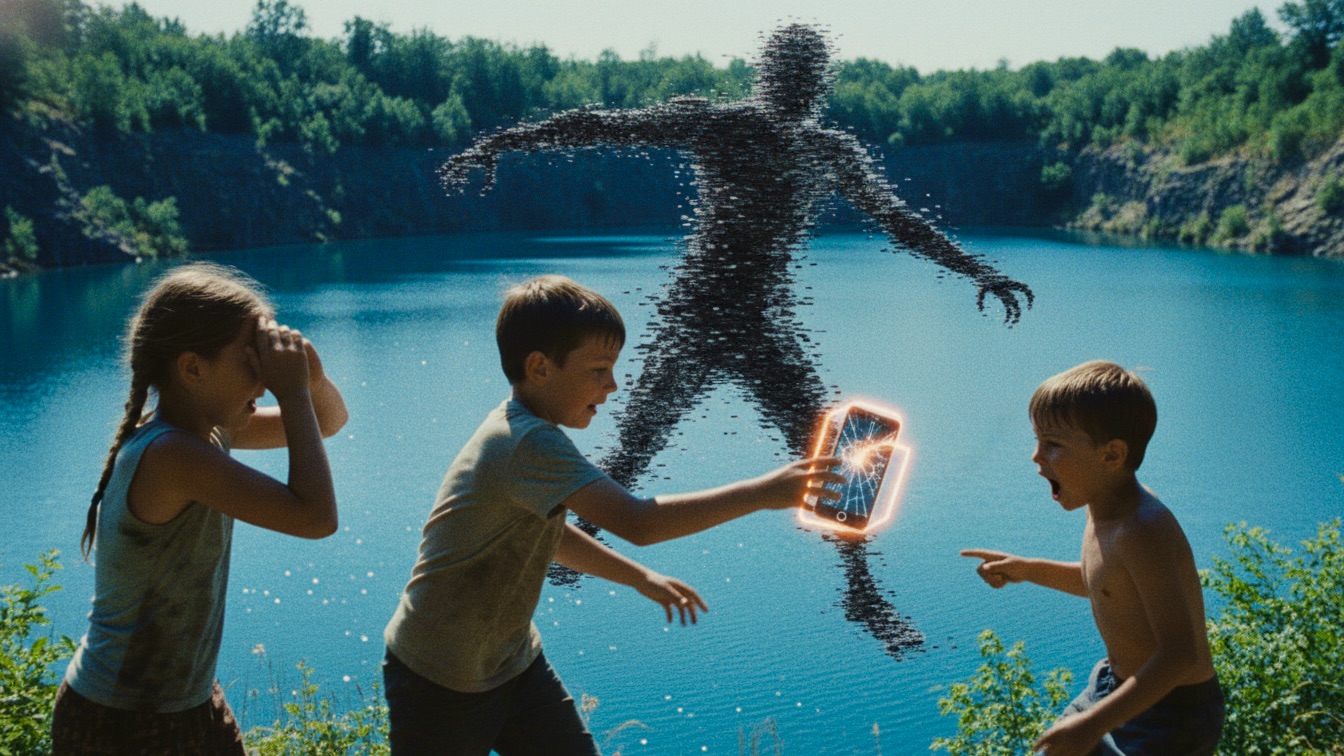
Art, Mia, and Toby are biking through the oppressive heat of Camp Green Heart when Art’s hidden phone begins to vibrate uncontrollably, attracting a "Static Man"—a creature made of gray pixels and white noise. The entity begins erasing the physical world around it, starting with Art’s bike, forcing the trio to seek refuge in a grease-smelling equipment shed where they use rhythmic "Voo" breathing to mask their presence from the creature’s signal-seeking senses.
Realizing the creature is a manifestation of digital "trash" that hates the organized patterns of nature, Art leads a desperate sprint to the local quarry, using "wide vision" to focus on the natural environment to remain invisible to the glitch. At the ledge of the quarry, Art makes the ultimate sacrifice of his device, throwing the phone into the deep water to lure the monster to its grounding destruction, finally finding peace in the silent, natural world.
Art: A tech-dependent pre-teen who begins the story anxious and tethered to his notifications, but undergoes a psychological shift from digital dependency to physical awareness after destroying his source of distraction.
Mia: A grounded, observant girl who serves as the group's tactical leader, using her mother's mindfulness techniques to provide the "Voo" grounding method that saves their lives.
Toby: The youngest and most vulnerable member of the group, whose accidental "unnatural" cry of pain serves as the catalyst for the final chase, representing the innocence at risk in a digital world.
Beat 1: Art struggles to bike through the heat while his hidden phone vibrates with increasing intensity, creating a sensory link between his physical discomfort and the digital "hum" in his pocket. The vibration suddenly synchronizes with a terrifying crackle in the bushes, and a faceless, static-filled entity lunges out, forcing the children to flee in terror as the creature begins to "blur" the reality of Art's abandoned mountain bike. Art drops his phone in the chaos, but the creature’s presence only grows stronger as it feeds on the dying signal of the cracked device.
Beat 2: Trapped inside a dark equipment shed, the children realize the monster is attracted to their internal "noise" and digital habits, prompting Mia to lead them in a rhythmic "Voo" breathing exercise to ground their frequencies. The tension peaks as the Static Man prowls outside, its jagged edges scraping against the tin roof while the air inside the shed grows thin and suffocating, mirroring Art's internal panic. Art experiences a moment of clarity, realizing that nature’s complex patterns—fractals—are the only weapon they have against the "messy" digital glitch.
Beat 3: The children sprint for the quarry using "wide vision" to blend into the natural landscape, but Toby’s trip alerts the creature, leading to a high-speed, glitchy pursuit where the monster appears to teleport closer with every blink. Art reaches the ledge, retrieves his scorched phone, and lures the Static Man toward him before hurling the device into the deep, spring-fed water. The creature dives after the signal and is instantly "grounded" by the lake, erupting into a cloud of gray mist that leaves the forest in a state of profound, natural silence.
The episode begins with a sense of sweltering, itchy anxiety, mirroring Art’s withdrawal symptoms and the oppressive summer heat. It transitions into a cold, sharp dread during the shed sequence, where the "Voo" breathing provides the first note of calm amidst the terror. The finale shifts from a frantic, high-stakes chase to a serene, cathartic resolution, leaving the audience with a sense of quiet wonder and a lingering, "unplugged" peace that is only slightly disturbed by the final, chilling stinger.
If expanded, the season would follow a "Digital Plague" spreading from rural camps to urban centers, with Art, Mia, and Toby becoming a specialized "Grounding Cell" that teaches others how to fight the static. Each episode would introduce new types of entities—Buffer Wraiths, Data Leeches, and Ping Phantoms—representing different aspects of internet culture and technological overreach that have begun to manifest in the physical world.
The overarching narrative would explore the origin of the "Glitch" as a sentient byproduct of a global server crash, leading to a finale where the protagonists must find a way to "reboot" the physical world’s connection to nature. The characters would evolve from frightened children into resilient survivalists who balance modern life with ancient grounding techniques, eventually discovering that the Static Men are actually trying to "archive" a world they believe is failing.
The visual style utilizes a "Dual-Aesthetic" approach: the natural world is shot with high-saturation, deep focus, and organic textures, while the Static Man and its influence are rendered with jarring frame-rate drops, chromatic aberration, and digital "tearing." The tone is "Eco-Horror meets Amblin-style Adventure," blending the wonder of a summer camp movie with the unsettling body-horror of a corrupted video file.
Comparables include the "glitch" aesthetics of Spider-Man: Into the Spider-Verse contrasted with the grounded, rural suspense of A Quiet Place. Sound design is critical, moving from the rhythmic, organic sounds of cicadas to the harsh, non-linear screeching of a 56k modem, creating an auditory landscape that feels like a battle between the earth and the machine.
The target audience is the "Gen Z/Alpha" demographic (ages 10-16) and their parents, appealing to viewers who enjoy supernatural thrillers like Stranger Things or Black Mirror. It serves as a cautionary tale for a digitally native generation, making it ideal for family viewing and discussion about screen time, mindfulness, and the importance of maintaining a connection to the physical world.
The pacing is an "Accelerated Burn," starting with a slow, atmospheric buildup of heat and vibration before shifting into a relentless, 10-minute survival sequence. The act structure follows a traditional three-act format: The Breach (Arrival of the Static Man), The Grounding (The Shed/Breathing), and The Reset (The Quarry/Sacrifice), maintaining a tight tempo that prioritizes sensory immersion over heavy dialogue.
The Static Man should be achieved through a mix of a physical performer in a morph suit and post-production "datamoshing" effects to ensure the movement feels inhuman and non-linear. The "blurring" of the bike and environment can be handled with practical "melted" props and digital overlays that simulate a low-resolution texture, emphasizing the creature's ability to corrupt physical data.
Water safety for the quarry jump is paramount, requiring a controlled environment or a composite shot for the children’s leap into the water. The soundscape requires a specialized foley artist to create the "Voo" frequency and the "Static Man" shriek, ensuring the two sounds feel like they exist on opposing ends of the audio spectrum to emphasize the theme of grounding versus interference.


