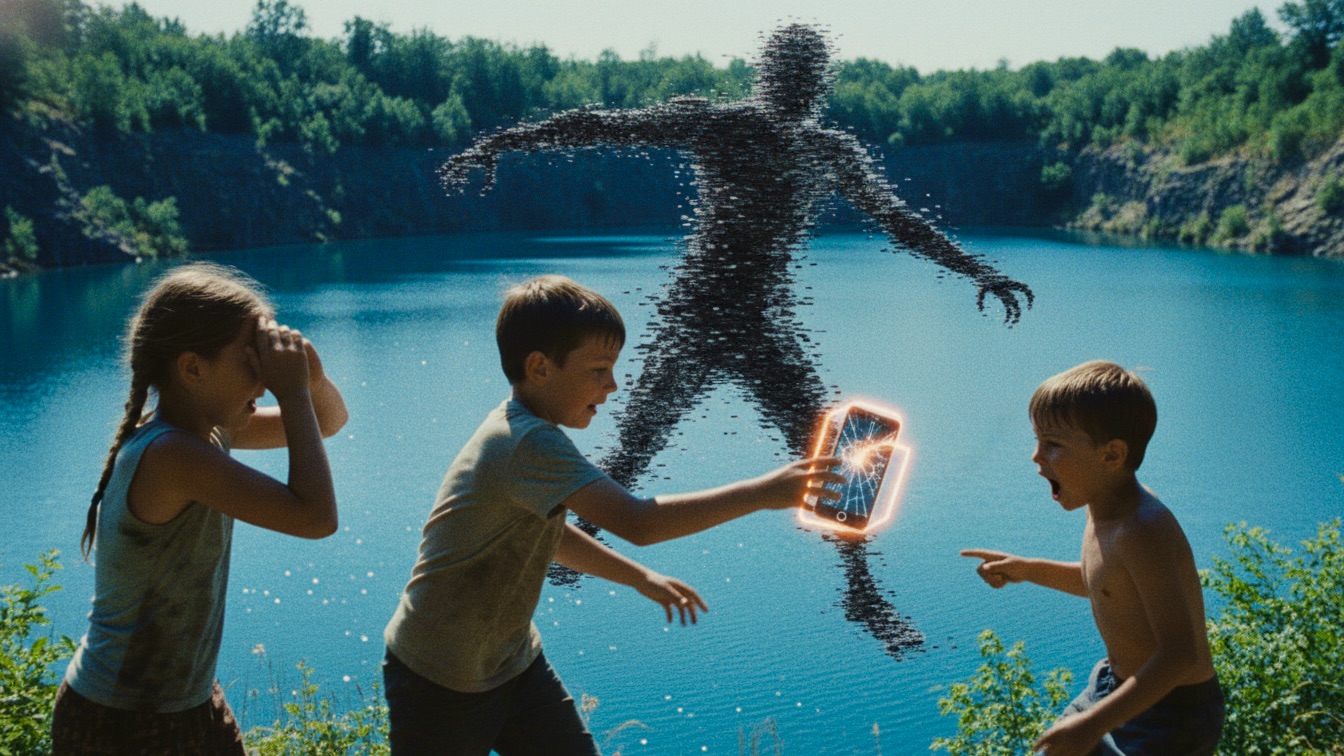
The story follows Art, a young boy attending Camp Green Heart, a "no-phone zone" where he has secretly smuggled his mobile device. While biking with his friends Mia and Toby, Art becomes increasingly distracted by the vibrations and heat emanating from the phone in his pocket. This digital intrusion manifests physically when a "Static Man," a creature composed of television-like noise and shadows, emerges from the woods to hunt them. The children flee to an old equipment shed, where the creature begins to "erase" the physical world, turning Art’s bike into a blurred, low-resolution mess.
To survive, Mia teaches the boys a grounding technique involving deep breathing and a resonant vocalization called "Voo." This biological frequency helps them become invisible to the digital monster, which thrives on electronic signals and fragmented attention. They eventually make a break for a nearby quarry, realizing that the natural patterns of the water and the woods act as a shield against the creature's chaotic nature. In a climactic moment of self-actualization, Art sacrifices his phone by throwing it into the deep water, lureing the Static Man to its destruction. Although the children return to camp feeling liberated, the final moments suggest that the digital haunting is not entirely defeated, as a familiar static sound hums from a cabin wall outlet.
The primary theme of the narrative is the conflict between digital overstimulation and biological grounding. The "Static Man" serves as a potent metaphor for the psychological toll of constant connectivity, representing the "trash" of signals and notifications that clutter the modern mind. By manifesting this noise as a physical monster that "erases" reality, the story suggests that excessive screen time leads to a loss of presence and a blurring of the physical world. The monster's inability to process natural fractals—like the patterns in leaves or ripples in water—highlights the restorative power of nature as a "reset button" for the human nervous system.
Another significant theme is the reclamation of agency through mindfulness. Art begins the story as a passive victim of his device, feeling his brain being "pulled by a string" toward the screen. His transition from a distracted, anxious child to a focused protagonist is achieved through sensory awareness. The "Voo" technique and the use of "soft eyes" represent psychological tools used to regulate the autonomic nervous system. These methods allow the characters to shift from a state of fight-or-flight into a state of "rest and digest," effectively making them incompatible with the predatory digital noise of the creature.
The story also touches upon the concept of digital environmentalism. Mia’s mother suggests that the world has become too "loud" with invisible signals, implying that human consciousness is being crowded out by technological waste. The creature is not an alien or a ghost in the traditional sense, but a "glitch" born from the excess of the modern age. This suggests a cautionary tale about the sustainability of our current relationship with technology. The ending reinforces this by showing that even when one device is destroyed, the infrastructure of the "noise" remains embedded in the very walls of our living spaces.
Art represents the modern struggle with digital addiction and the subsequent loss of focus. At the start of the chapter, he is physically present in nature but mentally tethered to his cargo shorts, where his phone hums like a "little brick." He experiences the "phantom buzz" phenomenon, illustrating how deeply the device has integrated into his biological self-perception. His journey is one of shedding this external identity, symbolized by the literal burning and eventual discarding of the phone. By the end of the story, he achieves a state of "clarity" that allows him to appreciate the complex beauty of a simple maple leaf.
Mia functions as the story’s psychological guide and the voice of intuitive wisdom. She is more connected to the environment than her peers, noticing dragonflies and natural patterns while Art is distracted by his pocket. She provides the necessary intervention when Art begins to spiral into a panic attack, using her knowledge of grounding techniques to save the group. Her character demonstrates that resilience in the digital age comes from a deliberate connection to the physical world. She is the anchor that prevents the boys from being consumed by the "glitch" of their own fear.
Toby serves as a representation of innocence and the heightened vulnerability of the very young in a high-tech world. As the smallest member of the group, he is the most physically and emotionally affected by the pursuit of the Static Man. His stumble near the end of the chase acts as a narrative catalyst, forcing Art to stop running and take a stand. Toby’s fear is pure and uncomplicated, highlighting the stakes of the conflict. He reminds the reader that the "noise" of the world is particularly threatening to those who have not yet developed the psychological defenses to tune it out.
The author employs a sensory-heavy prose style that emphasizes the contrast between the organic and the synthetic. The "hot lemon" sun and "electric saw" cicadas create an atmosphere of oppressive heat and noise, mirroring the internal pressure Art feels from his phone. These descriptions use familiar natural elements to introduce mechanical or uncomfortable sensations, preparing the reader for the arrival of the Static Man. The use of onomatopoeia, such as "clack-clack-clack" and "shhh-shhh-shhh," creates a rhythmic tension that mimics the intrusive nature of digital alerts.
Pacing in the chapter is expertly handled, moving from a slow, sweltering crawl to a frantic, "glitchy" chase sequence. The author uses short, punchy sentences during the action scenes to simulate the heart rate of the characters. This contrasts with the longer, more fluid descriptions of the water and the trees during the recovery phase at the quarry. This stylistic shift reflects the psychological state of the children, moving from the fragmented "static" of the chase to the smooth, "fractal" calm of the natural world.
The narrative voice effectively captures the "Uncanny Valley" through its description of the monster and the "erased" bike. By describing the creature as having "jagged edges like broken glass" and the bike as a "mistake," the author taps into a modern form of horror rooted in technological failure. The ending provides a chilling tonal shift, moving from the warmth of the mess hall to the cold, faint hum of the charging port. This final image leaves the reader with a sense of lingering dread, suggesting that while Art has changed, the digital "Static Man" is an inherent part of the modern landscape.


