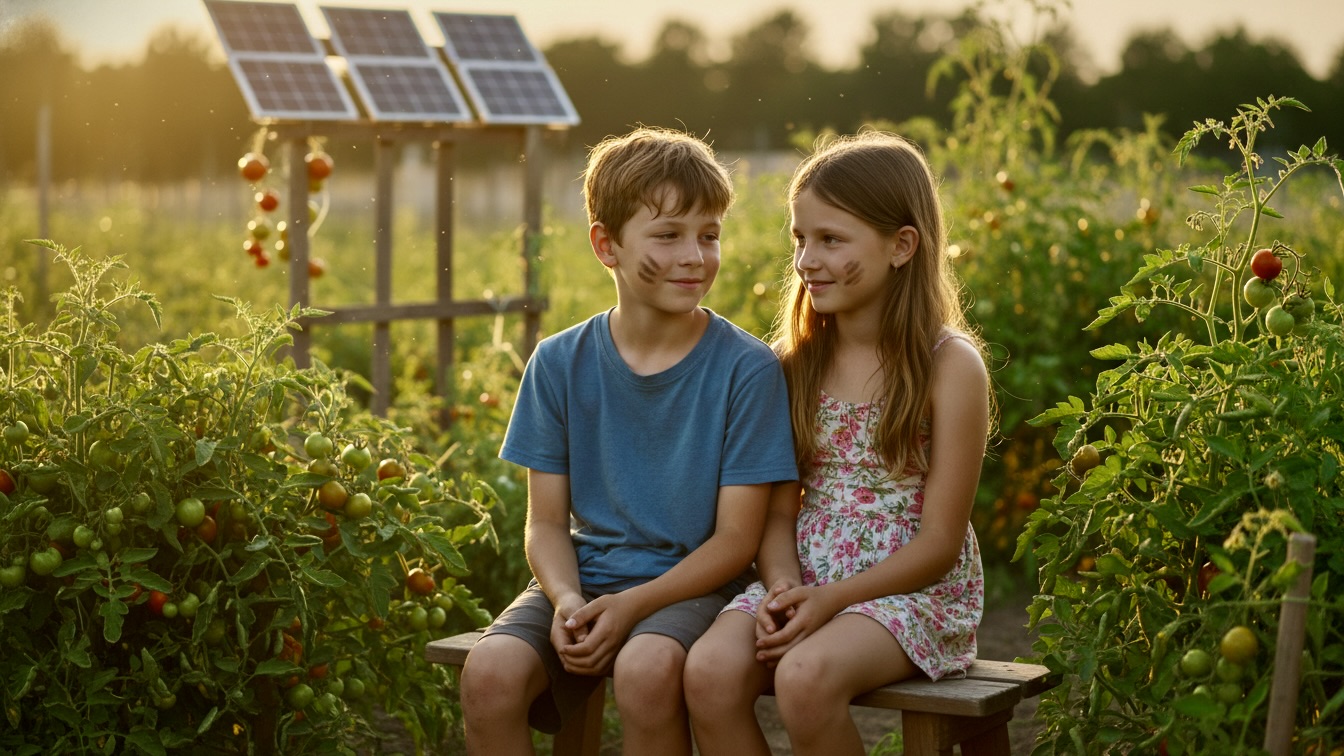
Format: Short Film / Anthology Episode | Est. Length: 10-12 minutes
Envision this story as a cornerstone of The Concrete Canopy, an anthology series exploring urban youth spearheading micro-level climate solutions in neglected city spaces. The series follows a rotating cast of "Climate Entrepreneurs" as they navigate the friction between high-tech aspirations and the gritty, low-tech reality of environmental maintenance. Overarching narrative arcs focus on the reclamation of urban land and the slow, arduous process of building community resilience against a backdrop of gentrification and rising temperatures.
Under a punishing July sun, two teenagers discover their solar-powered irrigation system is literally melting, threatening to incinerate the neighborhood’s only source of fresh produce.
When a record-breaking heatwave cripples their community garden’s technology, two unlikely friends must resort to grueling manual labor to save their heirloom crops. If they fail to keep the garden alive, the city will pave over their sanctuary to build luxury condos.
The primary theme explores the intersection of "High-Tech Dreams vs. Low-Tech Reality," highlighting how even the most advanced green energy solutions require human grit and physical labor to succeed. It examines the vulnerability of localized systems and the necessity of "Resilience through Redundancy," suggesting that community bonds are as vital as the hardware they protect.
The story also delves into "Youth Agency in the Climate Crisis," moving away from global despair toward tangible, local action. It portrays the garden not just as a source of food, but as a symbol of resistance against an increasingly hostile environment and the encroaching gray of urban development.
The immediate stakes involve the survival of Row C’s heirloom tomatoes, but the broader consequences are existential for the neighborhood. If the "Community Resilience Project" fails during its first major heatwave, the city will revoke the garden's charter and convert the lot into a parking garage for new luxury developments. For Leo and Maya, the garden represents their only escape from the concrete heat of the city and their primary source of purpose.
The primary antagonist is the "Heat Dome," an oppressive environmental force that turns the urban landscape into a furnace and causes the solar inverter to fail. Internal conflict arises from Leo’s desire for comfort and his feelings of inadequacy compared to Maya’s fierce, almost desperate commitment to the project. Secondary conflict is provided by the looming threat of urban development and the patronizing attitude of technical experts who underestimate the children's ingenuity.
In the sweltering heart of a city heatwave, Leo and Maya struggle to fix a warped solar inverter that has shut down their garden’s irrigation pump. As the temperature climbs to a hundred degrees, they realize the heirloom tomatoes—the crown jewel of Mr. Henderson’s community project—are minutes away from shriveling beyond repair. Faced with a "thermal cutoff" in their tech, the duo must abandon their roles as "Climate Entrepreneurs" and become manual laborers, hauling forty gallons of water by hand in a desperate race against the sun.
As they reach the limits of their physical endurance, Leo proposes a creative "evaporative cooling" hack using wet burlap sacks to lower the inverter's temperature. Their makeshift solution works briefly, bringing the pump back to life before a professional technician arrives to stabilize the system. Though their technical fix was temporary, their physical and mental resilience saves the crop, proving that the garden's true strength lies in the people who refuse to let it die.
Leo begins as a reluctant participant, more interested in snacks and air conditioning than the grueling demands of urban farming, hiding his anxiety behind humor and a feigned lack of technical knowledge. By the end of the episode, his "evaporative cooling" burlap sack idea proves his creative worth, and he transitions from a passive helper to a dedicated guardian of the green space.
Maya is the driven, high-strung visionary of the pair, carrying the weight of the garden’s future on her shoulders and masking her fear of failure with bossiness. Her arc involves learning to trust Leo’s unconventional problem-solving and finding a moment of peace amidst the chaos, realizing that her passion is what truly fuels the project’s resilience.
Jack is a supporting character, a tech-savvy teenager with a cynical edge who represents the "professional" side of climate resilience. While he initially mocks the children's low-tech efforts, his eventual acknowledgment of their hard work validates their struggle and highlights the necessity of both grit and expertise.
The story opens with the discovery of the "melting" inverter, establishing the oppressive heat and the immediate threat to Row C as the pump remains silent. Leo and Maya bicker over tools and the absurdity of their situation, but the tension spikes when Maya reveals the garden will be turned into a parking garage if they fail. This realization forces them into the grueling "Water Haul," a montage of physical exhaustion that highlights the staggering scale of the task they’ve undertaken.
The midpoint occurs when Leo hits a wall of heatstroke-induced despair, questioning if their small-scale efforts even matter in a world that is "really big and really hot." Maya’s fierce defense of the garden as the only "living" thing on the block inspires Leo to suggest the burlap cooling hack, shifting the narrative from desperate labor to creative problem-solving. They rig the wet sack "tent" around the inverter, and the sound of the pump whirring back to life provides a moment of high-stakes catharsis.
The climax arrives when the pump dies again and Jack, the cynical technician, enters to provide the final technical fix. While Jack handles the software, the emotional resolution comes when he admits that the children's manual labor was the "hard part" that actually saved the plants. The episode ends with Leo and Maya sitting in the dirt as the sun sets, watching the tomatoes recover and planning for a future that feels slightly more manageable.
The episode follows a "Descent and Ascent" trajectory, beginning with the frantic panic of a technical failure and descending into the physical exhaustion and hopelessness of manual labor. This low point transitions into a sense of communal triumph when the water finally flows, ending on a quiet, golden-hour resolution that emphasizes connection and hope. The audience experiences the visceral discomfort of the heat, followed by the cathartic relief of the irrigation system’s rhythmic "psst-psst-psst" sound.
If expanded, the season would follow Leo and Maya as they defend the garden against a series of escalating environmental and bureaucratic challenges, from localized flooding to a legal battle with the condo developers. Each episode would introduce a new "Climate Entrepreneur" from the neighborhood, building toward a season finale where the entire community must unite to transform the garden into a permanent, city-recognized "Resilience Hub."
Thematic escalation would move from simple survival to political advocacy, showing the characters growing from kids playing in the dirt to recognized leaders of an urban movement. The season-long arc would explore the idea that while technology can fail, the "social infrastructure" of a neighborhood—the relationships and shared goals—is the most resilient system of all.
The visual style utilizes a "Saturated Realism," with high-contrast lighting and a warm, amber color palette that makes the heat feel tangible and oppressive to the viewer. Close-up shots of sweat, cracked earth, and the "melting" plastic of the inverter create a sense of claustrophobia, which is later relieved by wide, cooling shots of the garden at sunset.
Tonal influences include the gritty urban optimism of The Florida Project blended with the youthful, tech-centric problem-solving of Halt and Catch Fire. The tone remains grounded and sincere, avoiding "after-school special" tropes by focusing on the physical reality of the work and the genuine chemistry between the leads.
The target audience is "Young Adult and Family," specifically viewers aged 10-18 and their parents, who are interested in environmental themes and social justice. It appeals to a "Climate-Conscious" demographic looking for stories that offer agency and practical hope rather than doomsday scenarios.
The pacing is "Accelerated Real-Time," designed to make the 10-12 minute runtime feel like a frantic race against a ticking clock. The first act moves quickly through the technical failure, the second act slows down to emphasize the grueling nature of the bucket brigade, and the third act ramps up for the "burlap hack" before settling into a lyrical, slow-paced denouement.
Production requires a high-sun location with a mix of industrial concrete and lush garden beds to emphasize the "urban oasis" aesthetic. Special attention must be paid to the "melting" inverter prop and the water-flow effects to ensure the stakes feel physically real.
The use of practical heat effects, such as lens flares and shimmering heat haze, will be essential to convey the atmospheric pressure without relying heavily on digital post-production. Sound design will play a critical role, contrasting the harsh, abrasive sounds of the cicadas and traffic with the soothing, rhythmic sounds of the working irrigation system.


