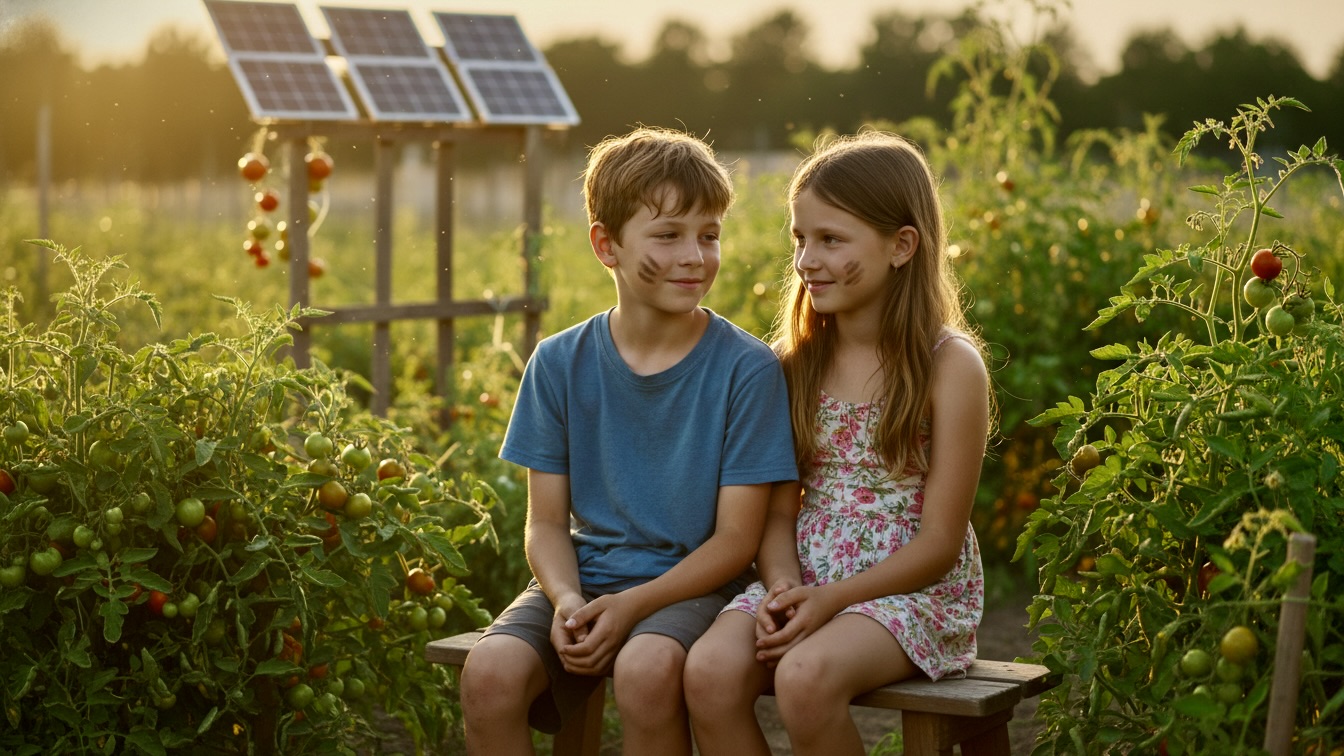
The story follows two young protagonists, Leo and Maya, as they struggle to maintain a community garden during a punishing July heatwave. The central conflict arises when the solar-powered irrigation system fails because the inverter begins to warp and overheat in the direct sun. Fearing for the survival of Mr. Henderson’s heirloom tomatoes and the future of the garden lot itself, the pair attempts to water the plants manually. This grueling labor pushes them to their physical limits, highlighting the stakes of their "Climate Entrepreneur" roles.
In an effort to fix the machinery, Leo suggests a creative solution involving evaporative cooling by draping wet burlap over the inverter. While his makeshift "outdoor AC" successfully restarts the pump for a brief period, the system eventually fails again due to a tripped breaker. A tech-savvy teenager named Jack eventually arrives to provide a professional fix, adjusting the internal settings to handle the extreme temperatures. Despite the brief blow to their egos, the chapter concludes with the garden receiving its necessary hydration and the two friends sharing a moment of quiet triumph as the sun sets.
The narrative primarily explores the theme of climate resilience through the lens of youthful idealism clashing with harsh environmental realities. The "Melted Tomato Project" serves as a microcosm for the larger global struggle against rising temperatures. By focusing on a small urban garden, the story emphasizes that climate action is often unglamorous, involving physical exhaustion and the constant threat of mechanical failure. The recurring mention of the "Climate Entrepreneurs of the Future" suggests a burden placed on the younger generation to solve problems they did not create.
Another significant theme is the tension between human ingenuity and technological limitations. The solar inverter, designed to be a "green" solution, ironically fails because of the very sun it is meant to harness. This paradox highlights the vulnerability of current infrastructure to extreme weather events. Leo and Maya’s transition from high-tech reliance to "medieval" manual labor and then to creative improvisation illustrates the necessity of adaptability. It suggests that while technology is vital, human persistence and "out-of-the-box" thinking are the true drivers of survival.
Finally, the story touches on the psychological impact of ecological anxiety on children. Maya’s fear that the city will reclaim the lot for a parking garage if they fail reveals a deep-seated insecurity about the stability of her environment. The garden represents more than just food; it is a "proof of concept" for their ability to exist independently of a failing grid. Their emotional investment in the heirloom tomatoes reflects a desire to preserve beauty and life in a world that feels increasingly "gray and black."
Leo functions as the story’s grounding force, utilizing humor and a self-deprecating attitude to cope with the physical demands of the garden. He initially appears reluctant, complaining about the heat and the lack of snacks, which suggests a typical adolescent desire for comfort. However, his internal motivation is revealed through his loyalty to Maya and his genuine concern for Mr. Henderson. He does not want to be the cause of an old man's tears, indicating a high level of empathy hidden beneath his cargo shorts and sweaty exterior.
Psychologically, Leo demonstrates a "growth mindset" when he moves from complaining to active problem-solving. His idea to use evaporative cooling shows a capacity for lateral thinking and a willingness to experiment despite the risk of failure. He experiences a brief moment of professional jealousy when Jack arrives, feeling that his "Climate Entrepreneur" title has been revoked. Ultimately, his sense of worth is restored not by the machinery, but by the shared success of keeping the plants alive.
Maya is the ideological leader of the duo, driven by a fierce sense of responsibility and a looming fear of failure. She is characterized by her intensity, which is visually represented by the "war paint" of soil on her forehead. Unlike Leo, she is deeply attuned to the political and social stakes of their project, frequently referencing her father’s warnings about the city’s developers. This suggests that she carries a heavy psychological burden, perhaps feeling that she is the only thing standing between the garden and a parking garage.
Her perfectionism and "bossy" demeanor are defense mechanisms against the chaos of the environment. She uses the manual and the garden charter as anchors to provide a sense of order in a situation that feels out of control. Despite her rigid adherence to the rules, she shows vulnerability in her exhaustion and her eventual acceptance of Leo’s unorthodox cooling plan. Her final moment of leaning on Leo’s shoulder signifies a release of tension, showing that she values the human connection as much as the ecological success.
Jack serves as a brief but important foil to the protagonists, representing the "professional" side of climate resilience. His neon-green hair and "COMPUTE OR DIE" shirt signal his identity as a digital native who views the garden as a technical problem rather than a moral mission. He acts with a sense of superiority, dismissing Leo and Maya’s efforts as "medieval" and "stupid." This arrogance creates a momentary rift in the protagonists' sense of agency, making them feel small and ineffective.
However, Jack’s character also provides a necessary validation of the children's efforts. By admitting that their burlap idea was "creative" and that their manual labor was "brutal," he acknowledges the grit required to maintain the garden. He represents the bridge between youthful passion and the technical expertise required to sustain long-term systems. His intervention allows the story to reach a resolution that is realistic, showing that while heart is necessary, technical skill is also a requirement for modern resilience.
The author employs vivid sensory imagery to immerse the reader in the oppressive atmosphere of the heatwave. Descriptions of the sun "poking him in the eyeballs" and the ground having cracks like a "giant puzzle" create a visceral sense of discomfort. The auditory details, such as the "screaming" cicadas and the "metallic sound" of tools, heighten the tension of the scene. These choices effectively mirror the characters' physical and mental strain, making the reader feel the urgency of the failing irrigation system.
The pacing of the narrative is carefully managed to reflect the transition from frantic panic to rhythmic exhaustion. The middle section, titled "Forty-Two Gallons," slows the tempo of the story through repetitive descriptions of the long walk to the rain barrel. This deliberate slowing down mimics the "saltwater taffy" feeling in Leo’s arms and the sluggishness of a body under heatstroke. When the pump finally whirs back to life, the prose regains its energy, using shorter sentences and more active verbs to convey excitement.
The tone of the story strikes a delicate balance between coming-of-age charm and existential dread. The dialogue between Leo and Maya is filled with the playful bickering of close friends, which provides a lighthearted contrast to the "high-pressure dome" of the climate. The use of metaphors, such as the tomatoes looking like "dead spiders" or the inverter having a "brain freeze," makes the complex issues of climate change accessible. This stylistic blend allows the story to feel both intimate and significant, framing a small afternoon task as a heroic struggle for the future.


