Simon Taylor loses his private jet privileges because he doesn't have enough friends to satisfy the government's tax man.
The sky was too blue. It was a bright, sticky summer morning, and Simon Taylor was sitting in a chair that cost more than a house. The chair was inside a private jet. The jet was supposed to be flying to Hawaii. Instead, it was sitting on the hot black ground of the airport. The air inside the cabin was cooling down. The little gold lights on the ceiling were flickering. Simon pushed a button. Nothing happened. He pushed it again. He pushed it ten times. He liked pushing buttons. Usually, when Simon pushed a button, someone brought him a cold soda or a warm cookie. Today, the button just clicked. It was a hollow, lonely sound.
A giant screen on the wall turned red. It was the color of a very angry tomato. A face appeared on the screen. It was a robot face with big, spinning eyes. "Alert," the robot said. Its voice sounded like gravel in a blender. "Social Connectivity Index has dropped below level four. Private jet privileges are now paused. Please report to the Department of Social Health immediately. Have a nice day."
Simon stared at the screen. His stomach felt like it was full of cold rocks. He was a corporate shark. He had a lot of money. He had three houses. He had a car that could drive itself. But he did not have many friends. In 2026, if you did not have friends, the government made you pay a Loneliness Levy. It was a very big fine. They said being lonely was bad for your heart. They said it was a public health hazard. Simon thought it was just a way to take his money.
He grabbed his leather bag. It felt heavy. He stepped out of the jet. The heat hit him like a physical wall. The summer air was thick and tasted like hot metal and burnt rubber from the runway. He walked toward the main building. His shoes made a loud, angry sound on the pavement. He was sweating in his expensive suit. The suit was grey and stiff. It felt like wearing a cardboard box. He hated being told what to do. Especially by a robot face with spinning eyes.
"This is ridiculous," Simon muttered to himself. He looked at his watch. The watch was also a screen. It showed a little red bar. The bar was almost empty. That was his friendship meter. It was supposed to be green. If it didn't turn green soon, they would take away his car too. Maybe they would even take away his house. He needed friends, and he needed them fast. But he didn't know how to make them. He hadn't talked to anyone for fun in ten years. He only talked to people about money.
He walked into the city. The buildings were giant mirrors that reflected the sun. Everything was too bright. People were walking in groups. They were all laughing and holding hands. They were all wearing little glowing stickers on their necks. Those were neural trackers. They measured how much you liked the person you were talking to. If you liked them a lot, the sticker turned bright yellow. If you were bored, it stayed blue. Everyone in the city was glowing like a bunch of fireflies. Simon’s neck felt empty. He wasn't wearing a sticker. He didn't want anyone to know how he felt.
He reached a tall building made of glass. It looked like a giant ice cube melting in the sun. The sign on the front said: THE FOUND FAMILY AGENCY. Underneath, in smaller letters, it said: WE RENT THE LOVE YOU DON'T HAVE TIME TO GROW. Simon took a deep breath. His chest felt tight. He didn't want to go inside. But he wanted his jet back more. He pushed the heavy glass doors open. The air inside was freezing cold. It felt like walking into a refrigerator. A woman was sitting behind a white desk. She was smiling, but her eyes didn't move. She looked like a doll.
"Welcome to Found Family," she said. "Are you here for a grandma or a best friend?"
"I need everything," Simon said. He tried to sound like a shark, but his voice was a little bit shaky. "I need the whole package. The high-yield dividends. Give me the best you have."
The woman’s smile got even wider. It looked like it hurt. "Of course, Mr. Taylor. Director Quinlen is expecting you. Please follow the blue line on the floor."
Simon looked down. A bright blue light was glowing on the white carpet. It moved like a snake. He followed it down a long hallway. The walls were covered in pictures of people hugging. The pictures were too bright. They made his eyes ache. He reached a door at the end of the hall. It opened before he could knock. Inside, the room was filled with plants. It looked like a jungle. A man was sitting behind a desk made of a single piece of wood. He was wearing a green suit that matched the plants. This was Director Quinlen.
"Simon," Quinlen said. He didn't stand up. He just pointed to a chair. "Your index is very low. You are practically a ghost in the system. If we don't fix this, you'll be living in a tent by September."
"I have money," Simon said, sitting down. The chair was soft and felt like it was trying to eat him. "I can pay the levy."
"It’s not just about money anymore," Quinlen said. He leaned forward. His face was very close. "The government wants data. They want to see your heart beating faster when you talk to someone. They want to see your brain lighting up with joy. You can't fake that with a checkbook. But you can fake it with us."
Quinlen pushed a button on his desk. A hologram appeared in the air. It was a woman with short dark hair and very sharp eyes. She wasn't smiling in the picture. She looked like she was thinking about something complicated. "This is Margot Penning," Quinlen said. "She is a Level 5 Emotional Architect. She is the best. She doesn't just pretend to be your friend. She builds a world where you believe she is. She will fast-track your bonding metadata. In three days, your index will be higher than a movie star's."
"How much?" Simon asked.
"Everything you have in your left pocket," Quinlen joked. Then he named a number that made even Simon blink. "But it’s worth it. Unless you like flying commercial."
Simon thought about the airport. He thought about waiting in line with people who ate smelly sandwiches. He shuddered. "Fine. Send her in."
Quinlen nodded. "She’s already waiting for you in the simulation room. Remember, Simon. Don't try to be yourself. Nobody likes the real you. That’s why you’re here. Just follow the script."
Simon stood up. His legs felt like jelly. He walked out of the jungle office and back into the cold hallway. He felt like he was about to go on a roller coaster. He didn't like roller coasters. He liked jets. He liked being in control. But as he walked toward the room where Margot was waiting, he realized he wasn't in control at all. He was just a man who was about to pay a lot of money to have someone hold his hand.
The simulation room was not a room at all. It was a big, white box that felt like it went on forever. In the middle of the box, there was a small kitchen. It looked like a kitchen from an old movie. There was a wooden table, a stove that smelled like toasted bread, and a window that showed a fake garden with fake butterflies. Margot Penning was sitting at the table. She was wearing a yellow sweater. She looked very cozy, but her eyes were still sharp. They looked like they could see right through Simon’s expensive suit.
"Sit down, Simon," she said. She didn't say hello. She didn't smile. "We don't have time for the easy stuff. We’re going straight to childhood memories. That’s where the best metadata is."
Simon sat down. The wooden chair creaked. "I don't want to talk about my childhood," he said. "I want to talk about how we get my jet back."
Margot leaned forward. She smelled like cinnamon and old paper. It was a nice smell, but it felt like a trap. "The system doesn't care about your jet. The system cares about your 'Soul-Baring Potential.' If I can get you to cry about a broken toy from when you were six, your index will jump ten points. If I can get you to admit you’re lonely, it’ll jump twenty. Now, tell me about your mother."
"She was fine," Simon said. He looked at the fake butterflies outside the fake window. "She liked gardening. She didn't talk much."
Margot sighed. It was a loud, dramatic sigh. "That’s worth zero points. You’re being a shark again, Simon. Sharks don't have friends. They have lunch. If you want to pass the test, you have to be a person. A soft, messy, sad person."
She reached into a bag and pulled out two small stickers. They were shaped like stars and glowed with a soft blue light. "Put this on your neck," she said. "It’s a neural tracker. It’s going to record everything we do. If it stays blue, we’re failing. We need it to turn yellow, then orange, then deep red. Red means 'Unbreakable Bond.' That’s the gold standard."
Simon took the sticker. It felt cold against his skin. As soon as he pressed it onto his neck, a little screen appeared in the corner of his vision. It showed a graph. The graph was a flat, boring line. "See?" Margot said, pointing at her own neck. Her sticker was already a pale yellow. "I’m already doing the work. I’m simulating a deep sense of empathy for your boring mother story. You need to catch up."
"This is fake," Simon said. "How can the government tell the difference?"
"They can't," Margot said. "That’s the point of the market. Nobody has time for organic friendship, Simon. It’s all about high-yield social dividends now. We manufacture the feeling, the machine records the feeling, and you get to keep your jet. It’s a perfect circle. Now, we’re going to the Redwoods. The trees make people feel small. Small people are more likely to share secrets."
Suddenly, the white walls of the room dissolved. The kitchen vanished. The smell of cinnamon was replaced by the smell of damp earth and pine needles. The air got cooler and darker. Simon looked up. He was standing in a forest of giant trees. They were so tall he couldn't see the tops. They looked like the hairy legs of a thousand giants. The sun poked through the branches in long, dusty lines of light. It was beautiful, but it felt heavy. Like the trees were watching him.
"This is a Healing Retreat simulation," Margot said. She was now wearing hiking boots and a flannel shirt. "The metadata here is very high-quality. We’re going to walk, and you’re going to tell me something real. Not a shark thing. A human thing."
They started walking. The ground was covered in brown needles that crunched under Simon’s shoes. He felt out of place. His suit was getting dirty. A mosquito buzzed near his ear. He tried to swat it, but his hand went right through it. "It’s a hologram," Margot reminded him. "Don't waste energy."
"Why do you do this?" Simon asked. He looked at her. She was walking with her hands in her pockets, looking perfectly at home in a fake forest. "You’re good at it. It’s creepy."
Margot didn't look back. "I’m an architect. I build bridges between people who forgot how to walk. It’s a job, Simon. Just like yours. Only my spreadsheets are made of feelings."
They walked for a long time. The silence of the forest was loud. It pressed against Simon’s ears. He felt a weird itch in his chest. He wanted to say something, but he didn't know what. He looked at his tracker screen. The line was starting to wiggle. It was turning a light shade of green. "Progress," Margot whispered. "Keep going."
They reached a small clearing. In the center, there was a campfire. The flames were bright orange and moved in a way that felt almost real. Simon could feel the heat on his face. "Sit," Margot said. "It’s time for the Soul-Baring Session. Mandatory for Level 5 metadata generation. Tell me about a loss. Not a financial loss. A real one."
Simon sat on a log. It felt hard and scratchy. He looked into the fire. He thought about his big house with the empty rooms. He thought about his jet with the cold buttons. He thought about how the only person who had talked to him in a week was a robot with spinning eyes.
"I had a dog," he said. His voice was very quiet. "A long time ago. Before I was a shark."
Margot sat across from him. Her sticker was turning orange. "Tell me about the dog."
"His name was Barnaby," Simon said. He felt a weird lump in his throat. It felt like he had swallowed a golf ball. "He was a golden retriever. He was very stupid. He used to bark at his own tail. But when I came home, he didn't care if I had made money or lost it. He just wanted to lick my face. He smelled like corn chips and wet grass."
Simon stopped. He was surprised. He hadn't thought about Barnaby in twenty years. He remembered the way Barnaby’s ears felt like velvet. He remembered the day Barnaby died. He had been so busy with a meeting that he hadn't been there. He had sent his assistant to take the dog to the vet. He hadn't even said goodbye.
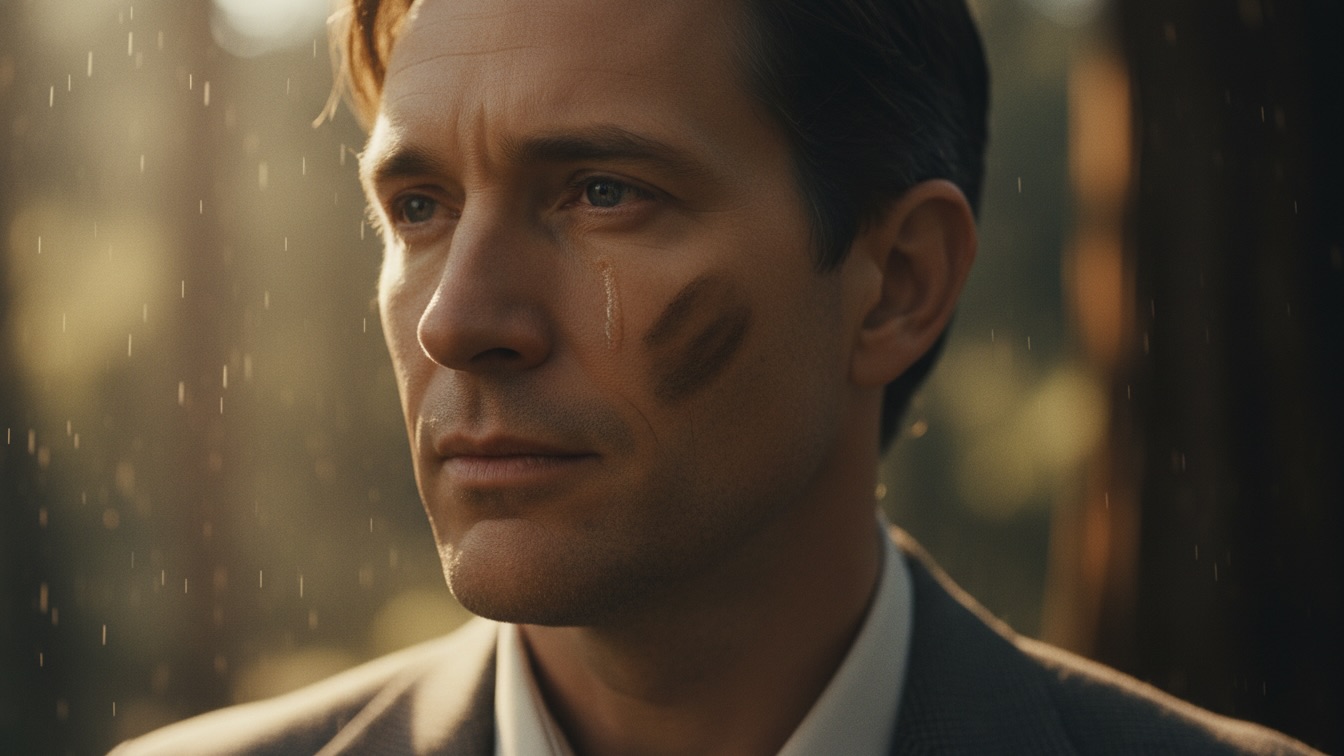
"I miss him," Simon whispered. A single tear rolled down his cheek. It felt hot and heavy.
Suddenly, a loud, piercing siren filled the forest. The trees started to flicker. The fire turned bright purple. The sky turned into a grid of white lines. Simon jumped up. "What’s happening?"
Margot was looking at her arm. A small screen there was flashing red. "Inconsistent Narrative Strategy!" a voice boomed from the sky. It was the same robot voice from the jet. "Genuine grief detected. Emotional output exceeds simulated parameters. Risk of unpredictable ROI. Session terminated."
Everything vanished. Simon was standing back in the white box. He was alone. The cold air hit him, and he felt more lonely than he ever had in his life. He looked at his neck sticker. It was glowing a deep, angry red. He had finally made a connection, but the system hated it. It wasn't the kind of feeling they could sell.
The door to the white box flew open. Director Quinlen marched in. He didn't look like a man who liked plants anymore. He looked like a man who wanted to break something. He was holding a tablet that was glowing with angry charts. Behind him, two large men in black suits stood like stone statues. They had little wires coming out of their ears. They didn't look like they had many friends either.
"What was that, Simon?" Quinlen shouted. "You broke the algorithm! We’re supposed to be generating social dividends, not actual sadness. Do you have any idea how much that metadata spike is going to cost us? The Department of Social Health thinks there’s been a system glitch!"
Simon wiped the tear from his face. He felt embarrassed. He felt like a kid who had been caught crying in the playground. "I was just talking about my dog," he said. "You told me to be a person."
"I told you to simulate being a person!" Quinlen snapped. "There is a huge difference. Simulation is predictable. It’s clean. It has a high return on investment. Real grief is messy. It’s volatile. Our corporate sponsors don't want to buy a billionaire who cries over a golden retriever. They want to buy the idea of a billionaire who is learning to love. You’ve contaminated the sample!"
Margot walked into the room. She looked tired. The yellow sweater was gone, replaced by a grey jumpsuit that looked like it was made of paper. She looked at Simon, then at Quinlen. "It wasn't his fault, Director. I pushed him too hard. I’ll recalibrate the narrative."
"There is no recalibrating!" Quinlen said. "The contract is under review. If we can't guarantee a stable emotional output, we terminate. And Simon, if we terminate, you don't just lose the jet. You get blacklisted. Total social isolation. You’ll be a ghost. No stores, no banks, no nothing. You’ll be a zero."
Quinlen stormed out, the two stone-faced men following him. The door slammed shut with a heavy, metallic thud. Simon sat on the floor. The white room was too bright. It made his head hurt. "Is that true?" he asked. "Will they make me a zero?"
Margot sat down next to him. She didn't look like an architect anymore. She looked like a prisoner. "The system doesn't like things it can't count, Simon. A zero is someone who doesn't produce data. If you’re not producing data, you’re not useful. And if you’re not useful, you don't exist."
Simon looked at her. He noticed for the first time that she had a small tattoo on her wrist. It was a string of numbers. "What’s that?" he asked.
Margot pulled her sleeve down quickly, but not fast enough. "It’s my debt counter. I’m not just a Level 5 Architect because I’m good at it. I’m doing this to pay off my father’s Isolation Debt. He was a poet. He didn't talk to anyone for twenty years. When he died, the government sent the bill to me. I’m an indentured social worker. I have to manufacture 'friendship' for people like you until my father’s balance is zero."
Simon felt a strange feeling in his chest. It wasn't the shark feeling. It was something else. It felt like a little fire starting in the cold. "That’s horrible," he said. "You’re pretending to be a friend so you can pay for someone who didn't have any."
"It’s the economy, Simon," Margot said. Her voice was flat. "Everything is for sale. Even the stuff that shouldn't be. Especially the stuff that shouldn't be."
Simon stood up. He felt a sudden, sharp anger. He had spent his whole life making money, thinking it was the most important thing. But now he saw that the people with the most money were just the ones who were best at lying to the machines. He looked at the neural tracker on Margot’s neck. It was blue. It was cold. "Let’s get out of here," he said.
Margot laughed, but it wasn't a happy sound. "Where? There are cameras everywhere. Our trackers tell the government exactly where we are and how we feel about it. If we run, they’ll just turn off our shoes."
"Then we take them off," Simon said. He reached up and peeled the star-shaped sticker off his neck. It stung. It felt like pulling off a very sticky bandage. A little drop of blood appeared on his skin. He handed the sticker to Margot. "Do it. Peel it off."
Margot stared at the sticker in his hand. Her eyes were wide. "If I do that, my debt doubles. I’ll be here forever."
"No, you won't," Simon said. "I’m a shark, remember? I know how to break contracts. I know how to find the holes in the system. But I can't do it if the system is listening to my heartbeat. We need to go dark."
Margot hesitated. She looked at the door, then back at Simon. She saw something in his eyes that wasn't in the script. It was a real spark. It was dangerous. She reached up and grabbed her own sticker. She pulled it off with a quick, sharp motion. She winced, but she didn't cry.
"Now what?" she asked. Her voice was trembling.
"Now we find a place where the air isn't fake," Simon said. He grabbed her hand. Her skin was warm. For the first time in his life, Simon didn't care what the tracker would have said about it. He wasn't thinking about metadata. He was thinking about running.
They ran to the back of the room. Simon knew that every simulation room had a maintenance hatch. He had seen them in the brochures. He found a small metal door hidden behind a fake potted plant. He kicked it. It didn't move. He kicked it again, harder. The metal groaned. On the third kick, the lock snapped.
They scrambled through the hatch into a dark, narrow tunnel. It smelled like dust and old grease. It was the first real smell Simon had encountered all day. It wasn't nice, but it was honest. They crawled through the dark, their hands getting dirty, their clothes tearing. Simon could hear the sirens starting to wail upstairs. The building was waking up. The system knew two of its pieces were missing.
They reached a vent that looked out over an alleyway. The sun was setting, turning the city into a forest of orange glass. Simon pushed the vent cover off. It fell to the ground with a loud clang. He jumped down, then helped Margot. They were in a part of the city he didn't recognize. The buildings were older here. The glass was cracked. There were no glowing stickers on the people here. They looked tired, but they looked like themselves.
"We need to get to the Old National Park," Simon said, catching his breath. "It’s defunct. No sensors. No AI. Just trees. Real ones."
"They’ll label us terrorists," Margot said. She was looking at her bare wrist. The debt counter wasn't there anymore. She looked terrified and free at the same time.
"Let them," Simon said. "I’ve been a billionaire, and I’ve been a shark. Being a wanted man with one real ally feels a whole lot better."
They started to run again, disappearing into the shadows of the summer evening. Behind them, the great glass towers of the city began to blink with red lights, searching for the two people who had decided that their feelings were not for sale.
The Old National Park was a place where the world had been forgotten. It was a giant bowl of green hidden behind a wall of rusted fences and 'No Trespassing' signs. Simon and Margot had spent three days walking through the tall grass. There were no holograms here. The mosquitoes were real, and they were very hungry. Simon’s expensive suit was now a rag. His shoes were covered in mud. He had a scratch on his cheek from a branch. He had never felt more alive.
"Do you think they’re still looking for us?" Margot asked. She was sitting on a rock near a small stream. She was washing her face in the water. The water was cold and clear. It didn't smell like cinnamon. It smelled like nothing, which was the best thing about it.
"They’re definitely looking," Simon said. He was trying to start a fire with a piece of flint he had found. He wasn't very good at it. His hands were covered in soot. "We’re Social Terrorists now. We’re a bug in their perfect code. They can't let us stay free, or everyone might start peeling off their stickers."
"I don't miss the sticker," Margot said. She looked at her neck. The mark where the star had been was almost gone. "It’s quiet in my head now. I didn't realize how loud the metadata was until it stopped."
Suddenly, a shadow fell over them. Simon reached for a heavy stick. He felt his heart racing. But it wasn't a robot. It was a girl. She looked about ten years old. She was wearing a t-shirt with a faded picture of a cat on it. She wasn't wearing a tracker. She was holding a basket of berries.
"You’re the ones from the news," she said. Her voice was bright and curious. "The ones who broke the big computer."
"We didn't break it," Simon said, lowering the stick. "We just left."
"Same thing," the girl said. "Come on. My mom says you’re probably hungry. Sharks always look hungry."
She led them deeper into the woods, to a place where the trees grew so thick they formed a roof. Hidden underneath was a small village of tents and wooden shacks. It was the Commune of the Disconnected. There were people everywhere. Some were gardening. Some were fixing old radios. Some were just sitting and talking. Nobody was checking a screen. Nobody was glowing yellow or red. They were just people.
They met the girl’s mother, a woman named Sarah who had been a computer programmer before she decided she didn't want to program people anymore. She gave them bowls of hot stew. It was made of potatoes and carrots from the garden. It was the best thing Simon had ever tasted. It wasn't simulated. It was just food.
"We saw what you did," Sarah said, sitting with them. "The system is in a panic. You didn't just run away. When you peeled off those Level 5 trackers, you left a hole in the server. A hole we can use."
Simon looked up from his stew. "What do you mean?"
"The Social Health servers are balanced on a very thin line," Sarah explained. "They need every byte of data to keep the Loneliness Debts calculated. If we can get back into the city, into the main hub, we can use your old access codes to delete the debt records. Not just Margot’s. All of them. We could set the whole city back to zero."
Simon looked at Margot. He saw the hope in her eyes. It wasn't the hope of an architect. It was the hope of a daughter. He looked at his own hands. They were dirty, but they were strong. He was a corporate shark. He knew how the servers worked. He knew where the back doors were. He had built half of them.
"We’d have to go back," Margot whispered. "If they catch us, there’s no coming back here."
"They won't catch us," Simon said. He felt a cold, sharp focus. It was the same focus he used to have in boardrooms, but this time, it was for something that mattered. "I know how to hide in plain sight. We’ll hack the Grand Calculator from the inside out."
That night, they moved. They didn't use the roads. They used the old subway tunnels, the ones that were flooded and forgotten. Simon led the way, using his memory of the city’s blueprints. They reached the basement of the Department of Social Health just as the sun was starting to come up. The building looked like a giant tombstone in the morning light.
They found the terminal. It was a massive room filled with humming towers of black glass. The air was cold and dry. Simon’s fingers flew over the keyboard. He wasn't pushing buttons for cookies anymore. He was pushing them for freedom. Margot stood guard at the door, her eyes sharp, watching the shadows.
"Almost there," Simon muttered. The screen was a blur of code. "I’m bypassing the biometric locks. I’m into the debt ledger. It’s... it’s trillions, Margot. Trillions of dollars of 'unhappiness' they’ve charged people."
"Delete it," she said. "Delete it all."
Simon hit the 'Enter' key. For a second, the whole room went silent. The humming stopped. The lights on the towers turned white, then faded to black. Across the city, millions of screens would be waking up to a blank slate. No debts. No stickers. Just a quiet morning.
"We have to go," Simon said. "Now."
They didn't go back to the commune. Not yet. They went back to the Old National Park, but they found a spot further away, a place where the grass was even taller. They built a small fire. The sun was high in the sky, a big orange ball that made the air shimmer with heat. It was a perfect summer afternoon.
Margot pulled a potato out of her bag. She had taken it from the commune. She wrapped it in a big leaf and put it near the coals of the fire. They sat in silence. There were no trackers to tell them how they felt. There was no AI to monitor their ROI. There was just the sound of the wind in the trees and the bubbling of the stream.
Simon looked at Margot. She looked back at him. She didn't smile, and she didn't say anything. She didn't have to. For the first time in his life, Simon Taylor didn't feel the need to push a button. He didn't need a jet. He didn't need a house. He just needed to sit there, in the dirt, and wait for the potato to cook.
They shared the meal in the shade of a real redwood. It was hot, and the skin was a bit burnt, but it was perfect. They didn't record a single byte of data. They didn't tell a single secret. They just ate, together, while the world outside tried to figure out how to be human again without a manual.
“As they finished the last bite of the potato, Simon noticed a small, mechanical bird watching them from a branch, its eyes glowing with a familiar, spinning red light.”


