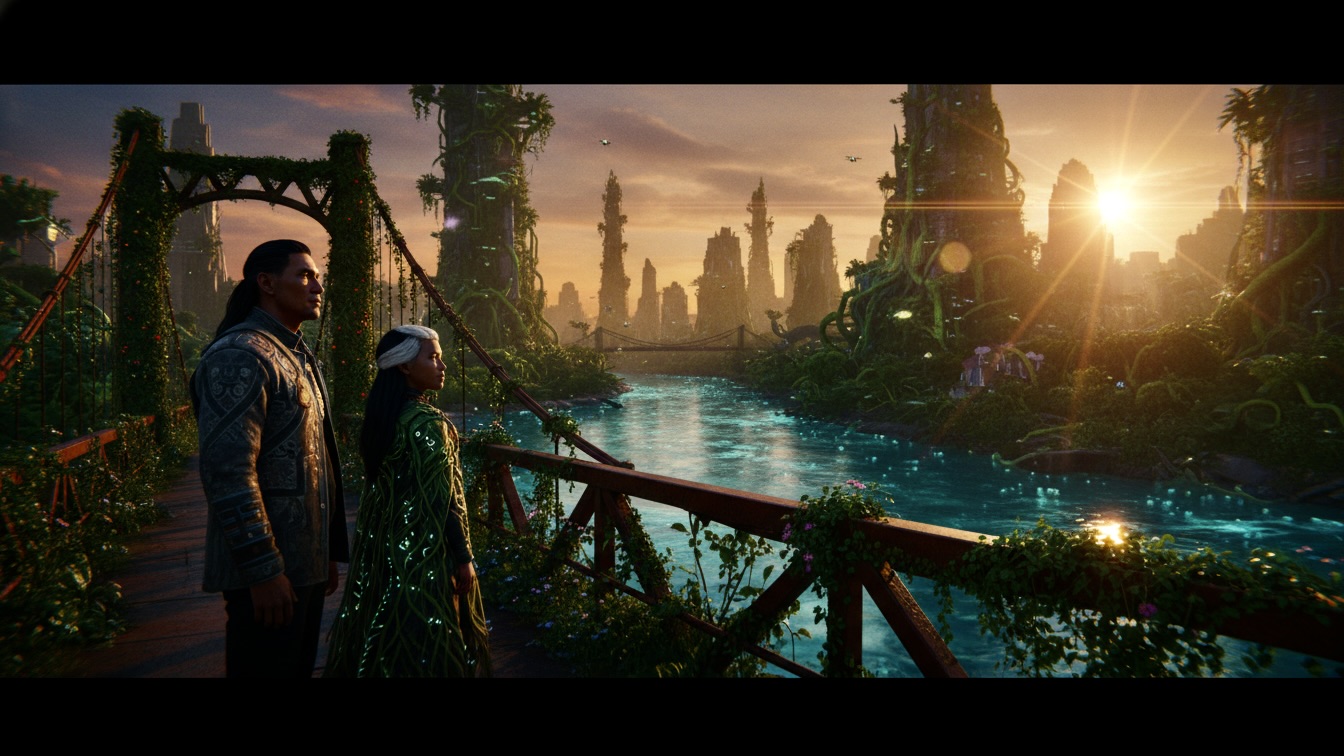
In a drowned Winnipeg, Evan finds a lost terraforming node that could heal the river or save his family.
The heat in Winnipeg didn’t just sit. It pressed. It was the kind of humidity that felt like wearing a wet wool blanket in a sauna. Evan wiped sweat from his forehead with the back of a grease-stained hand. He stood behind a folding table made of salvaged plywood and rusted steel. This was his space. Rez-Cycle. It wasn't much, just a patch of mud at the Punk Rock Flea Market, but it was theirs. The market was a sprawling mess of shipping containers and tarp-covered stalls tucked under the skeleton of the old Disraeli Bridge. Below them, the Red River churned. It wasn't the brown water of his grandfather’s stories. It was a sick, pulsing red. Bioluminescent algae, a gift from the last decade of corporate runoff and heatwaves, choked the flow. It looked like a vein of open blood cutting through the city.
"Water?" Malaya asked. She didn't look up from her tablet. She was nineteen, her hair shaved on one side, the other side a shock of bleached white. She was fast with a soldering iron and faster with a code-breaker. She was also perpetually unimpressed.
"Later," Evan said. He adjusted a row of 'ghost-tech'—old smartphones with cracked screens, copper coils salvaged from defunct streetlights, and a few 2010s-era game consoles he’d managed to refurbish. "We need a sale first. The lot fee is due by five."
"The river is high today," Malaya said. She finally looked up, her eyes tracking the movement of the red sludge. "Algae’s peaking. If it hits the banks, the smell is going to kill the foot traffic."
"It’s already hitting the banks," Evan muttered. The scent of wet, sun-baked asphalt mixed with the sharp, metallic tang of the algae. It wasn't just a smell; it was a physical weight in the lungs. He felt the vibration of the city above them, the heavy hum of the mag-lev trains crossing the bridge, a sound that never stopped. It was the sound of people going somewhere else. Somewhere cleaner.
He moved a vintage Nintendo DS to the front of the display. It was a relic, a piece of plastic from a time when people didn't have to worry about the water table being toxic. It was a toy for a ghost world. A teenager wandered into the stall. The kid looked like he’d been dragged through a hedge. His jeans were shredded, and he wore a hoodie despite the thirty-degree heat. He looked twitchy. Nervous. He wasn't looking at the tech. He was looking at Evan.
"You take trades?" the kid asked. His voice was thin, cracking under the pressure of the heat.
"Depends on what you got," Evan said. "I don't take junk. No scrap metal, no drained batteries."
The kid reached into his oversized hoodie pocket. He pulled out a heavy object wrapped in a tattered microfiber cloth. He set it on the table with a dull thud. The plywood groaned. When he unwrapped it, Evan felt the hair on his arms stand up. It was a cube, maybe six inches on each side. It was a dull, brushed silver, but it didn't look like any metal Evan had ever seen. There were no seams. No screws. No charging ports. And it was vibrating. It wasn't a mechanical shake; it was a low-frequency hum that Evan felt in his teeth.
"What is it?" Malaya asked, leaning over the table. Her cynicism had vanished. She reached out a hand, then hesitated.
"Found it in the North End," the kid said. "Near the old pumping station. It sounds... I don't know. It sounds like it’s crying. It’s weirding me out. I just want that," he pointed to a black PlayStation 4 sitting on the edge of the shelf. "The one with the physical drive."
Evan looked at the box. He looked at the kid. "You want to trade this for a forty-year-old console?"
"I want to play something that doesn't need a cloud connection," the kid said. "I want to forget about the river. Deal?"
Evan picked up the cube. It was cold. Impossibly cold, despite the sweltering afternoon. The hum intensified against his palm. It felt alive. "Deal," Evan said. He pushed the console across the table. The kid grabbed it, stuffed it into his bag, and disappeared into the crowd before Evan could ask anything else.
"Dad," Malaya whispered. She was staring at the silver box. "That thing isn't salvage."
"I know," Evan said. He looked around. The market was busy, but nobody was watching them yet. He pulled a heavy canvas tarp over the front of the stall. "Let's get the diagnostic rig. Fast."
They moved to the back of the stall, where a small workbench was squeezed between crates of old wires. Malaya hooked up her handheld scanner. The device flickered, its screen turning bright yellow. That wasn't normal. Yellow meant a high-energy signature. Yellow meant something that shouldn't be in a flea market.
"Is it a bomb?" Evan asked. His heart hammered against his ribs. He’d seen plenty of old military tech that was still live, but this felt different. It felt purposeful.
"No," Malaya said. She tapped the screen, her brow furrowed. "The frequency is too stable for a weapon. It’s... wait. Look at the spectral analysis."
She turned the screen toward him. A series of complex wave patterns pulsed in rhythm with the box’s hum. At the top of the screen, a small icon flashed. It was a stylized leaf inside a circle. A logo Evan hadn't seen in twenty years, not since the corporate wars began and the global climate initiatives were dismantled.
"Gaia-Link," Malaya whispered. Her voice was flat, stunned. "It’s a terraforming node. These were supposed to be extinct. The government said they were all destroyed during the Great Reset."
"Why?" Evan asked. He touched the surface of the cube again. It felt smoother now, almost soft.
"Because they actually work," Malaya said. "They fix the soil. They clean the water. You can't sell a filtration system if the river is already clean. You can't sell synthetic food if people can grow their own in the backyard. This thing... Dad, this is a ticket. This is the biggest score of our lives."
Evan looked out through a gap in the tarp. The red river glowed in the distance. The heat shimmered over the water, distorting the skyline of the downtown high-rises where the rich people lived behind glass walls and air scrubbers. He thought about the debt. He thought about the eviction notice tucked into his back pocket. He thought about Malaya’s future, spent scraping the bottom of a dying city.
"We could sell it to the scouts," Malaya said. Her voice was urgent now. "One of the corporate enforcers is already circling the market. I saw him near Uncle Jim’s place. If we give it to them, we’re done. We move to the suburbs. We get a real house. No more mud."
Evan didn't answer. He looked at the cube. He looked at the red water. The hum in his hand felt like a pulse. It felt like a heart beating for a world that was trying to survive. He didn't know if he could let the corporations take it. He didn't know if he could let them lock it in a vault just to keep the world broken.
The atmosphere in the market shifted. It wasn't the weather—not yet. It was the presence of someone who didn't belong. Evan saw him through the slit in the canvas. A man in a high-end synth-leather jacket, the material too matte and too clean for the mud of the flea market. He held a digital clipboard, his eyes scanning the stalls with a practiced, predatory indifference. He was an Enforcer. Officially, they were 'Salvage Compliance Officers,' but everyone knew the truth. They were the cleanup crew for the tech conglomerates. They found what was valuable and they took it, using a dozen different permit violations as an excuse.
"He’s coming this way," Malaya said. She was already packing the diagnostic rig into a lead-lined bag. "Dad, we have to hide it. Or we hand it over and name our price."
"Not yet," Evan said. He shoved the silver cube into an old crate filled with rusted plumbing joints. He covered it with a piece of oily burlap. "Stay cool. If he thinks we have something, he won't negotiate. He'll just seize it."
"We can't afford to be cool," Malaya snapped. "We owe three months on the stall. The mag-lev is going to cut our transit passes by Monday. Look at that guy. He’s got enough credits on his wrist to buy this whole market twice over. Just give him what he wants."
Evan looked at his daughter. He saw the desperation in her eyes. It was a hard, cold thing that had been growing there for years. She didn't remember the world before the algae. She didn't remember when you could walk through a park without a mask. To her, the cube was just currency. To him, it felt like a ghost of a promise.
"Uncle Jim is talking to him," Evan noted. A few stalls down, Jim, a man whose skin looked like weathered parchment, was gesturing wildly toward his collection of VHS tapes. Jim was a legend in the market. He claimed his tapes were cursed, but really, he just liked the aesthetic of the old world. He was a distraction, a loud one.
"Jim won't hold him for long," Evan said. He felt a bead of sweat roll down his spine. The air was getting heavier. The sky was turning a strange, bruised purple. A storm was coming, the kind of summer storm that broke the heat with violence.
"Dad, please," Malaya said. She stepped closer, her voice dropping to a low hiss. "Don't do the thing. Don't do the 'ancestral responsibility' thing. We are literally one bad weekend from being homeless. This box is our ticket out of the mud. If you don't sell it, I will."
Evan felt a sharp pang in his chest. It wasn't anger; it was a realization of how much he’d failed her. He wanted to give her the world, but all he had was a box of junk and a sinking stall. He looked back at the crate. The hum was audible now, even over the noise of the market. It was a steady, rhythmic throb that seemed to be syncing with the distant thunder.
"It’s not just a battery, Malaya," Evan said. "I felt it. When I touched it, the vibration... it wasn't just energy. It was a pattern. It was a filter."
"So what?" she asked. "It filters water. Great. We can't drink the whole river. But we can sell the patent. Or the hardware. Let the suits figure out how to use it. They have the resources."
"They won't use it," Evan said. "They'll bury it. They make billions selling the cure for the algae. Why would they want to kill the disease?"
Malaya opened her mouth to argue, but the sound of heavy boots on the wooden pallet floor stopped her. The Enforcer was at their stall. He didn't wait for an invitation. He pulled back the canvas tarp with a gloved hand and stepped inside. The smell of his expensive cologne—something cold and synthetic—cut through the humidity.
"Evan Red-Sky?" the Enforcer asked. He didn't look at Evan. He looked at the table, his eyes darting over the refurbished tech.
"Just Evan," Evan said. He stood up straight, trying to block the view of the back workbench. "You lost? The high-end tech is three blocks north of here."
"I’m not looking for high-end tech," the Enforcer said. He tapped his clipboard. "I’m looking for an unregistered emitter. High-frequency signal, localized. Very specific signature. My sensors put it right here."
"Everything here is registered," Malaya said, her voice smooth and professional. She stepped forward, her tablet held out. "We have the salvage permits for every piece of silicon on the table. You want to see the logs?"
The Enforcer looked at her. He gave a small, condescending smile. "I’m sure your logs are immaculate, kid. But I’m not talking about phones. I’m talking about a Class-A terraforming signature. The kind that carries a mandatory seizure order and a very heavy fine for possession."
He started to move toward the back of the stall. Evan stepped into his path. The Enforcer was taller, broader, his body reinforced with subtle cybernetics under the jacket. Evan felt like a ghost compared to him, but he didn't move.
"You got a warrant for a search?" Evan asked.
"I have a corporate mandate," the Enforcer said. "In this district, that’s the same thing. Move aside."
Outside, the first crack of thunder split the sky. The light in the stall flickered. The silver cube in the crate responded with a bright, sudden pulse of light that bled through the burlap. The Enforcer’s eyes widened. He pushed past Evan, knocking him into the crates. He reached for the burlap.
"There it is," the Enforcer whispered. He sounded almost reverent. "I didn't think any of these were left."
He reached out to grab the cube, but as his fingers touched the surface, he recoiled. A blue spark jumped from the metal to his glove, the smell of scorched plastic filling the small space. The cube began to glow with a steady, intense light, the silver surface turning translucent. Inside, Evan could see a complex web of filaments, shifting and flowing like water.
"It’s active," Malaya said. She was staring at her tablet. "Dad, it’s reacting to the atmosphere. The pressure drop from the storm. It’s starting the cycle."
"Shut it down!" the Enforcer yelled, nursing his hand. "If that thing hits full power without a containment field, it'll fry every circuit in the market!"
"It’s not frying anything," Evan said. He stood up, wiping the mud from his pants. He looked at the river. The red algae was swirling, drawn toward the stall by an invisible force. "It’s working."
The sky didn't just rain; it collapsed. The temperature plummeted twenty degrees in seconds, a freak weather shift common in the era of broken climates. The humid summer air met a wall of arctic pressure, and the result was a deluge of freezing rain. It turned the market’s mud into a slick, treacherous slurry. The sound on the warehouse roof above them was a deafening roar, like a thousand hammers striking at once. The vendors scrambled to secure their tarps, but the wind was picking up, tearing at the fabric.
Inside the stall, the tension was a physical pressure. The Enforcer had drawn a compact stun-baton, its tip crackling with a pale light. He wasn't smiling anymore. The corporate polish had been replaced by a sharp, jagged desperation. He knew what that cube was worth. He knew it was worth more than his career, more than his life.
"Step back," the Enforcer commanded. "This is a public safety hazard. I am authorized to use force to secure unauthorized emitters."
"Unauthorized?" Evan laughed. It was a dry, bitter sound. "You mean un-taxed. You mean something you can't control."
"Dad, look at the readings," Malaya shouted over the roar of the rain. She held her tablet out. The screen was a chaotic mess of data points. "It’s not just a filter. It’s a localized atmospheric stabilizer. It’s trying to counter the storm. It’s drawing energy from the thermal gradient."
"Is it safe?" Evan asked.
"I don't know!" she yelled. "It’s five hundred years ahead of anything we have. It’s doing what it was built to do. It’s fixing things!"
Through the open front of the stall, Evan saw the river. The freezing rain was hitting the red algae, but instead of turning to ice, the water was steaming. A pale green light began to spread from the bank below their stall, bleeding out into the red. It was a slow, beautiful invasion. Where the green touched the red, the water cleared. The sludge vanished, replaced by a crystalline blue that Evan had only seen in old photographs.
"It’s beautiful," Malaya whispered. She had forgotten about the Enforcer. She had forgotten about the money. She was watching the world change.
"It’s a violation of city ordinance 402," the Enforcer said, though his voice lacked conviction. He was looking at the river too. "You can't just... you can't just change the ecosystem without a permit. The economic impact of cleaning the Red River without a phased plan would be catastrophic."
"Catastrophic for who?" Evan asked. He stepped toward the Enforcer, his hands open. "For the people who sell the bottled water? For the clinics that treat the algae lung? The river is dying. We’re dying. This thing is the only real thing I’ve seen in my life."
"It belongs to the corporation," the Enforcer said. He leveled the stun-baton at Evan’s chest. "They funded the research. They own the patents. It was stolen from a secure facility thirty years ago. I am returning property."
"It was found in the mud," Evan said. "The land took it back. Now it’s giving it back to us."
Suddenly, the warehouse doors at the end of the aisle burst open. A group of city officials in yellow hazmat suits marched in, led by a woman with a face like a hatchet. They were carrying heavy-duty containment units. Uncle Jim was trailing behind them, looking pale and defeated.
"Evan!" Jim shouted. "They’re clearing the floor! Permit violation! They’re seizing everything!"
"Perfect timing," the Enforcer said. He looked at Evan. "Give it to me now, and I’ll tell them you were cooperating. I’ll make sure you get a finder’s fee. Enough to get you and the girl to a clean zone. Don't be a hero, Evan. Heroes die in the mud."
Evan looked at Malaya. She was looking at him, waiting. The decision was hers as much as his. She looked at the tablet, then at the glowing cube, then at the Enforcer. She saw the synth-leather jacket, the expensive boots, the life that was being offered. Then she looked at the river, where the green light was fighting the red dark.
"No cap," she said, her voice steady. "The suit is lying. They'll just take it and we'll still be here. But the river... if the river gets clean, everything changes. They can't charge us for a clean river."
Evan felt a surge of pride so strong it made his eyes sting. "You heard her," he said to the Enforcer. "The box stays."
"Fine," the Enforcer said. He stepped forward, the stun-baton swinging. "We do it the hard way."
Evan didn't have a weapon. He had a crate of old plumbing parts. He grabbed a heavy brass pipe and swung. The metal clashed with the stun-baton, a shower of sparks lighting up the stall. The Enforcer was fast, his movements precise and calculated, but the mud was his enemy. He slipped on the wet floor, his boots losing traction. Evan pushed him, using his weight to shove the man back into the display table. Refurbished electronics cascaded to the floor, glass shattering.
Outside, the freezing rain turned into a strange, warm mist. The Gaia-Link was humming at a frequency that made the very air feel soft. The chaos of the market seemed to slow down. The other vendors, drawn by the light and the noise, began to gather around Evan’s stall. They were people like him—scavengers, dreamers, the left-behind. They saw the Enforcer, they saw the city officials in their hazmat suits, and they saw the glowing silver cube.
"What’s going on?" a woman from the jewelry stall asked. "What is that thing?"
"It’s a miracle," Uncle Jim said, stepping forward. He looked at the Enforcer with a sneer. "And the suits want to take it."
"They always take the good stuff," a man in a grease-stained jumpsuit muttered. He stepped up beside Evan, holding a heavy wrench. "Not today."
One by one, the vendors of the Punk Rock Flea Market formed a line. They were a ragged, dirty shield made of human bodies. They didn't have tech or armor, but they had the numbers. The city officials stopped, their containment units held at their sides. The woman in charge looked at the crowd, then at the Enforcer. She saw the phones coming out, the little red lights of live-streams blinking in the dim warehouse. The miracle was being broadcast. It was already out of their control.
The Enforcer stood up, wiping mud from his synth-leather sleeve. He looked at the line of vendors. He looked at the cameras. His face was a mask of calculated risk assessment. He knew the optics. A corporate agent beating down an Indigenous father and his daughter while they fixed the environment was a PR nightmare that no amount of scrubbing could fix. He lowered the stun-baton.
"You think this is a win?" the Enforcer asked, his voice low. "You’re holding a piece of hardware that requires a fusion-grade maintenance schedule. In six months, the filters will clog. In a year, the core will destabilize. You’re just delaying the inevitable."
"We'll figure it out," Malaya said. She was already typing on her tablet, her fingers a blur. "The code isn't locked. It’s open-source. The original designers meant for it to be shared. I’m already uploading the diagnostic schematics to the mesh-net. By tomorrow, every tech-head in the city will know how to keep this thing running."
The Enforcer’s jaw tightened. That was the killing blow. You couldn't own a patent if the whole world had the blueprints. He turned to the city officials. "The situation has been compromised. Withdraw. We’ll handle this through legal channels."
"Legal channels?" Evan said. "Good luck with that. The river doesn't care about your laws."
The Enforcer didn't look back. He marched out into the warm mist, his boots clicking on the wet pavement. The city officials followed, their hazmat suits looking ridiculous in the gentle, summer-like air. The tension in the warehouse broke like a fever. People started cheering, a raw, honest sound that drowned out the hum of the mag-lev trains.
Evan turned to the silver cube. It was still glowing, but the intensity had settled into a soft, pulsing blue. The heat of the stall had vanished, replaced by a breeze that smelled of clean water and growing things. It didn't smell like a city anymore. It smelled like a memory.
"We did it," Malaya said. She looked exhausted, her shoulders sagging. She reached out and touched the cube. This time, it didn't spark. It just felt warm.
"We started it," Evan corrected. "Now we have to finish it."
They didn't sell the cube. They didn't hide it. With the help of the other vendors, they carried the Gaia-Link down to the riverbank. The mud was still thick, but it felt different now—richer, less like rot and more like earth. They found a spot near the old bridge pilings, a place where the water pooled. Evan knelt in the mud and settled the cube into a natural cradle of stones. As it touched the water, a ripple of blue light shot out, racing across the surface of the river. The red algae didn't just die; it transformed. It became a carpet of green, then sank, leaving the water clear and deep.
"It’s going to take time," Malaya said, watching the light fade into the depths. "The node is small. It has to work through the whole water table. But it’s started. The sensors are already showing a drop in toxicity."
"The stall is gone," Evan said, looking back at the market. "The Enforcer was right about one thing. We’re broke. All our stock is smashed."
"Who cares?" Malaya said. She looked at him, a real smile breaking through her exhaustion. "We’re not salvage vendors anymore, Dad. Look around."
People were coming down to the river. Not just the vendors, but people from the street, people who had seen the stream. They were standing at the edge of the water, reaching out to touch it. Someone started playing music on a portable speaker. It wasn't the aggressive, distorted punk of the market; it was something rhythmic and hopeful.
Uncle Jim walked down, carrying a crate of his 'cursed' tapes. He set it down and started handing them out for free. "The world’s changing, Evan! Might as well have something to watch while it happens!"
Evan’s stall did become a hub, but not for selling junk. It became the center of the Green-Punk movement. They built more filters. They used Malaya’s blueprints to hack old city infrastructure, turning the grey concrete of the North End into a vertical garden. They were still poor, in the way that credits were measured, but they were the richest people in Winnipeg. They had air they could breathe and water they could drink.
Months later, the summer was at its peak. The heat was still there, but it was a natural heat, the kind that made the corn grow in the community plots they’d planted along the banks. Evan and Malaya sat on the edge of the old Disraeli Bridge, their feet dangling over the side. The Red River flowed below them, a deep, healthy blue that mirrored the sky. The bioluminescence was gone, replaced by the natural shimmer of the sun on moving water.
"Do you miss it?" Evan asked. "The idea of the clean zone? The suburbs?"
Malaya looked at her hands. They were still stained with grease and mud, but she didn't hide them. She looked at the city, where green vines were starting to climb the sides of the grey buildings. She looked at the people gathered on the riverbank, sharing food and stories.
"Nah," she said. "The suburbs were mid anyway."
Evan laughed. He leaned back, feeling the warmth of the sun on his face. The silver cube was still down there, buried in the silt, a quiet heart beating for the city. It wasn't a perfect world. There was still work to do, still fights to be had with the corporations who wanted their control back. But for the first time in a generation, the river was alive.
As the sun began to set, casting long, golden shadows across the water, the first stars appeared. The city lights flickered on, but they didn't look like a threat anymore. They looked like a promise. Evan put his arm around his daughter’s shoulders. They watched the river flow, a silver ribbon cutting through the heart of a world that refused to stay broken.
“As the moon rose, a second silver pulse flickered from deep within the river, answering a call they hadn't yet learned to hear.”


