The story unfolds in a sweltering, climate-ravaged Winnipeg, where Evan and his daughter Malaya run a salvage stall called Rez-Cycle. Their lives change when a nervous teenager trades a mysterious, vibrating silver cube for an ancient PlayStation 4. Upon inspecting the device, Malaya identifies it as a Gaia-Link terraforming node, a legendary piece of technology capable of purifying the environment. This discovery immediately draws the attention of a corporate Enforcer who attempts to seize the device under the guise of legal mandate and public safety.
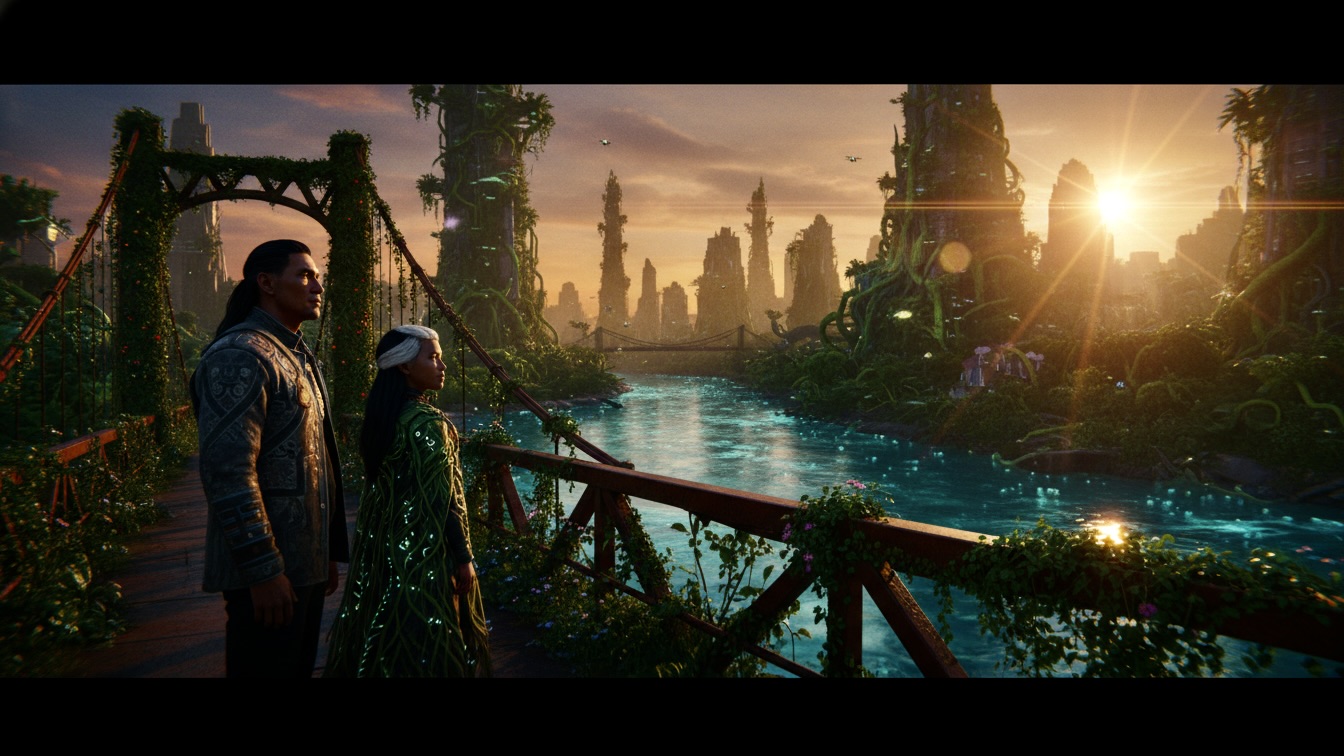
As a violent storm breaks the oppressive heat, Evan and Malaya face a pivotal choice between personal financial security and the restoration of their dying river. Despite the Enforcer’s threats and Malaya’s initial desire to sell the cube for a better life, they choose to activate the device. The community of the Punk Rock Flea Market rallies around them, forming a human shield against corporate intervention. The chapter concludes months later, showing a transformed Winnipeg where the Red River has cleared and a new "Green-Punk" movement has begun to thrive through shared, open-source technology.
The central theme of the narrative is the conflict between corporate commodification and the democratization of life-sustaining resources. The Gaia-Link cube represents a lost potential for global healing that was suppressed because it threatened the profit margins of those selling "cures" for environmental collapse. By choosing to activate the node and share its blueprints, Evan and Malaya subvert a system that thrives on scarcity. This act of rebellion suggests that true ecological restoration requires the dismantling of intellectual property in favor of communal survival.
Another prominent theme is the psychological weight of generational trauma in a dying world. Malaya represents a generation that has never known a clean environment, leading to a pragmatic cynicism where survival outweighs idealism. Her initial urge to sell the cube reflects a trauma-informed response to poverty and displacement. Conversely, Evan’s connection to his grandfather’s stories provides him with a moral anchor, allowing him to recognize the cube not just as currency, but as a restoration of a broken promise to the land.
The story also explores the concept of "Green-Punk" as a hopeful evolution of the cyberpunk genre. While traditional cyberpunk often focuses on "high tech, low life" in a state of permanent decay, this narrative posits that technology can be salvaged to reclaim the natural world. The transformation of the red, toxic river into a healthy blue stream serves as a powerful visual metaphor for this shift. It suggests that while the world is broken, it is not beyond repair if the tools of the powerful are seized by the hands of the marginalized.
Evan is a character defined by the tension between his roles as a protective father and a steward of his ancestral heritage. He navigates a world that has been stripped of its natural beauty, yet he retains a psychological connection to the "ghost world" of the past. His refusal to be intimidated by the Enforcer stems from a deep-seated weariness of corporate exploitation. He views the land not as a resource to be managed, but as a living entity that has finally offered a way back to health.
Psychologically, Evan struggles with the guilt of failing to provide a stable life for Malaya. This internal conflict is highlighted when he considers the Enforcer’s offer of a "clean zone" life. However, his ultimate decision to keep the cube shows a shift from individual survival to collective responsibility. He realizes that a clean house in a gated community is a hollow victory if the world outside remains a toxic graveyard. His strength lies in his ability to imagine a future that Malaya has been conditioned to believe is impossible.
Malaya serves as the intellectual and technical engine of the story, possessing a brilliance that is hampered by her harsh reality. Her character arc is a journey from desperate pragmatism to visionary activism. Initially, she views the Gaia-Link cube through the lens of escape, seeing it as a "ticket" out of the mud. This perspective is a direct result of her upbringing in a world where every breath is a struggle against corporate-induced toxicity. Her cynicism is a defensive mechanism against the disappointment of a failing city.
The turning point for Malaya occurs when she witnesses the river’s transformation. This sensory experience overrides her calculated survival instincts and awakens a sense of wonder she had previously suppressed. By choosing to open-source the cube’s schematics, she asserts her agency over the technology that the corporations sought to hide. She transitions from a scavenger of the old world to an architect of the new one. Her final acceptance of her "grease-stained hands" signifies her reconciliation with her identity and her commitment to the community.
The narrative employs a gritty, sensory-heavy prose style that effectively establishes the oppressive atmosphere of a climate-collapsed future. The description of the Winnipeg heat as a "wet wool blanket" and the river as a "vein of open blood" creates a visceral sense of discomfort. These metaphors serve to ground the science fiction elements in a recognizable, albeit exaggerated, reality. The use of color is particularly striking, moving from the "sick, pulsing red" of the algae to the "crystalline blue" of the purified water, signaling a tonal shift from despair to hope.
Pacing is managed through the contrast between the sluggish, humid beginning and the rapid-fire confrontation in the stall. The arrival of the storm acts as a catalyst for both the plot and the environment, mirroring the internal pressure felt by the characters. The dialogue is sharp and economical, reflecting the hard-edged lives of the market vendors. Evan’s dry observations contrast with Malaya’s technical jargon, creating a multi-layered narrative voice that feels both grounded and futuristic.
The author uses the setting of the Punk Rock Flea Market as a microcosm of societal resistance. The transition from the "heavy hum of the mag-lev trains" to the "rhythmic and hopeful" music at the end illustrates the shift in the city’s heartbeat. This stylistic choice emphasizes the theme of reclaiming space and sound from corporate dominance. The ending, with its focus on the "silver ribbon" of the river under the stars, provides a lyrical resolution that balances the earlier industrial grime. It leaves the reader with a sense of quiet, enduring strength.


