A stolen SUV, a dead man’s hidden bunker, and a secret that turns a family into national targets.
The dashboard of the Land Rover Defender was a technicolor hallucination in the pre-dawn gray. A notification bubbled up on the center console, pulsing a violent, rhythmic red. Moe stared at it. The text was stark: PROTOCOL PHOENIX INITIATED.
"What does that mean?" Toby asked. He was leaning so far forward from the back seat his chin was practically on Moe’s shoulder.
"It means we’re screwed," Moe said. He gripped the leather-wrapped steering wheel. It felt too expensive, too smooth. It felt like something that belonged to a person who didn't have dirt under their fingernails and a dead father with a ledger full of sins.
Andrea was frantically swiping through the tablet she’d snatched. Her face was washed out by the screen’s glare. "It’s a remote wipe command. They’re locking down every account Jerry touched. Bank accounts, shell companies, the works. If we don't get off the grid in the next twenty minutes, we’re going to be flagged by every automated license plate reader in three states."
"Can you block it?" Moe asked.
"I’m trying," Andrea said. Her thumbs were a blur. "But this isn't a normal security system. It’s an eradication suite. It’s designed to make a person stop existing on paper."
They were tearing down a two-lane blacktop, the summer woods a dark, solid blur on either side. The heat was already beginning to rise from the asphalt, shimmering in the beams of the high-intensity LEDs. It wasn't even six in the morning, but the humidity was already a physical pressure, a wet hand pressing against the windshield.
"Look at the rearview," Toby said.
Moe looked. A single set of headlights was a mile back, steady and unblinking. It wasn't the rental car. This was something faster. Something heavier.
"Is that Elias?" Toby asked.
"Elias is a middle-manager with a ruined shirt," Andrea said. "That’s the cleanup crew."
"We need to dump the car," Moe said.
"We just got it!" Toby protested. "It has a built-in refrigerator in the armrest, Moe. There are literal sparkling waters in here. Chilled."
"Toby, if we stay in this car, they’ll find us by the GPS pings before the sun is fully up," Moe said. He swung the wheel hard, the SUV’s suspension soaking up the violent transition from pavement to gravel.
They were on an old logging road. The branches of overgrown oaks scraped against the sides of the vehicle, a sound like fingernails on a chalkboard. Moe didn't slow down. The Defender bounced over ruts and exposed roots, its engine a low, confident growl.
"Jerry had a place," Andrea said. She wasn't looking at the tablet anymore. She was looking at a crumpled piece of paper she’d pulled from the back of the ledger. "It’s not on the deed. It’s not in the probate files."
"A secret house?" Toby asked. "Very on-brand for him. Was it a tax dodge or a mistress?"
"Neither," Andrea said. "The coordinates are listed under 'Asset Recovery.' It’s a cabin in the North Ridge. He bought it in 1998, the year Mom..."
She stopped.
"The year Mom left," Moe finished for her.
"He never mentioned it," Toby said. "We spent every summer at that dump of a farm while he had a cabin in the mountains?"
"It wasn't for vacations, Toby," Moe said. He checked the mirror again. The headlights were gone, but he knew they were still there. They were just running dark now.
"Turn left at the fork," Andrea commanded.
Moe yanked the wheel. The tires threw gravel into the underbrush. The road narrowed until it was barely a trail, the grass high enough to brush the underside of the chassis. The summer heat was becoming a visible haze, the rising sun catching the dust kicked up by their flight.
"How far?" Moe asked.
"Six miles," Andrea said. "Then we walk."
"Walk?" Toby groaned. "In this? I’m wearing vintage sneakers, Moe. They have zero arch support."
"You’ll live," Moe said.
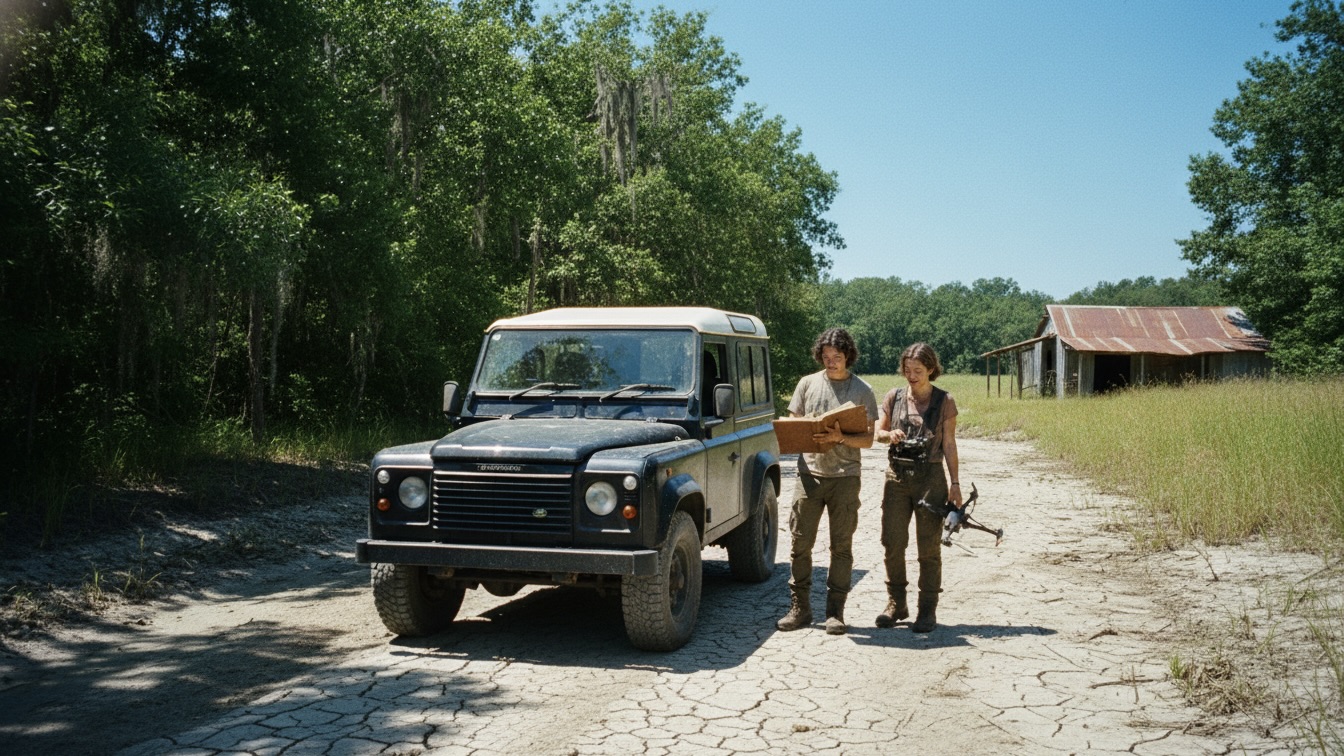
Moe pushed the SUV as far as it would go. The trail ended at a dry creek bed, the stones bleached white by the sun. He killed the engine. The silence that rushed in was deafening, filled only by the ticking of the cooling metal and the frantic, rhythmic buzz of cicadas in the canopy above.
"Phones in the center console," Moe said.
"What? No," Toby said. "My streaks, Moe. My entire digital life is on this thing."
"Your digital life is a breadcrumb trail for people who want to erase you," Moe said. "Put it in the box."
Toby looked at his phone like it was a dying pet. He dropped it into the console. Andrea did the same, her face a mask of cold calculation. Moe added his own, then shut the lid.
"We take the ledger, the tablet, and the water," Moe said. "And the wrench from the glove box."
"A wrench?" Toby asked.
"For the arch support," Moe said.
They stepped out into the heat. It was a physical blow, a wall of moist, static energy that made the skin on Moe’s neck prickle. There was no breeze here, only the suffocating weight of the woods. They began to climb the ridge, their boots crunching on the dry needles of the pines.
"If Thomas finds out we’re here..." Toby started.
"He won't," Andrea said. "He thinks we’re heading for the state line. He thinks we’re predictable. He thinks we’re just kids."
"We are just kids," Toby said, wiping sweat from his forehead. "I’m twenty-one. I should be at a pool party, not hiking into a murder-forest."
"Jerry didn't raise us for pool parties," Moe said. He looked up through the trees. The sky was a brilliant, mocking blue. "He raised us for this. He just forgot to tell us why."
The hike was a two-hour descent into physical misery. Every step was a negotiation with the terrain. The ground was a treacherous mix of loose shale and tangled roots, all hidden beneath a layer of deceptive, golden-brown pine needles. The heat didn't just sit on them; it vibrated. It was a hum in the marrow of their bones.
"I can feel my pulse in my teeth," Toby panted. He was leaning against a lightning-scarred cedar, his face the color of a ripe tomato. "Is that normal?"
"It’s the humidity," Andrea said. She hadn't stopped moving. She was the smallest of them, but she had a relentless, mechanical gait that made Moe think of a wind-up toy. "It prevents sweat from evaporating. Your core temperature is spiking. Don't sit down. If you sit down, you’ll never get back up."
"I’m already dead," Toby informed her. "Tell my followers I died doing something mid."
"Shut up and move," Moe said. He was carrying the leather-bound ledger under one arm, the weight of it feeling heavier with every yard. It was as if the secrets inside were gaining mass.
They reached the summit of the first ridge. Below them, tucked into a fold of the landscape that the sun hadn't quite reached yet, was the cabin. It wasn't a cabin. It was a shipping container that had been clad in rough-hewn cedar planks and topped with a rusted tin roof. It looked like a piece of industrial debris that had been reclaimed by the forest.
"That’s it?" Toby asked, his voice cracking. "That’s the safe house? It looks like a place where they film documentaries about people who eat their neighbors."
"It’s perfect," Andrea said. "No power lines. No satellite dishes. It’s a dead zone."
They scrambled down the slope, sliding on the shale. Moe reached the door first. It was heavy, reinforced steel painted to look like wood. There was no keyhole. Instead, a small, recessed keypad was hidden behind a knot in the cedar siding.
"The code," Moe said, looking at Andrea.
She checked the ledger. "There isn't a code. There’s just a drawing of a clock. It’s set to four-fifteen."
"Four-fifteen?" Moe tried the numbers. 0-4-1-5.
A mechanical click echoed through the metal frame. The door swung inward on silent, greased hinges. The interior was cool, a sharp contrast to the baking world outside. It didn't have the stale air of a closed room; it felt filtered, sterile.
Moe stepped inside. The floor was polished concrete. The walls were lined with shelves—not for books, but for gear. Pelican cases, vacuum-sealed bags of clothing, and rows of black batteries. In the center of the room was a long table with a series of monitors that looked like they belonged in a server room, not a hunting lodge.
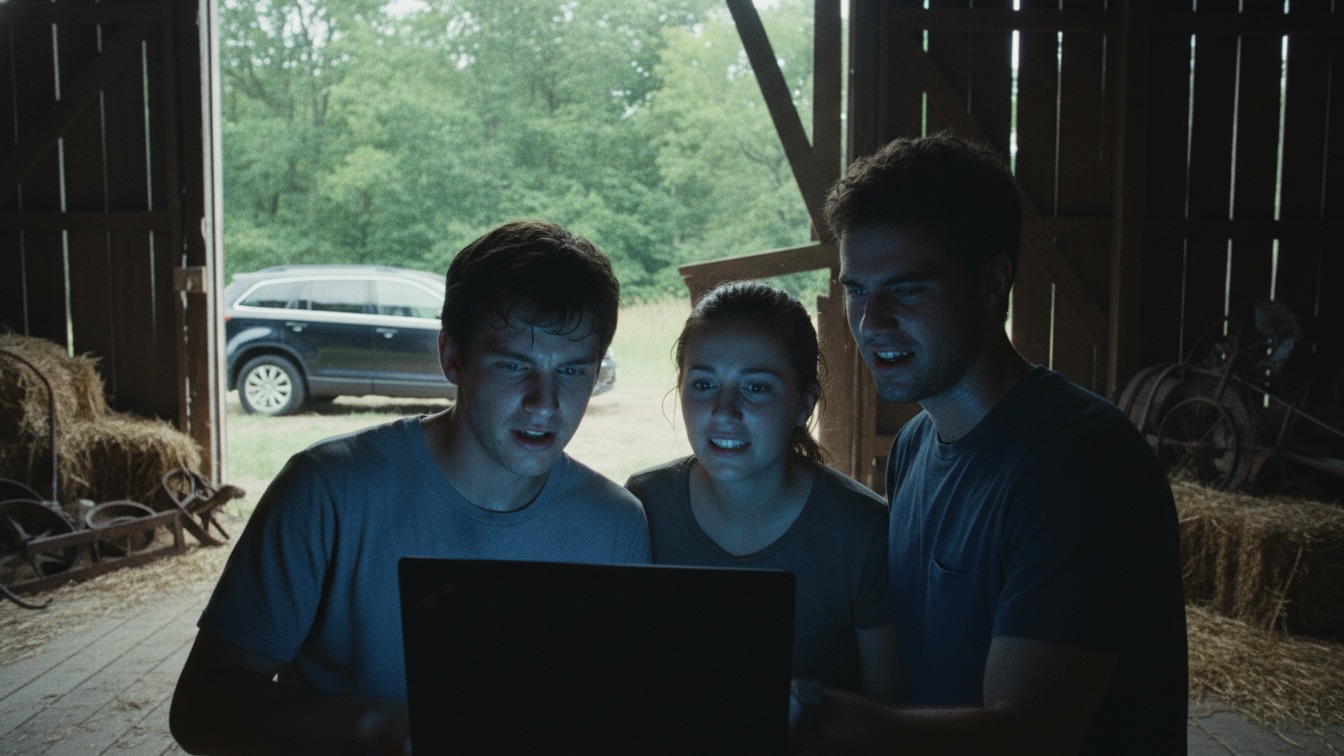
"Jerry was a prepper?" Toby asked, his voice echoing. He walked over to one of the cases and flipped the latches. "Oh my god. These are drones. High-end ones. This is better tech than the security at the fair had."
"He wasn't a prepper," Andrea said. She was standing at the main console. She flipped a switch, and the monitors flickered to life. "He was a node. Look at these feeds. He was monitoring the environmental runoff from Thomas’s sites for twenty years."
On the screens, maps of the county were overlaid with glowing green and orange plumes. They looked like slow-motion explosions.
"The cannery waste," Moe said. "The 'Project Phoenix' land. He wasn't just bookkeeping. He was building a case."
"Then why didn't he go to the police?" Toby asked.
"Because Thomas owns the police," Andrea said. "And the state land bureau. And the governor’s office. Jerry knew that if he released this the normal way, it would just be deleted. He needed a kill-switch. He needed us."
"Why us?" Moe asked. "He could have sent this to the EPA. He could have leaked it to the press."
"He did," a voice said.
They all spun around. The voice didn't come from the room. it came from the speakers embedded in the ceiling. It was Jerry’s voice, but it wasn't the gravelly, drunken slur they remembered. It was sharp. Younger.
"If you’re hearing this," the recording continued, "it means the fair went sideways and you found the North Ridge. It also means I’m dead, which is a shame, because I had a very good bottle of scotch saved for this moment."
"He’s joking," Toby whispered. "He’s dead and he’s still making dad jokes."
"I kept you out of this for as long as I could," the voice said. "But Thomas is moving faster than I anticipated. The Phoenix Protocol isn't just about deleting files. It’s about clearing the site. And you three are the only ones left who know where the bodies are buried. Literally."
Andrea leaned over the console. "What bodies?"
"The ledger has a map," the recording said, as if answering her. "Page eighty-four. Under the floorboards of the old cannery. That’s where the real debt is. Not money. Not land. Your mother didn't leave, Moe. She didn't walk out on us."
The silence in the cabin was total. The heat outside seemed to hammer at the steel walls, trying to get in. Moe felt a cold, sharp stone form in his chest.
"She found out what Thomas was doing," Jerry’s voice said, sounding weary now. "She tried to stop him. And he stopped her. I’ve spent twenty years trying to find a way to burn him down without burning you down with him. I failed. Now, you have to decide. You can take the SUV, drive to the coast, and try to disappear. Or you can finish it."
The recording clicked off.
"He’s lying," Toby said. His voice was small. "He has to be lying. Mom... she sent postcards. From California. From Vegas."
"Jerry sent those postcards," Andrea said. She was looking at a stack of stamped envelopes on the corner of the desk. They were all addressed to the house. All postmarked from different cities. All in Jerry’s handwriting.
"He kept them here," she whispered. "He sent them to us to keep us quiet. To keep us from asking questions."
Moe walked to the door and looked out at the shimmering heat. The forest was beautiful, lush, and completely indifferent to them.
"We aren't going to the coast," Moe said.
"Moe..." Andrea started.
"He killed her," Moe said. He turned back to them. His eyes were hard. "He killed her and he made us think she didn't want us. We’re going to the cannery."
"We have a wrench and some drones, Moe," Toby said. "They have guns and lawyers."
"We have the ledger," Moe said. "And we have the secret ingredient."
"Which is what?" Toby asked.
"Nothing left to lose," Moe said.
The return trip to the SUV was faster. Adrenaline had replaced the lethargy of the heat. They moved through the woods like ghosts, their movements dictated by a sudden, sharp clarity. The summer air felt thinner now, as if the revelation about their mother had sucked the oxygen out of the world.
They reached the dry creek bed. The Defender was still there, a black monolith in the dust. Moe didn't hesitate. He climbed into the driver’s seat and fired the engine. The roar felt different this time—not like a getaway, but like a challenge.
"The cannery is twenty miles east," Andrea said. She was staring at the tablet, which was now synced to the cabin’s local network. "It’s been closed since 2012. Thomas bought it for pennies at a tax auction. It’s the centerpiece of the Project Phoenix development."
"Why?" Toby asked. "It’s a ruin. Why build a data center on a toxic waste site?"
"Because if you build a massive concrete structure over the soil, nobody ever checks what’s underneath," Andrea said. "The data center isn't the business. The burial is the business."
Moe drove with a reckless precision. He didn't use the logging roads. He drove straight through the brush, the Defender’s high clearance allowing them to bypass the main gates. The heat haze was so thick now that the horizon was a wavering, liquid line.
They saw the cannery rising out of the flats like a skeletal beast. It was a massive, windowless structure of corrugated tin and reinforced concrete. Rust bled down the sides like dried blood. Around it, the land was gray and barren—the only place in the county where the summer green hadn't taken hold.
"Look at the soil," Toby said. "Nothing’s growing. Not even weeds."
"The arsenic levels are off the charts," Andrea said. "Jerry’s reports said the runoff was being pumped directly into the aquifer. That’s what Mom found."
Moe pulled the SUV to a stop behind a stack of rotting pallets. He didn't turn off the engine.
"Toby, get the drone up," Moe said. "I want to know who’s inside."
Toby pulled a compact, black quadcopter from a Pelican case. He launched it from the roof of the SUV. The tiny machine buzzed into the air, a mechanical hornet in the still heat. On the tablet, a grainy, thermal view of the cannery appeared.
"Three signatures," Toby reported. "Two by the main loading dock. One in the office upstairs. They’re armed."
"Elias?" Moe asked.
"One of them has the same height profile," Toby said. "He’s pacing. Looks like he’s waiting for instructions."
"We can't just walk in," Andrea said. "They’ll see us coming from a mile away."
"We don't walk in," Moe said. "We use the ventilation shafts. Jerry’s map shows a cooling tunnel that runs from the creek to the basement. It was for the industrial chillers."
They moved on foot, staying low in the tall, dead grass. The heat was a different beast here; it felt metallic, sharp. It didn't smell like the woods. It didn't smell like anything. It was a void.
They found the intake—a rusted grate half-buried in the silt of the creek. Moe used the wrench to pry the bolts loose. They groaned, the sound echoing in the hollow pipe.
"One at a time," Moe whispered.
They slid into the darkness. The tunnel was narrow, the air inside cool and damp. It felt like crawling into the throat of a corpse. Moe led the way, his flashlight beam cutting through the gloom. The walls were slick with a dark, oily residue.
"Don't touch the walls," Andrea hissed from behind him. "That’s the leachate."
They reached a vertical shaft. A rusted ladder led upward. Moe climbed, his heart hammering against his ribs. He pushed open a heavy iron hatch and emerged into a room that smelled of nothing. It was the basement.
It was a vast, low-ceilinged space filled with concrete pillars. In the center, the floor had been torn up. A rectangular pit, ten feet deep, yawned in the darkness.
"That’s it," Moe said.
They stood at the edge of the pit. Moe shone his light down. At first, he saw only dirt and shattered concrete. Then, he saw the corner of something metallic. A blue trunk.
"I remember that," Toby whispered. "That was in the attic. Mom used it for her winter clothes."
Moe felt a wave of nausea that had nothing to do with the heat. He climbed down into the pit, his boots sinking into the soft, chemically-treated earth. He reached the trunk and brushed away the dirt. It wasn't locked.
He opened the lid.
Inside was a collection of files, a digital camera from the early 2000s, and a small, sealed plastic bag containing a lock of blonde hair. Below the files was a shape wrapped in a plastic tarp.
Moe didn't unwrap it. He didn't have to.
"She wasn't just evidence," Andrea said, her voice trembling as she stood at the edge of the pit. "She was the message. Thomas didn't just kill her. He made Jerry bury her here. He made him the accomplice."
"That’s why he stayed," Moe realized. "That’s why he drank. He couldn't leave her. And he couldn't tell us."
"We have the camera," Toby said, pointing. "And the files. That’s the proof. That’s what the ledger was missing."
"It’s not enough," a voice boomed from the darkness above.
A floodlight snapped on, blinding them. Moe looked up, squinting. Elias was standing at the edge of the pit, his silhouette framed by the harsh white light. He wasn't holding a pistol this time. He was holding a submachine gun.
"I have to admit," Elias said, his voice echoing in the basement. "I didn't think you had the stomach for this. Jerry was a coward. I thought his children would be too."
"Jerry wasn't a coward," Moe said, standing his ground in the pit. "He was a prisoner. There’s a difference."
"A distinction without a meaning," Elias said. "Mr. Thomas is very disappointed. He wanted this to be a clean transition. Now, I have to fill in the rest of this hole."
"Wait," Andrea said. She was holding the tablet up. "You kill us, the upload finishes. We set a timer. If I don't enter a code every ten minutes, the entire contents of that trunk go to the FBI, the EPA, and the New York Times."
Elias laughed. It was a dry, hollow sound. "You’re bluffing. The cell towers in this area are down. I killed them myself an hour ago. You’re in a dead zone, Andrea. There is no upload."
He raised the weapon.
"You're right," Moe said. "There is no upload."
He reached into his pocket and pulled out the small, translucent strip—the cold storage key.
"But there is a trigger," Moe said.
He jammed the key into a small port on the side of the wrench—which Toby had modified back at the cabin. It wasn't just a wrench anymore. It was a signal jammer.
"Toby, now!" Moe yelled.
From the darkness behind the pillars, the drone screamed to life. It didn't fly away. It flew straight at Elias’s face.
Elias ducked, firing a burst of lead into the ceiling. The sound was deafening, the muzzle flashes illuminating the basement like a strobe light.
"Run!" Moe shouted.
The chaos of the basement was a blur of noise and shadow. Moe scrambled out of the pit, his fingers catching on the jagged edge of a concrete slab. He ignored the sting of the skin tearing. Behind him, Elias was swatting at the drone, the small machine darting and weaving with a frantic, insectoid intelligence.
"To the stairs!" Andrea yelled.
They sprinted across the open floor, the heavy boots of the other two guards thudding on the level above. The heat in the cannery was rising, trapped by the uninsulated metal roof. It felt like the building was a giant oven, and they were the meat.
"They’re cutting us off!" Toby panted. He was still controlling the drone with one hand, his eyes fixed on the screen of his phone. "I’m losing signal! The concrete is too thick!"
"Forget the drone!" Moe said. "Hit the fire suppression!"
"What?"
"The pipes!" Moe pointed to the red-painted lines running along the ceiling. "This place was a cannery. They used high-pressure steam and chemical fire retardant. If the tanks are still pressurized..."
Toby didn't ask questions. He pulled the wrench from his belt and swung it with everything he had. He hit the main valve assembly.
The metal didn't just break; it detonated.
A wall of white, powdery foam exploded into the air, followed by a screaming jet of high-pressure CO2. The basement was instantly swallowed by a freezing, opaque cloud.
"I can't see!" a guard yelled from somewhere in the fog.
"Keep moving!" Moe grabbed Andrea’s hand. He used his memory of the floor plan to guide them toward the industrial elevator. It was a rusted cage, but it led to the roof.
They tumbled into the elevator. Moe slammed the gate shut and pulled the lever. The machine groaned, the cables straining with a sound like a dying cello. They began to rise, the basement floor disappearing into the white haze below.
"Where are we going?" Toby asked, coughing. The fire retardant tasted like chalk and bitterness.
"The roof," Moe said. "The Defender is parked by the back gate. If we jump from the second-story ledge, we can make it."
"Jump?" Toby squeaked. "Moe, I have a very low threshold for physical trauma!"
"You’ll have a lower one if Elias catches you!"
The elevator lurched to a halt at the second floor. Moe kicked the gate open. They emerged onto a catwalk overlooking the main processing floor. Below them, the two guards were stumbling through the foam, firing blindly into the mist.
Elias was nowhere to be seen.
"There!" Andrea pointed to the end of the catwalk. A heavy steel door led to the exterior fire escape.
They ran. The catwalk vibrated under their weight, the rusted supports groaning. They reached the door. Moe threw his weight against it. It didn't budge.
"It’s chained!" he cursed.
"Move over," Andrea said. She pulled a small, high-intensity laser cutter from her bag—another piece of Jerry’s 'Asset Recovery' gear. She pressed it against the chain. A shower of blue sparks lit up the hallway.
"Hurry!" Toby urged, looking back.
A shadow emerged from the elevator. Elias. He looked like a nightmare—his face white with fire foam, his eyes burning with a cold, predatory focus. He didn't fire. He raised a hand, signaling them to stop.
"Give me the key, Moe," Elias said. His voice was calm, even in the middle of the chaos. "Give me the key and the camera. You don't have to die in a cannery. You can go back to your lives. I’ll tell Thomas you were never here."
"You’re lying," Moe said. He stood in front of his siblings, the leather ledger clutched to his chest. "You can't let us go. We’ve seen her."
Elias sighed. It was a sound of genuine regret. "I know. But it was worth a try. Efficiency is the soul of business, after all."
He leveled the gun.
Crack.
The chain snapped. Andrea kicked the door open.
"Now!" she screamed.
They dived through the opening just as a burst of gunfire shredded the metal frame. They were on the fire escape, the summer sun hitting them with a blinding glare. The heat was a relief compared to the freezing fog of the basement.
They scrambled down the stairs, the metal scorching their palms. They reached the last landing, ten feet above the ground.
"Jump!" Moe ordered.
Toby went first, landing in a heap in the dead grass. Andrea followed, rolling like a pro. Moe was the last. He hit the ground hard, the impact jarring his spine. He didn't wait to check for injuries.
They sprinted for the Defender. Moe hit the remote start. The engine roared to life, a beautiful, mechanical symphony. They piled in, the tires spitting gravel as Moe slammed it into gear.
"We have the camera?" Moe asked, his breath coming in ragged gasps.
"I have it," Toby said, holding the old digital unit like a holy relic.
"And the ledger?"
"Right here," Andrea said.
Moe looked in the rearview. The cannery was a shrinking silhouette in the dust. Elias was standing on the fire escape, watching them go. He didn't fire. He just stood there, a small, dark figure against the rusted tin.
"He’s not coming after us," Toby said.
"He doesn't have to," Moe said. "He knows where we’re going."
"Where are we going?" Andrea asked.
"The state capital," Moe said. "We aren't going to the press. We aren't going to the cops. We’re going to the one person Thomas can't buy."
"Who?"
"The Attorney General," Moe said. "Jerry’s ledger... the last page wasn't a map. It was a phone number. With a personal note. 'For the boy who remembers.'"
"What does that mean?" Toby asked.
"It means the Attorney General was the one who tried to help Mom twenty years ago," Moe said. "And Jerry has been paying him off to stay quiet ever since. Not with money. With evidence. He was the vault."
As the sun began to set, casting long, orange shadows across the highway, the heat finally began to break. A breeze stirred the trees, but it didn't feel cool. It felt like the world was waiting for something to happen.
Moe looked at the dashboard. The red light was gone. The tablet was dark. They were off the grid, carrying a dead woman’s secrets toward a man who might be their savior or their executioner.
In the distance, the skyline of the city flickered into view.
"We’re going to make it," Toby whispered, his eyes closing in exhaustion.
"We haven't made it yet," Moe said.
He looked in the mirror one last time. Far behind them, a single set of headlights appeared on the horizon. It wasn't an SUV. It was a black sedan.
The Phoenix Protocol wasn't over. It was just entering the next phase.
“The Phoenix Protocol wasn't over; it was just entering the next phase.”