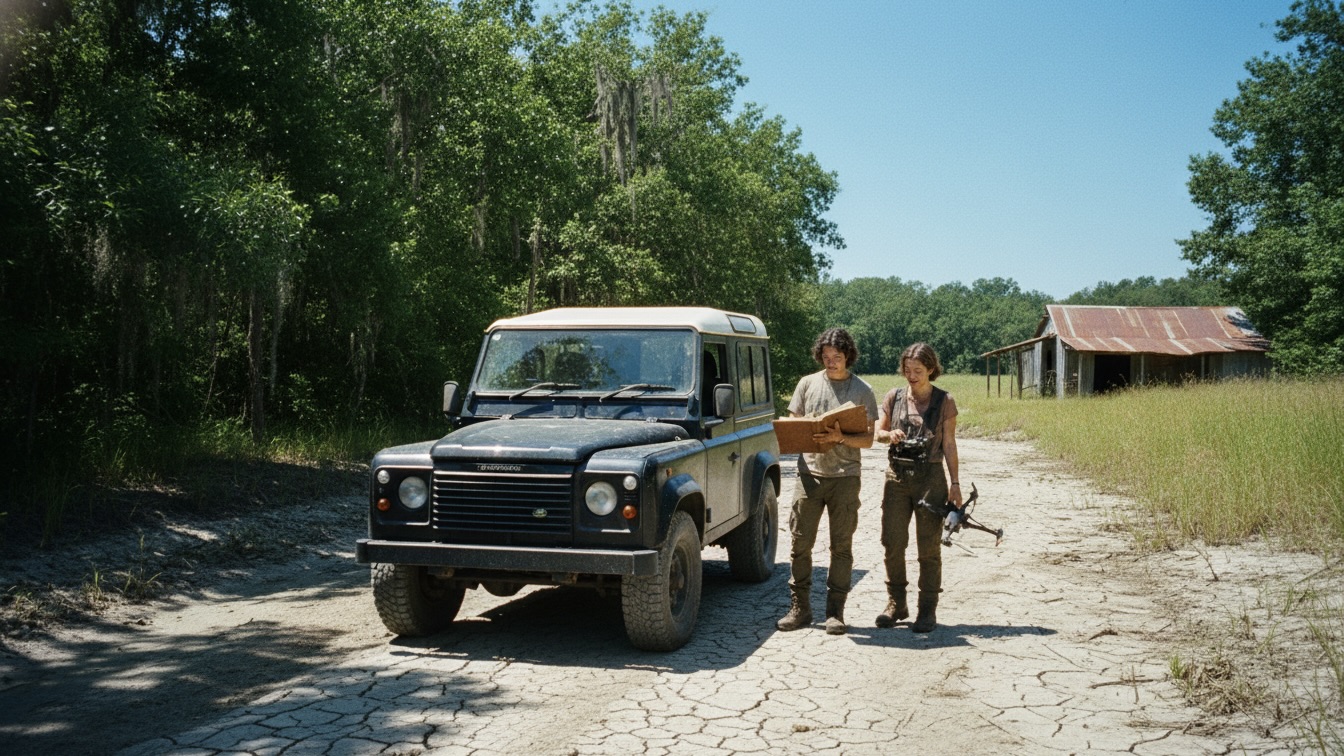
The chapter opens with three siblings—Moe, Toby, and Andrea—fleeing in a Land Rover Defender as a digital eradication command known as "Protocol Phoenix" wipes their father’s legal and financial existence. Pursued by a relentless cleanup crew led by a man named Elias, the trio navigates a brutal summer heatwave to reach a hidden mountain cabin. This reinforced shipping container serves as a "dead zone" where their late father, Jerry, stored decades of evidence regarding environmental crimes committed by a powerful figure named Thomas.
Inside the cabin, a pre-recorded message from Jerry reveals a devastating truth: their mother did not abandon them twenty years ago, but was murdered by Thomas after discovering his illegal activities. Jerry, coerced into silence and complicity, spent the rest of his life documenting the corruption while pretending she was still alive. This revelation shifts the siblings' objective from mere survival to a quest for justice and closure.
The narrative reaches its climax at a derelict cannery, the site where Jerry was forced to bury their mother’s body beneath a concrete foundation. After a tense confrontation with Elias in the basement of the facility, the siblings use a combination of a drone distraction and a chemical fire suppression explosion to escape. Carrying the definitive proof of the murder and the environmental ledger, Moe drives the group toward the state capital to confront the Attorney General, while a mysterious black sedan follows them into the night.
The central theme of the narrative is the crushing weight of legacy and the "sins of the father." Jerry’s life is revealed to be a long, agonizing penance for his inability to protect his wife, a failure that forced him into a state of moral paralysis and alcoholism. The siblings are not just inheriting a ledger of crimes; they are inheriting the psychological trauma of a twenty-year-old lie. Moe, in particular, feels the burden of this inheritance, realizing that his father’s "parenting" was actually a form of survival training for a conflict Jerry knew was inevitable.
Another prominent theme is the intersection of digital erasure and physical reality. The "Phoenix Protocol" represents a modern form of execution where a person is deleted from the social contract before they are physically eliminated. This creates a terrifying sense of ontological insecurity, as the characters realize that without their bank accounts, GPS, and digital identities, they cease to exist in the eyes of the law. The "dead zone" of the cabin acts as a sanctuary precisely because it exists outside this digital web, suggesting that true safety can only be found in the analog world.
The environment itself serves as a metaphor for the corruption at the heart of the story. The oppressive, vibrating heat and the "dead zone" around the cannery, where nothing grows due to arsenic poisoning, mirror the moral decay of Thomas’s empire. The "Phoenix" in the protocol’s name is ironic; while the mythical bird rises from the ashes, this protocol seeks to turn living people into ash and bury the truth under concrete. The siblings must decide if they will be consumed by these flames or if they will use the fire to burn down the structures that destroyed their family.
As the eldest sibling, Moe functions as the group’s reluctant patriarch, assuming the protective role that Jerry abandoned through his drinking and eventual death. He is characterized by a stoic pragmatism, evidenced by his immediate willingness to dump the expensive vehicle and his focus on physical tools like the wrench. Psychologically, Moe is driven by a deep-seated need for autonomy; he resents the feeling of being "raised for this" without his consent. His decision to go to the cannery rather than flee to the coast marks his transition from a fugitive to a combatant, reclaiming his agency from both his father’s ghost and Thomas’s influence.
Toby represents the loss of innocence and the struggle to reconcile a modern, digital-first identity with a brutal, visceral reality. His initial obsession with "streaks" and his vintage sneakers serves as a defense mechanism against the life-threatening situation they face. As the youngest, he experiences the most acute shock upon learning the truth about his mother, as his entire childhood was built on the postcards Jerry forged. By the end of the chapter, he begins to integrate his technical skills—using the drone as a weapon—showing a psychological shift from a passive observer of his own life to an active participant in the family’s survival.
Andrea is the intellectual engine of the trio, possessing a "mechanical" gait and a cold, calculating demeanor that suggests a high degree of emotional compartmentalization. She processes the trauma of her mother’s death through the lens of data and logistics, focusing on "Asset Recovery" and upload timers rather than her own grief. This intellectualization allows her to function in high-stress environments where Moe’s brawn or Toby’s intuition might fail. However, her trembling voice at the edge of the burial pit reveals the cracks in her armor, suggesting that her technical proficiency is a shield against the overwhelming emotional reality of their situation.
Though deceased, Jerry is a pervasive psychological presence whose voice literally guides the siblings from beyond the grave. He is a tragic figure, a "prisoner" who spent twenty years in a self-imposed purgatory of guilt and surveillance. His decision to forge postcards from the mother was an act of both profound cruelty and desperate love, intended to spare his children the pain of her murder while keeping them close enough to protect. His character highlights the complexity of moral compromise, as he was both a victim of Thomas and an accomplice in the concealment of his wife's death.
The pacing of the chapter is relentless, mirroring the "violent, rhythmic" pulsing of the Phoenix Protocol notification. The author uses short, punchy sentences during action sequences to heighten the sense of urgency, particularly during the escape from the cannery. This is balanced by more atmospheric, descriptive passages that emphasize the sensory misery of the summer heat. The transition from the "technicolor hallucination" of the dashboard to the "bleached white" stones of the creek bed marks a shift from the artificial safety of the modern world to the harsh reality of the wilderness.
Sensory details are heavily focused on the oppressive nature of the climate, with the heat described as a "physical pressure" and a "wet hand." This atmospheric choice creates a sense of claustrophobia even in wide-open outdoor spaces, reflecting the characters' feeling of being hunted. The contrast between the "sterile" air of the cabin and the "metallic, sharp" void of the cannery reinforces the idea that the siblings are moving between different layers of a manufactured reality. The use of sound—the "fingernails on a chalkboard" of branches and the "screaming jet" of CO2—adds a visceral, auditory layer to the suspense.
The narrative voice is one of gritty realism, grounded in the physical details of the characters' struggle. The dialogue is sharp and often cynical, particularly from Toby, providing a necessary counterpoint to the grim revelations of the plot. The "Phoenix" motif is woven through the text not just in the protocol's name, but in the blue sparks of the laser cutter and the white "ash" of the fire retardant. This stylistic cohesion reinforces the theme of destruction and the potential for a painful, transformative rebirth for the siblings as they head toward the final confrontation.


