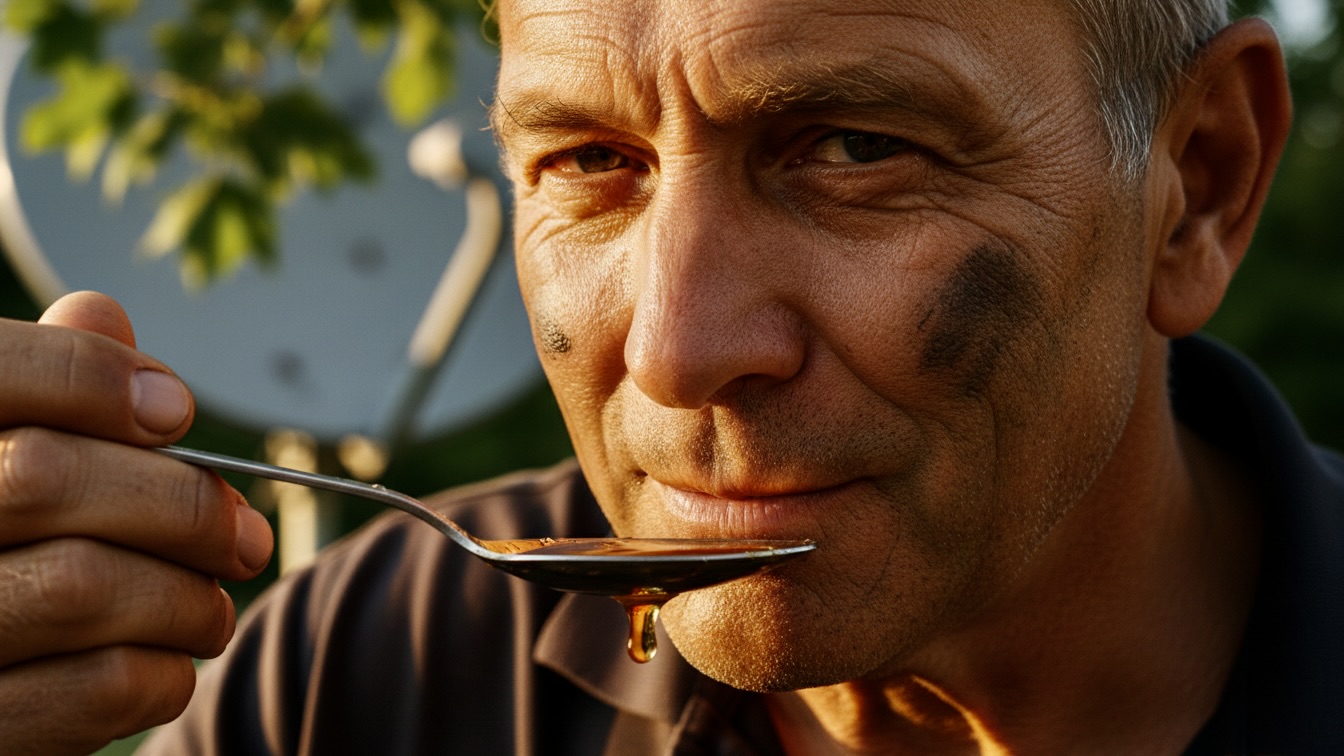
A veteran uses scavenged satellite parts to boil maple sap, triggering a high-stakes battle against physics and heat.
The mud in Evan Taylor’s backyard did not just sit; it breathed. It was a thick, grey slurry that clung to his boots like an unpaid debt. Manitoba spring was usually a slow thaw, a gradual transition from frozen white to muddy brown, but this year the heat had arrived like a physical blow. It was June-hot in late March. The sun hammered the prairie flat, turning the moisture in the ground into a heavy, invisible steam that made every breath feel like swallowing a damp cloth. Evan wiped sweat from his forehead with a grease-stained sleeve. He gripped the winch handle of the flatbed trailer, his knuckles white and scarred from years in motor pools that no longer existed. On the trailer sat the prize: a seven-foot decommissioned satellite dish, its surface a dull, matte silver that seemed to absorb the aggressive sunlight rather than reflect it. It looked like a fallen moon.
Evan’s jaw was a rigid line of bone and tension. He hadn't slept more than four hours a night since the sap started running. The maples at the edge of his property were bleeding out, the clear liquid pulsing through plastic tubes he’d rigged with the precision of a field hospital. But the old ways—the wood-fired evaporators, the slow, smoky pans—were too inefficient for the volume he was seeing. He needed speed. He needed concentrated thermal energy. He needed the curvature of a deep-space ear to focus the sun into a killing point of heat. He kicked a block of wood under the trailer tire. The mud groaned.
"You’re actually going to do it," a voice said from the porch.
Evan didn't look up. He knew the cadence of Jason Maxwell’s voice. It was the sound of someone who lived entirely in the digital present, a mix of irony and genuine curiosity that Evan found both exhausting and necessary. Jason was nineteen, wearing a black hoodie despite the ninety-degree heat, his phone held out like a holy relic. The screen was a bright square of light even in the sun.
"The physics are sound, Jason," Evan said. His voice was a low rumble, the formal clip of a man who had spent decades reporting to superiors. "The parabolic curve of this dish is designed to focus electromagnetic waves. Light is merely a different frequency of the same spectrum. If I align the focal point with the vacuum-sealed boiling chamber, I can achieve a differential pressure boil at sixty percent of the standard energy cost."
Jason stepped off the porch, his sneakers squelching in the muck. He didn't seem to care about the ruin of his footwear. He was busy framing the shot. "My followers are calling it NASA-core, Evan. You’re trending in the 'Prepper Tech' and 'Solar Punk' tags simultaneously. People think you’re building a death ray for the local squirrel population."
"Tell your followers that I am merely optimizing a primitive process," Evan muttered. He threw a heavy nylon strap over the dish. "And tell them to stay off my property. The focal point of this array will reach temperatures capable of liquefying lead. I have no desire to be responsible for the spontaneous combustion of a trespasser."
Jason didn't lower the phone. "I’ll put up a disclaimer. 'Warning: Veteran at work. Do not approach without a heat shield.' Honestly, it’s a vibe. The contrast between the rusted-out tractor and the literal space hardware? It’s peak aesthetic."
Evan ignored the 'vibe.' He focused on the winch. The metal cable groaned, a high-pitched metallic protest that vibrated in his teeth. He felt the stress in his lower back, the familiar ache of a body that had been used as a tool for too long. He guided the dish down the ramps. It slid with a heavy, ominous grace, landing in the mud with a sound like a muffled drum. It didn't belong here. It looked like an alien artifact discovered in a swamp.
"I require your assistance, Jason," Evan said, standing up and stretching his spine until it popped. "The mounting bracket requires a secondary anchor. If this dish shifts even three degrees off-axis, the focal point will miss the evaporator and potentially ignite the garage siding. Your role will be to monitor the digital inclinometer while I tighten the primary bolts."
Jason pocketed his phone, though his thumb still twitched as if he were scrolling in his sleep. "I can do that. But I’m telling you, those gaskets you bought? The ones from that surplus site? They looked a little... sketchy. They felt more like toy rubber than aerospace grade."
"They were listed as high-thermal silicone," Evan snapped. The doubt gnawed at him, but he pushed it down. He couldn't afford the real stuff. Not on a pension that was being eaten alive by the cost of living. "The specifications were clear. They are rated for the environment I am creating."
"Specs lie, man," Jason said, grabbing the inclinometer. "Especially when they come from a warehouse in a country that doesn't have extradition treaties. Just saying. We might want to keep the garden hose close by."
Evan looked at the garage. The vinyl siding was already warping slightly from the ambient heat of the unseasonable summer day. He looked at the dish, then at the maples. The sap was filling the collection barrels at an alarming rate. It was a race. It was always a race. He grabbed a heavy wrench and stepped into the mud, his feet sinking until the grey muck swallowed his ankles.
"Let us begin the alignment," Evan said. "The sun does not wait for our insecurities."
Jason held the device steady. "Zero point four degrees low. Move it up. No, your other up. There. Lock it in. We’re live, Evan. The sun is hitting the curve. I can see the shimmer already."
Evan tightened the bolt. He felt the heat rising. Not the general heat of the day, but a specific, localized intensity. It felt like a ghost was standing right next to him, breathing hot air onto his neck. The air in front of the dish began to ripple. The mud directly under the focal point started to hiss.
"It’s working," Jason whispered, his irony momentarily failing him. "It’s actually working."
Evan didn't smile. He just watched the pressure gauge on the tank. The needle hadn't moved yet, but he could feel the energy building. It was a coiled spring. It was a countdown. He adjusted his grip on the wrench and waited for the boil to begin.
By noon, the backyard had transformed into a shimmering oven. The satellite dish was no longer a piece of junk; it was a hungry eye, staring directly into the sun and spitting the energy back at a small, blackened copper tank suspended in the air. Inside that tank, the sap of a hundred Manitoba maples was being subjected to a brutal physical reality. Evan stood by the control manifold, his eyes shielded by dark, military-grade lenses. He looked like a man preparing for a tactical breach rather than a backyard cook.
"The pressure is climbing too fast," Jason noted, stepping back from the intense glow. He was still streaming, but his movements were more cautious now. "The gauge is vibrating. Is it supposed to do that?"
"It is a mechanical response to the turbulence within the chamber," Evan explained. He adjusted a brass valve with the delicacy of a safe-cracker. "We are operating under a Differential Pressure Boil. By lowering the internal pressure of the tank using a scavenged vacuum pump from a medical respirator, I can force the sap to boil at a much lower temperature. This preserves the delicate flavor molecules that are usually destroyed by high-heat evaporation. It is the taste of high-altitude thin air, Jason. Pure. Unadulterated."
"It sounds like a jet engine," Jason said.
Indeed, the evaporator was emitting a low, rhythmic thrum that resonated in the ground. It was a sound that didn't belong in a residential neighborhood. It was the sound of a machine trying to escape its own skin.
Around the corner of the garage, a small, boxy car pulled into the driveway. It was white with a faded city crest on the door. Evan stiffened. He knew that car. It was the chariot of bureaucracy. Inspector LeVieux emerged from the vehicle, holding a clipboard like a shield. He was a man composed entirely of sharp angles and deep-seated suspicion. He stopped ten feet from the rig, his eyes widening as he took in the silver dish and the screaming copper tank.
"Mr. Taylor," LeVieux said, his voice struggling to rise above the thrum of the machine. "I received a call regarding an unauthorized aerospace installation in a residential zone. I see the report was, if anything, an understatement."
Evan turned, his posture becoming unnaturally straight. "Inspector LeVieux. To what do I owe the pleasure of this intrusion? I am merely conducting a private agricultural experiment. There are no bylaws against the concentration of solar energy for the purpose of food production."
LeVieux gestured vaguely at the dish. "That is not a solar cooker, Evan. That is a hazard. It looks like a bomb. It sounds like a bomb. My office has strict regulations regarding pressurized vessels and experimental thermal arrays. Do you have a permit for this... whatever this is?"
"A permit for a pot of boiling water?" Evan’s theatricality flared, his words sharp and enunciated. "I find the structural integrity of your doubt to be quite robust, Inspector. However, this is a closed-loop vacuum system. It is safer than the propane burners your cousins use in their fish shacks. The pressure is regulated by a redundant series of blow-off valves."
Jason chimed in, moving the phone to capture LeVieux’s confused expression. "It’s NASA-core, Inspector. We’re disrupting the syrup industry. You’re witnessing history. Do you want to say hi to four thousand people who currently think you’re the villain of this narrative?"
LeVieux squinted at the phone. "Put that away, Jason. Mr. Taylor, I need to see the safety certifications for those copper coils. And that tank. Is that an old oxygen cylinder from a Vulcan transport?"
"It has been repurposed and pressure-tested to three hundred PSI," Evan lied. He had tested it to two hundred, and even then, the seams had sweated. "The integrity is beyond reproach."
"The integrity is currently whistling," LeVieux pointed out.
He was right. A thin, high-pitched screech began to emanate from the main seal of the tank. It wasn't a whistle of steam; it was the sound of air being sucked into a vacuum that was failing. The silicone gaskets—the cheap ones Evan had bought online—were beginning to fail under the intense thermal load. The concentrated solar beam was hitting the tank with more precision than Evan had anticipated, and the heat was migrating toward the seals.
"It’s fine," Evan said, though his heart was hammering against his ribs. "A minor seal adjustment is all that is required."
"It sounds like a dying tea kettle," Jason said, his voice losing its ironic edge. "Evan, the pressure gauge just jumped ten points. Why did it jump if the vacuum is failing?"
"Because the sap is flash-boiling!" Evan shouted. He lunged for the manual override, his boots slipping in the mud.
Suddenly, the screeching sound intensified, reaching a frequency that made the neighborhood dogs begin to howl. The vacuum seal on the main tank didn't just leak; it surrendered. With a sound like a gunshot, a section of the silicone gasket blew outward. The sudden influx of air into the low-pressure environment caused the boiling sap to erupt in a violent, sugary geyser. A spray of scalding, half-finished syrup shot into the air, catching the sunlight and turning into a mist of gold.
LeVieux dove behind his car. Jason scrambled backward, nearly tripping over a collection barrel. Evan stood his ground, his hand frozen on the valve. He could feel the heat of the spray on his face. The smell of scorched sugar—sharp, bitter, and thick—filled the air instantly. It wasn't the sweet smell of a kitchen; it was the smell of a chemical fire.
"Shut it down!" LeVieux screamed from behind the safety of his sedan. "Shut that thing down right now or I’m calling the fire department!"
"I cannot shut down the sun, Inspector!" Evan bellowed back. "The dish is locked! The focal point is fixed!"
He grabbed a heavy tarp and tried to throw it over the dish, but the wind caught the fabric, flapping it uselessly. The solar beam remained focused, unrelenting. The copper tank was beginning to glow a dull, dangerous orange. The 'Space Sap' experiment was moments away from becoming a backyard launchpad disaster. Evan’s jaw tightened until his teeth ached. He had spent his life fixing machines that were designed to kill. He wasn't about to let a maple tree win.
The situation was deteriorating with the mechanical inevitability of a plane crash. The temperature in the backyard had spiked another ten degrees as the solar concentrator continued to pour energy into the failing system. The copper tank was now hissing like a cornered viper, and the geyser of sap had turned into a steady, pulsing leak that was coating everything in a sticky, brown film.
"Evan, the garage!" Jason yelled.
Evan looked over his shoulder. The fringe of the solar beam—the stray light that wasn't perfectly focused—was hitting the vinyl siding of his garage. The plastic was bubbling and blackening, curling away from the wood like scorched skin. The smell of melting plastic joined the bitter tang of burnt sugar. It was a sensory overload of failure.
"The gaskets are melting," Evan said, his voice remarkably calm despite the chaos. It was the calm of a man who had seen engines melt in the desert. "The silicone is liquefying. I need a cooling agent. Something with high thermal conductivity that can stabilize the seal area until I can rotate the dish."
Jason froze, his mind racing through his digital catalog of knowledge. "Wait. The gel. My PC!"
"What are you talking about?" Evan demanded, struggling to keep the tarp from blowing away.
"I have a jar of high-performance thermal cooling gel in my room!" Jason shouted, already turning to run. "It’s for overclocking CPUs. It’s designed to pull heat away from silicon at insane speeds. It’s basically liquid ice!"
"Go!" Evan commanded.
As Jason disappeared toward his house, Inspector LeVieux peeked over the hood of his car. "Taylor, this is criminal negligence! Look at your garage! You’re going to burn down the entire block!"
"Your concern is noted and discarded, Inspector!" Evan shouted back. He grabbed a pair of heavy welding gloves and stepped toward the glowing tank. The heat was immense. It felt like standing in front of an open furnace. He could see the copper coils vibrating, the sap inside them moving at velocities they weren't designed for. If a coil burst, it would be a shrapnel event.
Jason returned, skidding through the mud. He held a small, neon-blue jar. "Here! It’s the top-shelf stuff. It costs fifty bucks an ounce, so don't waste it!"
Evan took the jar, unscrewing the lid with a practiced motion. The gel inside was a vivid, unnatural blue. He began to smear it around the failing seals with a wooden spatula. As the gel hit the hot copper, it hissed and turned into a thick, protective crust. The screeching sound of the air leak muffled, then stopped. The pressure gauge stabilized, the needle hovering just below the red line.
"It’s holding," Evan whispered. "For now."
But the victory was short-lived. The summer heatwave, which had been the engine of their success, was suddenly challenged by the erratic geography of the Manitoba plains. To the west, the sky had turned a bruised, sickly purple. A wall of clouds was moving in with terrifying speed, the leading edge of a violent spring storm. The wind picked up, a sudden, cold gust that clashed with the localized heat of the solar dish.
"Great," Jason said, looking at the horizon. "Now we get the lightning. This is literally a movie about a mad scientist. We’re in the third act."
"The temperature drop will crack the glass components," Evan said, his eyes scanning the rig. The vacuum pump used several glass observation tubes to monitor the sap’s clarity. If the cold rain hit the hot glass, it would shatter. "We need to shroud the machine. Now."
He grabbed the heavy-duty welding blankets from the workbench. They were thick, lead-lined sheets designed to stop sparks. "Jason, help me with the shroud. We have to insulate the glass and the coils before the rain hits."
They raced against the weather. The sky went from bright gold to a murky, oppressive grey in minutes. The first few drops of rain were large and heavy, hitting the hot copper with the sound of a thousand tiny hammers. Steam erupted everywhere, blinding them.
"I can’t see the gauge!" Jason yelled, struggling to pull the heavy blanket over the top of the tank.
"Forget the gauge! Secure the fasteners!" Evan shouted.
As they worked, the wind intensified into a howl. The seven-foot dish, despite being anchored, began to vibrate. It was a giant sail, and the storm was trying to rip it out of the mud. The bolts Evan had tightened earlier groaned under the lateral force.
"The dish is shifting!" Jason cried out. "Evan, if it tips, it’s going through the garage wall!"
Evan threw his weight against the mounting bracket, his boots sliding in the deepening muck. He was a small man against the power of the prairie wind, but he was stubborn. He jammed a crowbar into the pivot mechanism, locking it in place with brute force.
"I have it!" he roared. "Finish the shroud!"
Just as the sky opened up into a torrential downpour, the main valve on the tank chose that moment to seize. The combination of the cooling gel, the sudden rain, and the internal pressure had caused the brass fitting to contract and lock. The pressure, which had been stable, began to climb again. The needle crossed into the red.
"The valve is stuck!" Jason screamed over the thunder. "It’s going to blow!"
Evan didn't hesitate. He knew the risks. He had seen hydraulic lines snap and cut men in half. He grabbed a pair of pliers and a backup valve. "I’m going to perform a manual hot-swap. When I loosen the main nut, you have to jam the new valve in the second I pull the old one out. There will be spray. It will be hot. Do not let go."
Jason looked terrified. The irony was gone. The 'NASA-core' aesthetic was dead. This was just a dangerous, messy reality. "I... I can’t, Evan. I’ll get burned."
"You are the only one here, Jason!" Evan’s voice was like a hammer. "Trust the physics. Trust me. On three!"
The rain was a cold, driving sheet that turned the backyard into a grey blur. Thunder rumbled directly overhead, a heavy, physical vibration that shook the copper tank. Evan and Jason stood huddled under the welding blankets, the heat of the machine clashing with the chill of the storm.
"One!" Evan shouted, his hands steady on the wrench.
Jason gripped the replacement valve, his knuckles white. He was shivering, not from the cold, but from the raw adrenaline of the moment.
"Two!"
Evan applied pressure. The stuck valve didn't want to move. It was fused by heat and sugar. He gritted his teeth, his jaw muscles bulging. He gave it everything he had, a lifetime of manual labor channeled into a single turn of the wrist.
"Three!"
The nut broke free.
Immediately, a jet of boiling sap sprayed out of the opening. It hit the welding blanket with a sound like a fire hose. The steam was instantaneous, a white cloud that swallowed them both. Evan felt the heat through his gloves, a searing reminder of the energy they had captured.
"Now!" he yelled.
Jason lunged forward. He didn't look. He just felt for the opening, guided by the sound of the escaping pressure. He slammed the new valve into the socket just as Evan pulled the old one away. The spray hit Jason’s forearms, and he let out a strangled cry, but he didn't let go. He held the valve in place while Evan frantically tightened the secondary nut.
For a heartbeat, the world was nothing but steam and the smell of burnt sugar. Then, the spray stopped. The new valve held.
Evan collapsed back into the mud, his chest heaving. He looked at Jason, who was staring at his reddened arms, his eyes wide.
"You stayed," Evan said, his voice barely audible over the rain.
"I didn't want to be the reason the neighborhood exploded," Jason panted. He looked at his phone, which was lying in the mud, its screen cracked and dark. "I think I ended the stream. Probably for the best. That wasn't very aesthetic."
They sat there for a long time as the storm rumbled away, leaving behind a cool, quiet drizzle. The intense heat of the day had been washed away, replaced by the damp, earthy smell of a Manitoba spring. The machine was silent now, the pressure gauge slowly dropping as the tank cooled.
Inspector LeVieux eventually emerged from his car, his clipboard soggy and useless. He walked over to the rig, looking at the blackened garage, the blue-smeared tank, and the two exhausted men sitting in the mud. He opened his mouth to speak, then closed it. He reached out a hand, touched the cooling copper, and then looked at the collection jar at the end of the line.
Inside the jar was a single gallon of syrup. It wasn't the dark, amber color of traditional syrup. It was perfectly clear, like liquid diamond.
"Is that it?" LeVieux asked, his voice uncharacteristically soft.
Evan stood up, his joints protesting. He unscrewed the jar and held it up to the dim light of the overcast sky. He took a small spoon from his pocket, dipped it in, and tasted it.
He closed his eyes. It didn't taste like maple. Not exactly. It tasted like the first breath of air on a mountain peak. It was cold, sharp, and intensely sweet, without any of the smoky, heavy notes of a traditional boil. It was the product of pure physics and scavenged parts.
"It’s overkill," Evan admitted, handing the spoon to Jason. "The tech was entirely too much for a prairie spring. I was trying to outrun the sun with a satellite dish."
Jason tasted it and grinned, a genuine, non-ironic expression. "It tastes like... space. If space was made of sugar."
LeVieux took a taste as well. He chewed on the flavor for a moment, his brow furrowed. "It’s... highly unconventional, Taylor. I should still cite you for the garage. And the lack of permits."
"Do what you must, Inspector," Evan said, leaning back against the cool metal of the dish. "But the experiment is concluded. I believe next year I will return to a more grounded approach. Perhaps a simple solar-tracking trough. Something less... launchpad-adjacent."
As the sun began to peek through the clouds, the neighbors started to appear from their houses, drawn by the silence and the strange, sweet smell that lingered in the air. They gathered around the mud-caked backyard, looking at the 'Space Sap' with a mix of awe and skepticism.
Evan watched them, a quiet sense of peace settling over him. He had fought the heat, the wind, and the physics of the universe, and he had come away with one gallon of something pure. It was enough.
He looked at the satellite dish, its silver surface now dull and wet from the rain. It was just a piece of junk again. He wiped a streak of mud from his forehead and looked at Jason, who was already trying to find a way to dry out his phone.
"Jason," Evan said.
"Yeah?"
"The cooling gel. I will reimburse you for the cost. It was a vital component of the mission."
Jason laughed, a short, sharp sound. "Don't worry about it, Evan. The content was worth more than the gel. Even with the cracked screen."
Evan nodded. He looked at his scarred hands, then at the maples at the edge of the woods. The trees were still there, silent and patient, waiting for the next season. He closed his eyes and let the cool rain wash away the last of the salt and the stress.
In the distance, a crow called out, a sharp, lonely sound in the clearing. The summer heatwave had broken, and for the first time in weeks, Evan Taylor felt like he could finally breathe.
“But as he turned toward the house, a faint, rhythmic clicking sound began to emanate from the base of the dish, a sound he recognized from the service manuals of things that were never meant to be turned off.”


