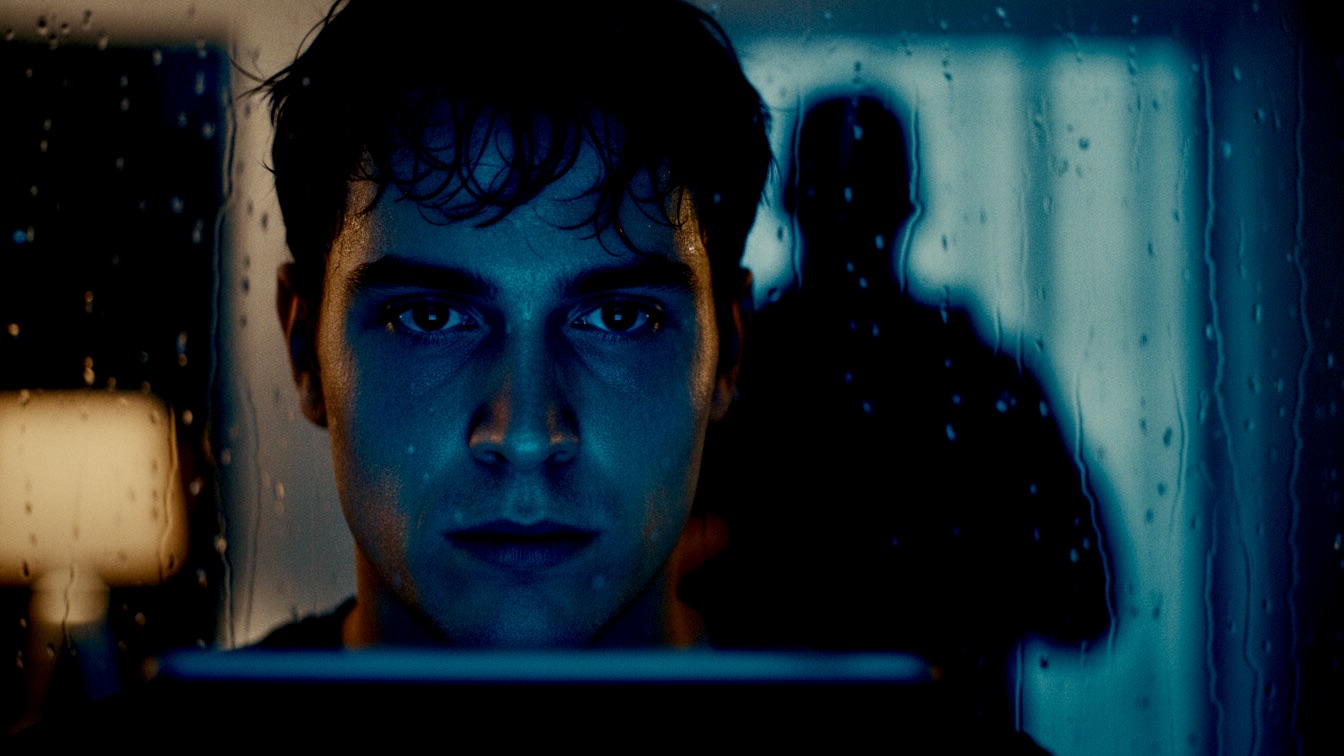
Paul watches Ben struggle with the isolation required to rewire a mind for the incoming, unseen summer heat.
The glass didn't vibrate when the wind hit. It was too thick for that, custom-tempered panes that cost more than the sedan Ben had abandoned at the trailhead three miles back. Paul sat in the Eames chair, his fingers tracing the rim of a crystal tumbler that held nothing but lukewarm water. He watched Ben. The boy—though twenty-four was hardly a boy in the eyes of the law—was currently trying to disassemble a modular server rack with a precision screwdriver that looked like a needle in his trembling hand. The sun was a white-hot disc hanging over the lake, bleaching the dock until the wood looked like bone. There were no birds. The silence in the valley was a physical thing, a pressurized seal that made the inner ear ache.
"The screw is stripped," Ben said. He didn't look up. His neck was red, a combination of the relentless July UV and the rising tide of frustration. He had been at the same three bolts for forty minutes.
"It isn't stripped," Paul replied. His voice was a dry scrape, low and devoid of the performative empathy Ben was clearly fishing for. "Your grip is inconsistent. You are treating the tool like a suggestion. It is a command."
Ben dropped the screwdriver. It clattered against the slate floor, the sound echoing through the open-plan living room like a gunshot. He stood up, his joints popping. He walked to the floor-to-ceiling window and pressed his forehead against the cool glass. Outside, the heat shimmered off the surface of the water, creating a mirage of oily rainbows that danced just above the lilies. The world looked unstable. It looked like it might dissolve if the temperature rose another degree.
"I can't think in this," Ben muttered. "It’s too quiet. It’s like the world stopped breathing."
"That is the point of the isolation," Paul said. He didn't move. He hadn't moved for an hour. "The noise of your life was a crutch. You used the chatter to drown out the fact that you were standing still. You think you were 'grinding' back in the city? You were just vibrating in place. Levelling up isn't a social activity. It’s a surgical one. You have to cut away the parts of you that need an audience."
Ben turned around. His eyes were bloodshot. The lack of sleep was starting to carve hollows under his cheekbones, making him look older, or perhaps just more desperate. "You make it sound like I'm joining a cult. I came here to learn the architecture of the new markets. I didn't come here to sit in a glass box and lose my mind."
"The market is the mind," Paul said. He finally took a sip of the water. It was flat. "If you cannot control the silence of this room, how do you expect to control the chaos of a billion-dollar liquidity event? You want the results. Everyone wants the results. But you’re terrified of the process because the process requires you to be alone with the version of yourself that fails. That’s the shame you’re running from. The rejection of the man you were yesterday."
Ben looked back at the server rack. The black metal casing seemed to absorb the light, a dark monolith in the center of the bright, airy room. It represented the future Paul had promised—a system of decentralized nodes that would bypass the traditional gatekeepers of the 2026 financial collapse. But to build it, Ben had to become a gatekeeper of his own focus. He had to endure the physical ache of boredom and the psychological rot of isolation.
"I’m not running," Ben said, though his voice lacked conviction. He picked up the screwdriver again. He didn't look at Paul. He looked at the tiny, silver head of the screw. He imagined it was the eye of an enemy.
"You are," Paul said. "You’re running toward the door every time your brain starts to itch. Sit down. Finish the rack. The heat isn't going anywhere. Neither are we."
Paul watched the boy’s shoulders drop. The tension didn't leave him; it just migrated, settling into the small of his back, into the grip on the tool. This was the first stage of the burn. The summer was young, and the isolation was only beginning to settle. The light shifted as a cloud passed over the sun, turning the room a bruised shade of purple for a fleeting second. In that flicker of shadow, Paul thought he saw something move at the edge of the tree line. A vertical shape that didn't belong to a trunk. He didn't blink. He didn't point it out. If Ben was going to survive what was coming, he had to learn to see the threats himself. He had to learn that the silence wasn't empty. It was occupied.
Ben’s screwdriver bit into the metal. A harsh, grinding sound filled the room. It was the sound of progress, or perhaps the sound of something breaking. Paul didn't care which it was, as long as it wasn't the silence of a man giving up. The transition from mediocrity to mastery was always violent, even if the violence was contained within a single, stripped screw.
"Focus on the torque," Paul whispered, more to the room than to the boy. "Feel where the resistance starts. That’s where the truth is."
Ben didn't respond. He was sweating now, the salt stinging his eyes, but he didn't wipe it away. He kept his hand steady. He was starting to learn that the ball was in his court, and the court was a lonely, airless place. The summer sun returned with a vengeance, hitting the glass like a hammer. The heat was a physical presence, a guest that had invited itself in and refused to leave. It was going to be a long afternoon.
By four o'clock, the light in the valley had turned a thick, syrupy gold. It was the kind of light that made everything look expensive and fragile. Ben had managed to open the server casing, revealing a labyrinth of fiber optics and copper heat sinks that looked like a miniature city. He sat on the floor, his legs crossed, staring at the circuitry as if it might speak. His shirt was stuck to his spine. The air conditioning in the house was humming, a low-frequency vibration that Paul had set to sixty-eight degrees, but it felt like it was losing the battle against the glass.
"Why this house?" Ben asked. He hadn't looked at Paul in nearly an hour. His voice was thinner now, worn down by the focus.
Paul leaned his head back against the leather. "Privacy is the only currency that doesn't devalue. In the city, you are tracked by the very pavement you walk on. Here, the only thing tracking you is the sun. And me."
"It feels like a tomb," Ben said. He touched a capacitor with the tip of his finger. "A high-end, architectural tomb."
"Every great achievement is a burial of what came before," Paul replied. "You want to 'level up,' as your generation says. You want the balls to take the risks. But you don't realize that the biggest risk isn't losing money. It's losing the comfort of your own mediocrity. It’s the shame of realizing you were happy being small."
Ben let out a short, jagged laugh. "I was never happy being small. I was just tired of being broke."
"Being broke is a temporary state of the ledger," Paul said, his eyes narrowing. "Being small is a permanent state of the soul. You think the isolation is about the work? The work is secondary. The isolation is about the separation. You have to separate yourself from the herd before the herd tramples you. The world is going to break in the next eighteen months, Ben. The systems you trust—the banks, the cloud, the very idea of a career—are all built on sand. This server is the first brick in a fortress. But a fortress is only as strong as its commander."
Ben looked at the server, then back at the window. The reflection of the room was beginning to appear on the glass as the exterior light began its slow decline. He could see himself, a pale, disheveled version of the confident kid who had walked into Paul’s office six months ago. He looked frightened. He looked like someone who had realized the door was locked from the outside.
"What happens if I can't do it?" Ben asked. The subtext was clear: What happens if you decide I'm not worth the investment?
Paul didn't answer immediately. He watched a dragonfly hit the glass, a soft thwack that left a tiny smear of iridescent dust. The insect flew away, unharmed but confused. "The shame of rejection is a powerful motivator. But the shame of self-betrayal is what kills you. If you can't do this, you go back to the city. You get a job in a cubicle. You spend your weekends drinking overpriced gin and complaining about the government. You live a long, unremarkable life. And every morning, when you look in the mirror, you’ll see the man who couldn't handle a quiet room in July."
Ben winced. The words were precise, aimed at the soft tissue of his ego. Paul was a master of the verbal scalpel. He didn't need to shout; he just needed to be accurate.
"I’m not going back," Ben said. He reached for a bundle of cables. "I’m finishing the bridge. I’m going to make the connection."
"Then stop talking about the tomb," Paul said. "The dead don't build bridges. Only the ones who have the balls to die to their old selves and be reborn as something harder. Something colder."
Paul stood up, his movements fluid despite his age. He walked to a small sideboard and poured another glass of water. He didn't offer one to Ben. The boy had to learn to manage his own thirst. He walked to the window, his gaze scanning the shadows that were stretching out from the forest. The shape he had seen earlier was gone, or perhaps it had simply integrated into the deeper dark of the pines. There was a shift in the air, a drop in the barometric pressure that suggested a storm was building behind the ridge. The heat was peaking, the atmosphere becoming brittle.
"The silence is changing," Paul murmured, mostly to himself.
"What?" Ben asked, his head snapping up.
"Nothing. Focus on the ports. The pins are fragile. One mistake and you’ve turned a million dollars of hardware into a very expensive paperweight."
Ben went back to work, his movements more deliberate now, his breathing shallow. He was entering the zone, that narrow corridor of hyper-focus where the rest of the world ceases to exist. Paul watched him for a moment longer, a flicker of something resembling pride—or perhaps just grim satisfaction—crossing his face. It was the look of a craftsman watching a blade take its edge. The isolation was working. The separation was complete. Now, there was only the focus, and the unseen threat that was waiting for the light to fail entirely.
The storm didn't break. It hovered behind the mountains like a threat that refused to escalate, leaving the valley in a state of suspended animation. The cicadas, which usually provided a constant, buzzing backdrop to the summer heat, suddenly went silent. It was a localized extinction of sound, a vacuum that made Paul’s skin prickle. He was standing by the bookshelf, a heavy volume of historical economics in his hand, but he wasn't reading. He was listening to the house.
Modern houses like this one were designed to be quiet, but they had their own vocabulary. The expansion of the wood, the hum of the HVAC, the click of a relay—these were the heartbeats of the structure. But there was a new sound. A rhythmic, metallic scraping coming from the deck. It was faint, nearly lost under the drone of the air conditioner, but it was there.
Ben didn't notice. He was deep in the server's guts, his hands steady as he seated the last of the memory modules. He was sweating through his second shirt of the day, his face illuminated by the harsh blue glow of a diagnostic tablet. He had found the ball. He was running with it.
"Ben," Paul said. It wasn't a shout, but the name cut through the boy’s concentration like a wire.
"I’m almost done, Paul. Just the handshake protocol left."
"Step away from the glass."
Ben paused, a module halfway into its slot. He looked up, his brow furrowed. "What? I need the light. I’m nearly there."
"Move to the kitchen island," Paul commanded, his voice dropping an octave. "Now. Do not look outside. Do not make any sudden movements."
Ben’s face went pale. The confidence he had built over the last few hours evaporated, replaced by the raw, unpolished instinct of a trapped animal. He did as he was told, sliding across the slate floor on his knees before standing and retreating behind the marble counter of the kitchen. He left the server open, its blue light pulsing like a dying star.
"Paul, what is it?" Ben whispered. His voice was shaking.
"Someone is on the perimeter," Paul said. He didn't move from the bookshelf. He was positioned in a blind spot, a sliver of shadow between the glass and the stone fireplace. "They’ve been watching the house for at least two hours. They waited for the cicadas to drop. They know the rhythm of the valley."
"Is it... them?" Ben’s eyes were wide. "The people from the city? The ones you said were tracking us?"
"It doesn't matter who they are," Paul said. "It only matters that they are here, and we are isolated. This is the risk you were talking about, Ben. This is the part where the theory ends and the physical reality begins. You wanted to level up? This is the test. The world doesn't just let you walk away with its secrets. It tries to take them back."
Paul reached behind a row of leather-bound books and pulled out a compact, matte-black handgun. He checked the chamber with a practiced, mechanical motion. The sound of the slide racking was the loudest thing in the room.
Ben stared at the gun. "I thought this was about finance. I thought this was about the architecture of the new world."
"It is," Paul said. "And this is the security system. Did you think a million-dollar decentralization project wouldn't require a physical defense? The balls to take risks, Ben. Remember? This is the endurance part. The part where you don't get to feel safe."
Outside, the light had faded to a bruised charcoal. The shadows of the trees reached all the way to the house now, long, skeletal fingers that seemed to be pulling the darkness closer. A shape moved on the deck. A shadow detached itself from the railing and drifted toward the sliding glass door. It was human, or at least human-shaped, dressed in dark technical gear that blurred its outlines.
Paul didn't fire. He waited. The deliberate pacing of the threat was designed to induce panic, to force a mistake. The intruder tapped on the glass. Three slow, rhythmic knocks. It wasn't an attempt to break in; it was a greeting. A claim of ownership.
"They know we're here," Ben hissed. He was crouched behind the marble, his fingers gripping the edge so hard his knuckles were white. "What do we do?"
"We do nothing," Paul said. "We wait for them to make the first move. If they wanted us dead, they would have fired through the glass minutes ago. They want the server. They want the bridge you just built. They’re waiting for the handshake."
"I haven't finished it," Ben said, a frantic note entering his voice. "If they take it now, it’s useless. The encryption hasn't been keyed."
"Then you have two choices," Paul said, his gaze fixed on the shadow outside. "You can stay behind that counter and hope I can stop them. Or you can finish the work. You can take the ultimate risk. You can stand up in the light, finish the key, and lock them out forever. But you’ll be a target. You’ll be the only thing they see."
Ben looked at the server. The blue light was still pulsing, a rhythmic heartbeat in the center of the room. He looked at Paul, who stood like a statue in the shadows, the gun a natural extension of his arm. Then he looked at the glass. The intruder was standing still now, a dark silhouette against the dying summer light.
"This is the separation," Paul whispered. "Choose who you are."
Ben took a breath. It was a jagged, desperate thing. He looked at the screwdriver on the floor. He looked at the tablet. The silence of the room was no longer a burden; it was a challenge. He realized that the mediocrity he had feared wasn't just about money or status. It was about the fear of being seen. It was about the fear of standing in the light when the world was trying to drag you into the dark.
He moved. Not toward the door, but toward the server. He didn't run; he walked, his feet silent on the slate. He sat down in the blue glow, his back to the glass, his back to the intruder. He picked up the tablet. His hands were no longer trembling. The torque was right. The focus was absolute. He began the final handshake protocol, his fingers flying across the screen. He was no longer a boy in a glass box. He was a commander in a fortress. And the summer heat was just a background detail.
The intruder didn't move when Ben sat down. The silhouette remained static, a dark sentinel watching the boy work. The subtext of the moment was suffocating—a silent negotiation between the one who builds and the one who takes. Paul stayed in his shadow, his weapon leveled at the center of the intruder’s mass. He didn't breathe. He was a part of the architecture, a structural element of the defense.
Ben’s world had shrunk to the size of the tablet screen. Lines of code scrolled past, a digital waterfall of green and white text. Initializing... Authenticating... Key Exchange in Progress. The server hummed louder now, the cooling fans kicking into high gear to handle the processing load. The sound was a mechanical roar in the silence of the house.
"Sixty percent," Ben whispered. He didn't know if he was talking to Paul or himself.
"Keep going," Paul said. "Don't look back."
A second shadow appeared on the deck. Then a third. They didn't try the door. They didn't produce weapons. They simply stood there, a row of dark figures watching the blue light flicker inside the glass house. It was a psychological siege. They were waiting for Ben’s nerves to snap. They were waiting for him to realize the hopelessness of his position. But Ben wasn't looking at them. He was looking at the progress bar.
"Eighty percent."
Outside, the first bolt of lightning finally cracked the sky. It wasn't a distant rumble; it was a violent, white-blue explosion that illuminated the valley for a fraction of a second. In that flash, the intruders were revealed in terrifying detail: masks, tactical vests, the glint of lenses. They weren't just thieves; they were a professional recovery team. The 'herd' that Paul had warned him about had arrived.
"They’re moving," Paul said, his voice as cold as the marble counter.
One of the figures raised a heavy, blunt-nosed tool—a battering ram or a breaching charge. They were done waiting. The handshake was taking too long, and they had decided to take the hardware by force.
"Ninety percent," Ben gasped. His thumb hovered over the final 'Execute' command. The screen was flashing a warning: Interrupted connection will result in total data loss. Confirm?
"Paul!" Ben screamed as the figure with the ram stepped forward.
"Finish it!" Paul roared.
Paul stepped out of the shadows. He didn't fire at the glass. He fired at the frame, the heavy slugs shattering the locking mechanism and the hinges. If they were coming in, he was going to control the entry. The sound of the shots was deafening in the enclosed space, a series of concussive thuds that vibrated in Ben’s chest.
Ben hit 'Confirm.'
The screen went black for a heartbeat, then a single word appeared in the center: SECURED.
The server emitted a long, low beep, and then the blue light died. The 'bridge' was locked. The encryption keys had been distributed to a thousand anonymous nodes across the globe. The fortress was complete, and the architects were no longer necessary.
At that exact moment, the glass door shattered. It didn't break into shards; it disintegrated into a million tiny diamonds that sprayed across the floor like frozen rain. The heat of the summer night rushed into the room, thick and oppressive, accompanied by the sudden, violent roar of the wind. The storm had finally arrived.
Paul fired again, two quick shots into the dust and the dark. Someone groaned outside. A flash-bang grenade skittered across the slate, bouncing off the server rack before rolling toward Ben’s feet.
"Close your eyes!" Paul yelled.
Ben didn't have time to think. He threw himself over the server, protecting the machine with his body, though he knew it was pointless. The grenade detonated—a blinding white sun that turned the world into a scream.
When the spots cleared from Ben’s eyes, the room was a chaotic blur of grey smoke and swirling rain. The air conditioner was still humming, a surreal, domestic sound amidst the wreckage. He could hear the heavy boots of the intruders on the slate. They were inside. They were moving toward him.
He looked up. Paul was on the floor, his back against the fireplace, his gun gone. He was holding his side, his fingers dark with something that looked like ink in the dim light. He wasn't dead, but he was finished. He looked at Ben, his eyes clear and terrifyingly calm.
"The dividend," Paul wheezed. "You paid it."
One of the intruders reached for Ben’s shoulder, a gloved hand closing like a vice. Ben didn't fight. He didn't scream. He looked at the server, then at the man in the mask. He felt a strange, cold sensation wash over him. It wasn't fear. It was the realization that the isolation hadn't ended when the glass broke. It had just expanded to include the whole world.
He had leveled up. He had taken the risk. He had endured the shame of his own terror and come out the other side. He was no longer the boy who ran. He was the man who had locked the door and thrown away the key, even while he was still inside the room.
As the intruder jerked him to his feet, Ben looked out at the lake. The water was white with foam, the surface whipped into a frenzy by the storm. The summer was over. The winter of the new world was beginning, and he was the only one who knew the password.
“As the intruder jerked him to his feet, Ben looked out at the lake and realized the man holding him had no idea the server was already empty.”


