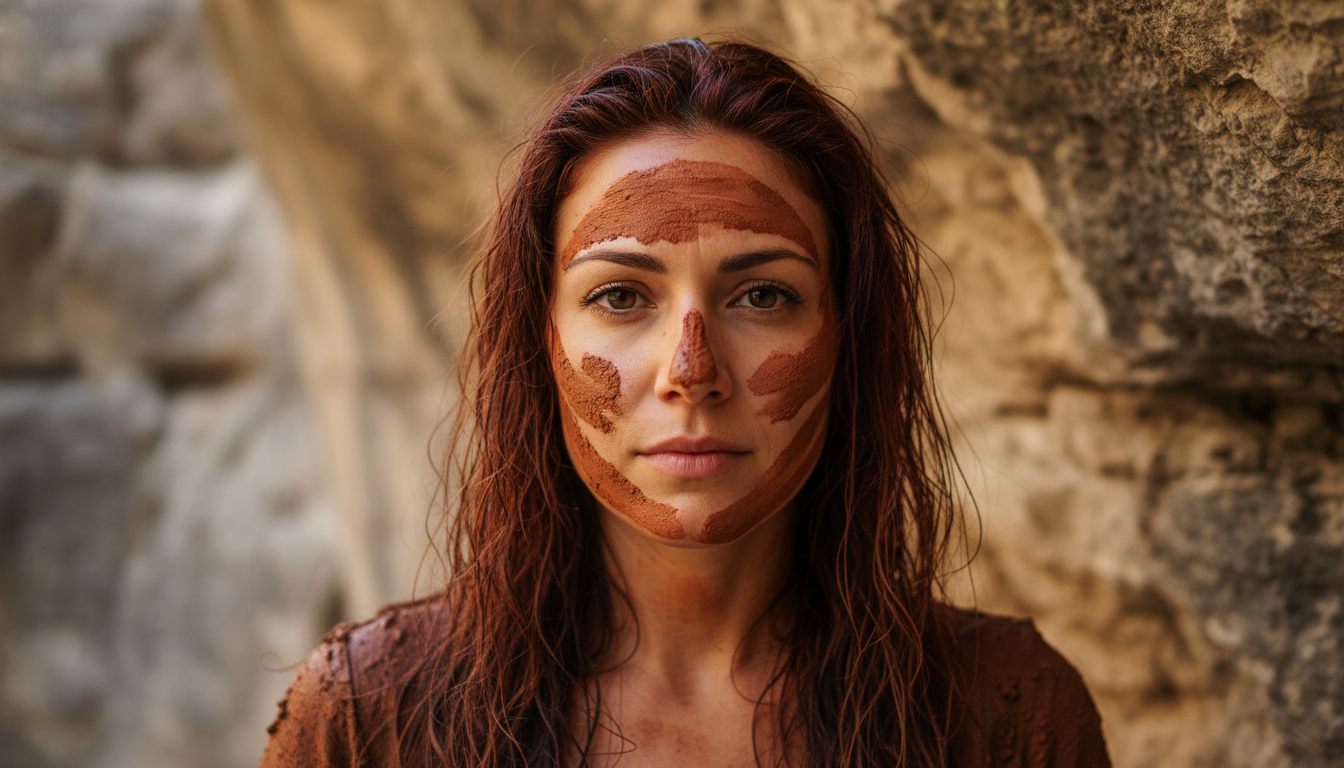
The story follows Jasmine, a former mountain guide whose career and reputation were destroyed after a fatal climbing accident three months prior. Living in a van and enduring relentless online harassment, she discovers a livestream of a young acquaintance named Brian, who is preparing to end his life at Red Clay Gorge. Despite her physical injuries and her status as a social pariah, she drives into a brewing monsoon to reach him.
Upon arrival, Jasmine finds Brian perched on a precarious sandstone spire, more concerned with his digital audience than the imminent flash flood. She confronts him with the brutal reality of his situation, stripping away the cinematic illusions he has built around his "final exit." As the spire collapses, she saves him from the fall, and the two are swept away by a violent surge of mud and debris.
They manage to survive the torrent and find temporary shelter in a limestone alcove. In the quiet aftermath of the storm, Jasmine and Brian share a moment of raw, unmediated human connection, stripped of digital filters and social media performance. The story concludes with their rescue by a search-and-rescue helicopter, as Jasmine finds a sense of internal peace by successfully bringing her "team" home.
The narrative explores the profound disconnect between digital performance and physical reality. Brian views his impending death as a "climax" for an audience of avatars, treating his own life as a sequence of content beats rather than a precious existence. Jasmine serves as the catalyst for his return to the physical world, forcing him to acknowledge that nature does not care about his engagement metrics or his "aesthetic."
The theme of social death and "cancel culture" is also central to the text. Jasmine is living in a state of post-social existence, where the internet has already pronounced her dead or monstrous. This shared state of being "canceled" or "glitched" creates a unique bond between her and Brian. However, while Brian seeks to finalize this social death with a physical one, Jasmine uses her survival skills to prove that reality exists outside the reach of the digital mob.
Nature is portrayed as an indifferent, leveling force that exposes the futility of human ego. The monsoon and the resulting flash flood do not provide a cinematic backdrop for Brian’s drama; instead, they represent a chaotic, dangerous "vibe-shift" that threatens to erase both characters without prejudice. The red clay itself acts as a metaphor for the messy, unrefined nature of existence that cannot be captured or curated by a smartphone camera.
Finally, the story touches on the nature of redemption and hope. Jasmine does not offer Brian a traditional "it gets better" speech, recognizing that such platitudes are often as hollow as the digital noise he is fleeing. Instead, she offers him the truth of physical persistence. Redemption for her is not found in clearing her name, but in the simple, grueling act of saving a life, reclaiming her identity as a guide in the most literal sense.
Jasmine is a woman defined by her trauma and her refusal to succumb to the "noise" of her detractors. She carries the physical and psychological weight of her past failures, manifested in her aching joints and her cynical outlook on the climbing community. Her decision to save Brian is not an act of traditional heroism, but a professional reflex that allows her to bypass her own self-loathing. She views herself as a tool that still has a function, even if the world has discarded her.
Her psychological state is one of "functional depression," where she maintains her skills and instincts despite having no audience for them. By confronting Brian, she is also confronting the parts of herself that wanted to give up after the North Face accident. She uses her "cancellation" as a shield, realizing that because she has already lost everything, she is the only person who can speak the harsh truth to Brian without fear of consequence.
By the end of the journey, Jasmine experiences a shift from isolation to a renewed sense of purpose. She realizes that the "real" world—the one that hurts, bleeds, and smells of wet sage—is the only one that matters. Her internal conflict is resolved not by an apology from the public, but by her own recognition that she is still capable of protection and leadership. She finds peace in the silence that follows the storm, finally silencing the "buzzing" of the world.
Brian represents the psychological casualties of the digital age, a young man who has externalized his entire identity. He suffers from a deep sense of "digital exhaustion," where the pressure to perform for an algorithm has rendered his actual life meaningless. He is not necessarily suicidal in a traditional sense; rather, he is trying to escape a simulation that he feels has already rejected him. His "final exit" is a desperate attempt to regain control over his own narrative.
His reliance on the gimbal and the livestream during a life-threatening storm highlights his dissociation from his own body. He is more afraid of being ignored or "cringe" than he is of drowning in a flash flood. When Jasmine breaks his gimbal and forces him into the mud, she effectively performs an intervention that shocks his system back into a state of somatic awareness. His tears at the end are a sign of his re-entry into the world of genuine emotion.
Through his interaction with Jasmine, Brian moves from being a "content creator" to being a survivor. The loss of his phone is a symbolic death of his digital persona, allowing his true self to emerge in the cold and the pain. He begins the story looking for a witness to his death, but he ends it by finding a witness to his life. His final realization is that the "noise" of the internet is optional, while the "fight" of reality is mandatory.
The pacing of the story mirrors the onset of a desert monsoon, beginning with a stagnant, oppressive heat and rapidly escalating into a violent, fast-moving torrent. The initial paragraphs are heavy with the "stagnant air" of Jasmine’s isolation, creating a sense of inertia that is shattered by the "rhythmic, aggressive vibration" of the phone. This transition sets the tone for a narrative that values sudden, visceral action over prolonged reflection.
Sensory details are used to ground the reader in the harsh reality of the desert. The author focuses on textures and smells—the "wet cardboard" of the sandstone, the "smell of wet asphalt and ozone," and the "red-stained wasteland." These descriptions serve a thematic purpose, contrasting the "high-contrast, blown out" quality of the digital livestream with the gritty, multi-sensory experience of the actual gorge. The use of "red clay" as both a setting and a literal lubricant for the action emphasizes the messy nature of survival.
The narrative voice is cynical and sharp, reflecting Jasmine’s internal state. She uses modern terminology like "vibe-shift," "glitch," and "engagement metrics" with a sense of weary detachment, showing how the language of the internet has infected even those who try to escape it. This linguistic choice highlights the tragedy of Brian’s situation, as he literally lacks the vocabulary to describe his pain without using the metaphors of the very system that is killing him.
The ending of the story provides a stark contrast to the opening, replacing the aggressive buzzing of the phone with the "rhythmic thwack-thwack-thwack" of the helicopter. This shift in sound design signifies a transition from the chaotic, unorganized noise of the digital mob to the structured, purposeful intervention of the real world. The final tone is one of quiet resilience, leaving the reader with a sense of "groundedness" that matches the characters' mud-caked reality.


