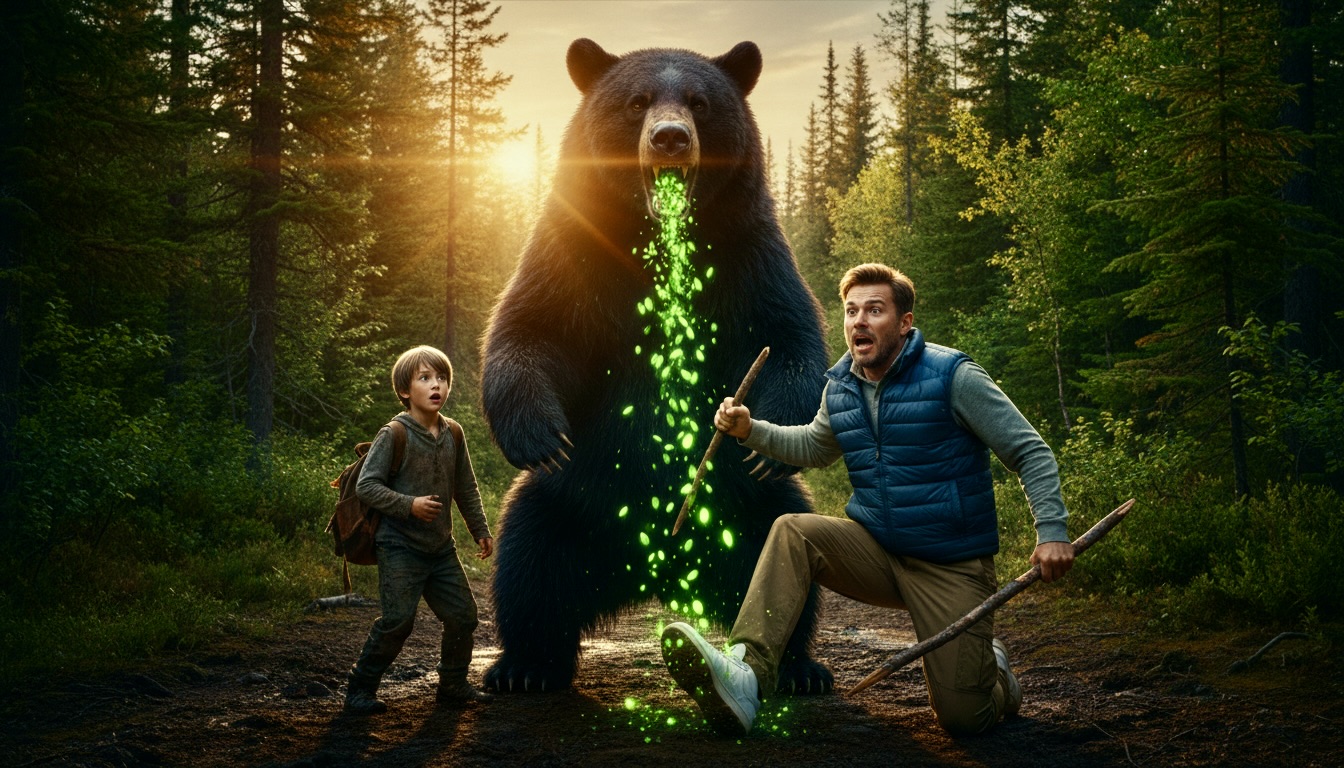
Dave, a ten-year-old boy, finds himself at a summer technology camp that is actually a misguided corporate venture led by Jason, a tech entrepreneur. Jason intends to disrupt the boreal forest by planting genetically modified super-kale, ignoring the warnings of Marla, a local agricultural expert. The group treks into the wilderness, where Jason’s reliance on apps and buzzwords leads them into a series of disasters, including poisoning and a dangerous fall into a ravine.
The expedition culminates in a terrifying encounter with a black bear that finds the super-kale so unpalatable it vomits on Jason’s shoes. Marla eventually leads the group back to safety, providing a harsh reality check to Jason’s delusions. However, the story concludes with Jason appearing on television a week later, having rebranded the near-fatal failure as a new high-stakes survival platform. Dave watches this from the safety of his home, ultimately choosing to disconnect from the digital noise.
The primary theme of the story is the profound disconnect between modern technological hubris and the unyielding reality of the natural world. Jason represents a specific brand of corporate delusion that believes every problem can be solved with an algorithm, a pivot, or a blockchain-based solution. He views the forest not as a complex ecosystem, but as a marketplace or a node that needs optimization. This arrogance leads him to ignore local expertise and physical warning signs, resulting in literal poisoning and physical danger.
Another central theme is the commodification of failure within venture capital culture. Despite the objective disaster of the expedition, Jason is able to reframe the experience to secure more funding. The narrative suggests that in the tech world, the truth of an experience matters less than the narrative constructed around it. Jason does not learn humility from the bear or Marla; he merely learns a new way to market his incompetence as a beta test.
The story also explores the loss of childhood innocence through the eyes of Dave. He is caught between the adult world of corporate jargon and the harsh, sensory reality of the woods. While Jason lives in a world of metrics and spreadsheets, Dave experiences the world through wet socks, mosquito bites, and the smell of bear vomit. His eventual decision to turn off the television signifies a rejection of the artificial narratives that adults use to mask their failures.
Dave serves as the grounded, sensory-driven protagonist who provides a sharp contrast to Jason’s abstract delusions. At ten years old, he lacks the vocabulary of a Junior Growth Hacker, but he possesses a keen ability to observe the physical world as it truly is. He is a reluctant participant, dragged into the expedition by a mother who believes she is helping him. His internal conflict stems from being forced to endure physical hardship for a cause he recognizes as nonsensical from the start.
Psychologically, Dave represents the ego trying to navigate between the wildness of the forest and the artificiality of corporate expectation. He is the only character who seems to feel the weight of the situation literally, as the heavy seed bags cause him physical pain that Jason ignores. By the end of the story, Dave has gained a cynical wisdom beyond his years. He recognizes that the disruption Jason preaches is a hollow lie, leading him to choose the silence of a black screen over the noise of the tech world.
Jason is the quintessential antagonist of the narrative, characterized by a pathological level of narcissism and a detachment from reality. He uses language as a shield, hiding his incompetence behind jargon like experiential youth onboarding and decentralized forest gardens. His psychology is defined by a refusal to accept feedback, which he ironically calls a gift while ignoring Marla’s expert advice. Even when he is poisoned and hallucinating, he attempts to apply his corporate framework to the trees and animals.
His reaction to the bear encounter reveals his underlying cowardice and fragility. Despite his talk of aggressive negotiation and dominance, he immediately hides behind a ten-year-old boy when faced with actual danger. Jason’s true talent is his resilience, but it is a toxic form of resilience that lacks self-reflection. He is unable to experience shame, which allows him to transform a traumatic failure into a million-dollar seed round within a single week.
Marla functions as the voice of reason and the archetype of the expert who is both nurturing and unforgiving. She is physically defined by her connection to the dirt, with her mud-stained pants and scratched leather boots serving as a direct counterpoint to Jason’s pristine white sneakers. Her motivation is the protection of the ecosystem she understands and respects. She is the only adult in the story who treats the forest as a real place rather than a playground for profit.
Her psychological role is that of the mentor who arrives too late to prevent the disaster but is essential for the survival of the group. She expresses her care through harshness and competence rather than soft words. While she saves the children and even Jason from their own stupidity, she is left frustrated by the realization that her logic cannot penetrate Jason’s delusional bubble. She represents the exhaustion of the expert in a world that increasingly values disruption over experience.
The pacing of the chapter mimics the grueling nature of the expedition, starting with a slow, stifling boardroom scene and escalating into a frantic survival situation. The author uses short, declarative sentences to emphasize the physical discomfort Dave feels. This creates a staccato rhythm that reflects the step-squish-step of the muddy hike. The transition from the sterile, air-conditioned city council room to the dark, wet swamp highlights the shift from abstract theory to visceral reality.
Sensory details are the strongest element of the narrative voice, focusing heavily on unpleasant textures and smells. The author describes the heavy and wet air, the stringy raccoon saliva, and the neon green vomit of the bear. These details ground the reader in Dave’s perspective, making the tech jargon feel even more absurd and out of place. The contrast between Jason’s white sneakers and the brown swamp water serves as a recurring visual metaphor for his doomed attempts to impose order on nature.
The tone of the story is deeply satirical, bordering on the grotesque. It mocks the language of Silicon Valley by placing it in the most inappropriate context possible. The humor is dark, particularly during Jason’s berry-induced hallucinations where he attempts to disrupt the pinecone. This tonal choice serves to alienate the reader from Jason’s worldview, ensuring that the audience sympathizes with Dave’s quiet exhaustion and Marla’s vocal frustration.


