Format: Short Film / Anthology Episode | Est. Length: 10-12 minutes
This story serves as a standalone entry in The Disruption Chronicles, an anthology series that satirizes the collision between Silicon Valley "solutionism" and the unyielding laws of biology and physics. Each episode follows a different "visionary" attempting to apply tech-industry logic to ancient, complex systems—such as the boreal forest—only to be met with catastrophic, albeit darkly comedic, results. The series highlights the collateral damage of these ventures through the eyes of the "interns" and locals who are forced to navigate the fallout of corporate hubris.
Ten-year-old Dave sits in a sweltering city council room, realizing his "technology camp" is actually a front for a delusional startup founder’s plan to "hack the dirt" of the boreal forest.
A tech-obsessed entrepreneur drags a group of reluctant interns into the wilderness to plant genetically modified kale, only to realize that nature cannot be disrupted by a pitch deck. When a bear rejects their "superfood" and a local expert intervenes, the founder simply rebrands the disaster into a new investment opportunity.
The primary theme is the absurdity of "techno-optimism" and the profound disconnect between digital abstractions and biological reality. It explores how corporate language is weaponized to mask failure, transforming a life-threatening survival situation into a "beta test" or a "pivot." The story suggests that modern tech culture has become a self-sustaining loop of jargon that is entirely detached from the physical world it claims to improve.
The secondary theme is the loss of childhood innocence and the realization that adult authority is often a performance. Dave observes the adults around him—the delusional Jason and the pragmatic Marla—and realizes that the "future" being sold to him is a fragile construction. The episode functions as a coming-of-age story where the protagonist learns that the most important skill in the modern world is recognizing when a "visionary" is actually a hazard.
For Dave, the stakes are physical safety and the preservation of his sanity in a world governed by delusional adults who treat him as "experiential youth onboarding." For Marla, the stakes are the ecological integrity of the boreal forest, which faces the threat of invasive, "disruptive" species that could choke out native mosses. For Jason, the stakes are purely financial and ego-driven, as he risks the lives of minors and his own health to secure his next round of venture capital funding.
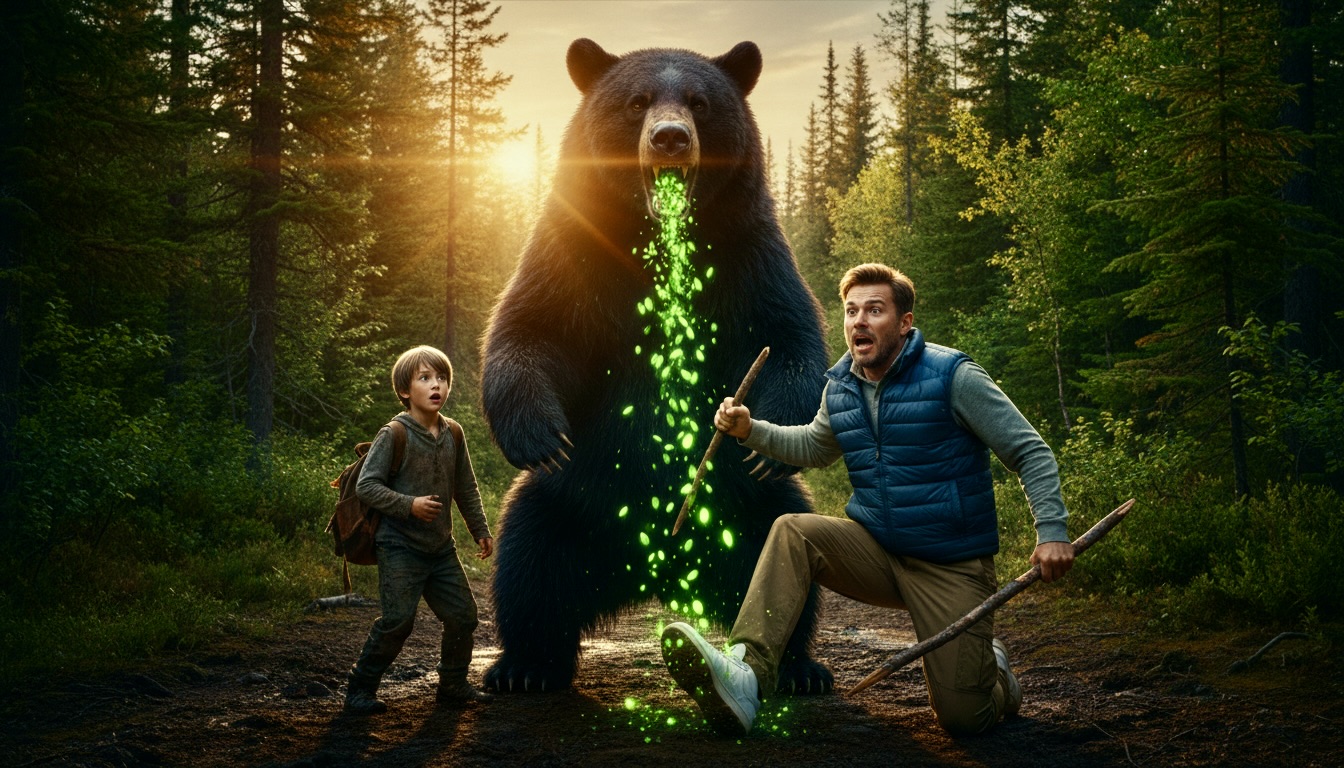
The primary external conflict is Man vs. Nature, as the group faces mosquitoes, swamps, poisonous berries, and a black bear, all of which are indifferent to Jason’s "algorithms." Internal conflict stems from Dave’s growing resentment toward his mother’s choice of camp and Jason’s refusal to acknowledge reality even when faced with a predator. The ultimate antagonistic force is Jason’s pathological narcissism, which treats every catastrophe—including being vomited on by a bear—as a "market signal" rather than a warning.
Dave, a ten-year-old hoping for a summer of video games, finds himself at a "Junior Growth Hacker" camp led by Jason, a tech-bro who intends to plant genetically modified "super-kale" in the boreal forest. Despite a public dressing-down from Marla, a local agricultural liaison who warns that the ecosystem will reject the invasive plant, Jason leads Dave and two teenagers into a swampy wilderness. Guided only by a glitchy app and carrying fifty-pound bags of "biodegradable hemp distribution pods," the group quickly descends into a physical nightmare of mud and mosquitoes.
The expedition collapses when Jason, trusting his phone over his eyes, eats toxic "Bane-berries" and enters a hallucinatory state where he attempts to "negotiate" with the forest. Marla eventually tracks them down to a deep ravine, where they are cornered by a massive black bear attracted to the scent of the modified seeds. After the bear eats the seeds and promptly vomits them back onto Jason’s shoes, the group is rescued by Marla. However, the episode ends with Dave watching Jason on television a week later, where the failure has been successfully rebranded as a million-dollar "BearMarket Survival" startup.
Dave: A cynical and observant ten-year-old who starts the story as a passive victim of his mother's parenting choices and ends as a silent witness to the ultimate corporate grift. His psychological arc moves from boredom to genuine terror, and finally to a state of quiet, disillusioned resignation about the adult world. He is the audience's surrogate, providing the grounded perspective necessary to highlight Jason's insanity.
Jason: A delusional startup founder who begins as a "visionary" and ends by rebranding a life-threatening bear attack as a million-dollar business model. He is incapable of internalizing feedback or physical pain, viewing every obstacle as a "metric" to be optimized. His arc is a flat line of narcissism; he does not learn or grow, but rather adapts his delusions to fit new failures.
Marla: A rugged, no-nonsense agricultural expert who serves as the voice of reason and the physical savior of the group. She represents the "real world" that Jason tries to disrupt, possessing the actual knowledge and survival skills required to navigate the forest. Her arc is one of mounting frustration, ending in a weary realization that logic cannot defeat a well-funded ego.
Beat 1: Dave sits in a sweltering, air-conditioned-deprived council room as Jason pitches a "decentralized forest garden" to a group of exhausted local officials. Jason ignores the scathing critiques of Marla, a local agricultural expert, and insists that his "super-kale" will solve food insecurity via the blockchain. Dave, a ten-year-old "Junior Growth Hacker," just wants to go home and play video games instead of being part of this "beta test."
Beat 2: The group enters the woods, where the physical reality of fifty-pound seed bags and mosquito-infested swamps immediately clashes with Jason’s "experiential onboarding" rhetoric. Dave’s shoes fill with brown swamp water and his skin is covered in bites, yet Jason insists that "discomfort is just weakness leaving the body." The tension rises as the "LeafSync" app loses its satellite signal, leaving the group lost in the dark canopy.
Beat 3: During a break, a fat raccoon steals their rations, forcing Jason to use his app to forage for "local nutrients." He misidentifies toxic, hard purple berries as "wild forest raspberries" and consumes a handful despite Dave’s obvious skepticism. Within ten minutes, Jason begins to hallucinate, attempting to "disrupt" a pinecone and lecturing a squirrel about its "asset allocation" as the sun begins to set.
Beat 4: Marla emerges from the brush to rescue the group, but a sudden mudslide sends everyone tumbling into a deep, steep-walled ravine. As they recover from the fall, a massive black bear enters the ravine, attracted by the smell of the neon-green, genetically modified seeds. Marla commands everyone to stay still, but the hallucinatory Jason decides to "show dominance" by confronting the predator with a rusty pitchfork.
Beat 5: Jason’s attempt at "aggressive negotiation" fails when he breaks his pitchfork against a rock, leaving him defenseless and hiding behind a terrified Dave. The bear ignores the humans and eats a mouthful of the glowing seeds, only to immediately and violently vomit the neon mush onto Jason’s white sneakers. The bear flees in disgust, proving that even a scavenger cannot stomach Jason’s "superfood," and Marla leads the humiliated group back to civilization.
Beat 6: A week later, Dave is home eating cereal and watching television when he sees Jason on a brightly lit stage in a brand new puffy vest. Jason announces to a cheering audience that the "kale initiative" was a successful failure that led to his new, million-dollar venture: "BearMarket Survival." Dave turns off the television, finally understanding that in Jason's world, the truth is just another thing to be disrupted.
The episode begins with a tone of dry, satirical comedy that slowly transitions into a tense, claustrophobic survival thriller. The audience experiences Dave’s mounting dread and physical discomfort, followed by a moment of peak absurdity during the bear encounter. The final beat leaves the viewer with a sense of cynical resignation as the antagonist is rewarded for his incompetence, mirroring Dave's own disillusionment.
In a full season, Jason would serve as a recurring antagonist, moving from one failed "disruption" to the next, leaving a trail of ecological and social destruction in his wake. Each episode would focus on a different victim of his schemes, with Dave appearing as a recurring "professional intern" who eventually uses his knowledge of tech-bro psychology to subvert a major corporate takeover in the season finale.
The thematic escalation would move from small-scale agricultural failures to larger infrastructure projects, such as "disrupting" a local power grid or a water treatment plant. Marla would act as the leader of a "Reality Resistance," a group of local experts trying to clean up Jason's messes. The season would conclude with the realization that the "market" cares more about a compelling narrative than a functional product.
The visual style should contrast the sterile, high-key lighting of the tech presentation with the muddy, desaturated, and oppressive greens of the boreal forest. Handheld camerawork in the woods should emphasize the chaos and physical strain, while the final TV segment should return to a glossy, over-saturated corporate aesthetic. The tone is a blend of Silicon Valley's corporate satire and The Revenant's grueling naturalism.
Color grading will play a vital role, with the "super-kale" seeds and vomit rendered in a sickly, unnatural neon green that feels out of place in the organic environment. Sound design will emphasize the "wetness" of the swamp—the squelch of shoes, the buzz of mosquitoes, and the liquid gurgle of the bear's stomach. This creates a sensory experience that highlights the physical reality Jason is trying to ignore.
The target audience includes adults and older teens who enjoy satirical dark comedies like Black Mirror or The White Lotus. It specifically appeals to viewers familiar with corporate jargon, "hustle culture," and the tech industry's tendency to over-promise and under-deliver. The presence of a child protagonist also makes it accessible to a younger demographic who can relate to the frustration of being forced into "educational" summer activities.
The pacing is brisk, moving from the static council room to the frantic hike within the first three minutes. The middle act slows down to emphasize the grueling, repetitive nature of the swamp trek, building a sense of "slow-burn" misery. The final five minutes accelerate into the high-tension ravine climax, followed by a sharp, punchy epilogue that lands the final satirical blow.
The bear encounter requires a mix of a trained animal for wide shots and high-quality practical effects/animatronics for the "vomit" sequence to maintain the dark-comedy tone. Using a real bear for the interaction with Jason would be too dangerous, so a combination of split-screen and a performer in a high-end creature suit may be necessary for the "negotiation" scene.
The "neon green" seeds and vomit will require specific color grading or fluorescent practical props to stand out against the natural forest floor. Production must also account for the challenges of filming in a genuine swamp or forest location, including moisture protection for equipment and the logistical difficulty of transporting "fifty-pound" props through rough terrain. Practical mud and "mosquito" effects will be prioritized over CGI to maintain the visceral, grounded feel of the story.


