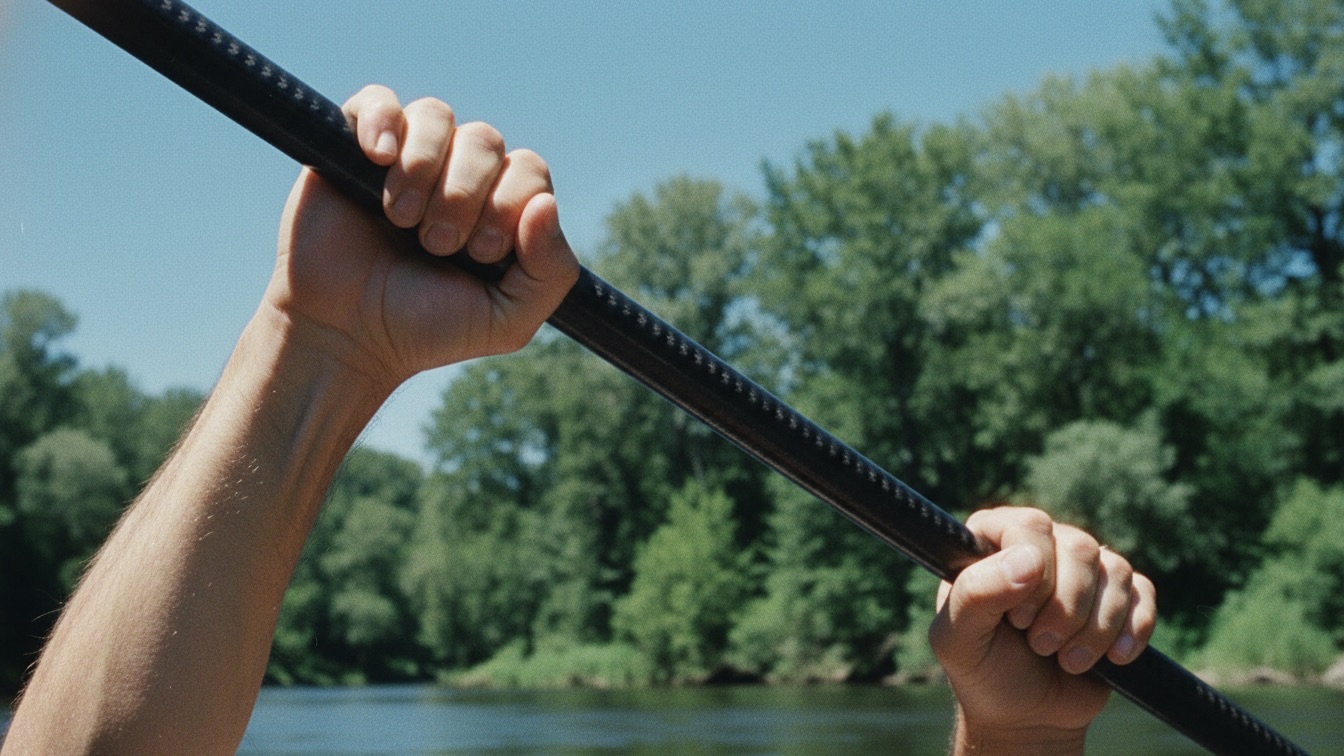
The story follows three middle-aged friends, Gary, Dave, and Linda, as they attempt to recreate a rugged kayaking trip from their youth on the Blackwood River. Upon arrival, they discover that the wild river they remembered from 2004 has been transformed into a hyper-commercialized, "Managed Flow Environment" complete with QR codes, digital waivers, and GPS-tracked safety drones. Gary, who has invested heavily in high-end gear to feel authentic, struggles with deep resentment as he realizes the experience is a sanitized simulation of nature.
A sudden, violent summer storm disrupts the artificial calm, but even nature’s fury is mitigated by the park's infrastructure. The trio finds themselves grounded on a concrete-paved riverbed designed for "user experience" before retreating to a luxury emergency pod. The trip concludes at a heritage-themed gift shop where they encounter a photograph of their younger selves. Seeing their past joy and grit, Gary realizes that while they have gained wealth and comfort, they have lost the raw, unmediated connection to life they once possessed.
The central theme of the narrative is the commodification of the "sublime" and the death of authentic experience in the digital age. The Blackwood River serves as a microcosm for a world where nature is no longer a force to be encountered, but a product to be consumed. By implementing "Managed Flow" and "Safe-Zone Pods," the wilderness is stripped of its danger and, consequently, its ability to provide genuine transformation. Gary’s frustration stems from the realization that he cannot buy his way back to the visceral reality of his youth.
Closely tied to this is the concept of the "hyperreal," where the simulation of an experience becomes more desirable or prominent than the reality itself. Dave’s insistence on viewing the river through his phone screen and his preference for filtered colors over the actual landscape highlights a psychological shift toward digital mediation. The characters are trapped in a loop where they use technology to record an adventure that the technology itself has rendered sterile. The "Memory Suite" offered at the end represents the final stage of this process, where the memory is pre-packaged and edited by an algorithm.
Finally, the story explores the psychological toll of aging and the pursuit of "comfort" as a substitute for "life." Linda’s admission that comfort is a "pretty good substitute for fun" at forty-five reflects a pragmatic but melancholy surrender to the limitations of the body and the soul. The contrast between the "Early Pioneers" photo and their current state illustrates the trade-off of the middle class. They have traded their vitality and "muddy" happiness for safety, high-end kayaks, and $12 macchiatos, leading to a profound sense of existential exhaustion.
Gary serves as the narrative’s moral and emotional anchor, embodying the "purist" who is painfully aware of his own hypocrisy. He possesses a deep-seated need for a "real" experience to validate his existence, yet he arrives at the river with a $4,000 carbon-fiber boat that symbolizes his participation in the very consumerism he loathes. His psychological state is one of "status anxiety," where he uses technical gear as a shield against the realization that he is no longer the "pioneer" he once was. He is a man who seeks a "blister" or a "scrape" because physical pain is the only thing the corporate "Blackwood Experience" hasn't managed to automate.
His internal conflict reaches a breaking point during the storm when he realizes the riverbed is made of concrete. This literal paving over of his memories causes a collapse of his "adventurer" persona, leaving him feeling like a "guest in a very expensive simulation." By the end of the story, Gary finds a small, bitter victory in his own physical suffering. The blisters on his hands represent a localized truth that cannot be deleted or filtered by an app. He chooses the pain of the blister over the beauty of the AI-generated sunset, signaling a desperate attempt to reclaim his humanity.
Dave represents the total assimilation of the modern individual into the digital landscape. Unlike Gary, he does not fight the "simulation" but instead embraces it as a means of managing his physical decline and anxiety. His obsession with battery percentages, 5G speeds, and "uploading the heron" suggests that his experiences only become real to him once they are validated by a digital audience. He is "blurred" and "softened," both physically and psychologically, reflecting a man who has traded his "invincibility" for the safety of the "Premium Tier."
Psychologically, Dave uses his phone as an emotional regulator to avoid the discomfort of the present moment and the reality of his aging body. When the storm hits, his first instinct is to check the app for instructions rather than trust his own senses. He views the "Managed Flow" not as a loss of nature, but as an improvement on a "death trap" past that he remembers only for its misery. His conflict with Gary in the pod reveals a man who is defensive about his need for comfort, equating his "bad knees" with a right to the luxury he has spent his life earning.
Linda is the most grounded and perhaps the most honest member of the trio. She approaches the trip with a weary pragmatism, recognizing the absurdity of Gary’s "technical" posturing and Dave’s digital addiction. While she enjoys the luxuries of the "Blackwood Experience," such as the oat milk macchiatos and the climate-controlled pod, she is not blind to what has been lost. Her character represents the "bridge" between the idealism of youth and the resignation of middle age, moving through the environment with a detached grace.
Her emotional peak occurs in the gift shop when she views the photograph of her younger self. The sight of her "swamp monster" hair and her genuine, uncurated laughter triggers a rare moment of vulnerability. She acknowledges that she hasn't laughed like that in a decade, revealing a hidden well of nostalgia and regret beneath her polished exterior. However, she ultimately chooses to return to her life of "showers that don't require a QR code," showing that while she mourns the past, she is no longer willing to endure the "mud" required to reclaim it.
The narrative voice is characterized by a sharp, satirical edge that borders on the cynical. The author uses highly specific, technical vocabulary—"Apex Predator," "Managed Flow Environment," "Gore-Tex shell"—to create a sense of cold, corporate artifice. This "technical" language stands in stark contrast to the organic, visceral descriptions of the 2004 trip, such as the "soggy pack of Marlboros" and the "tea-colored, churning mess." This linguistic shift mirrors the characters' own transition from participants in nature to consumers of a brand.
Sensory details are employed to emphasize the "uncanny valley" of the managed wilderness. The "Lo-fi beats" pumping from "artificial rockwork" and the "magnetic clamps" that click with a "high-tech thud" create an auditory landscape that feels intentionally wrong. The description of the river as "remarkably polite" and the heron that looks "bored" suggests a world where nature has been domesticated into submission. These details build a cumulative sense of unease, making the reader feel Gary’s resentment as he moves through this "liquid machine."
The pacing of the story mirrors the "Managed Flow" it describes, beginning with a stifling, heat-heavy stagnation and moving into a frantic, yet ultimately hollow, climax during the storm. The transition from the "Bear Point" deck to the "Concrete Rapids" is handled with a sense of escalating absurdity that highlights the theme of the simulation. The final scene in the gift shop slows the pace down significantly, allowing the emotional weight of the "Early Pioneers" photo to land. This quiet, melancholic ending provides a powerful counterpoint to the high-tech chaos of the preceding sections.


