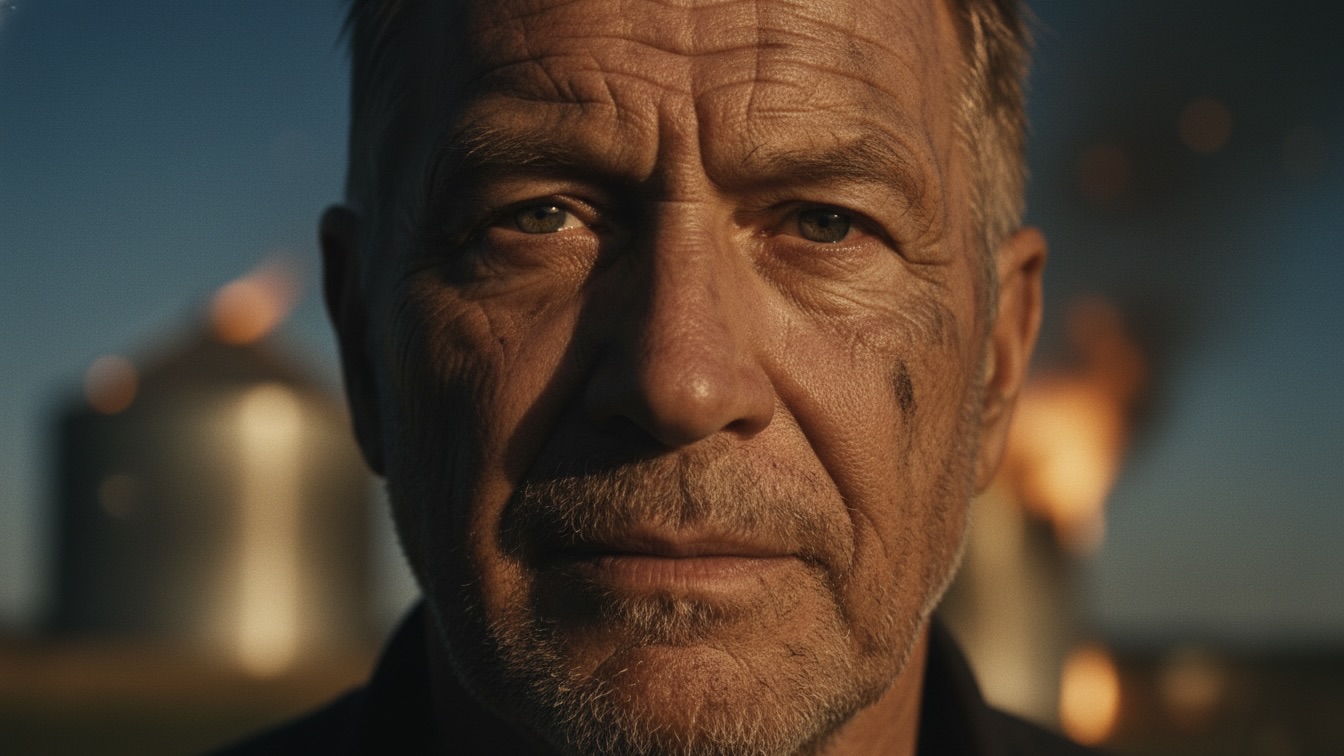
The story follows Max, a weathered farmer struggling to survive in a post-apocalyptic landscape defined by a relentless, soul-crushing drought. His world is one of extreme scarcity where the sun has become a destructive force and the soil has turned to useless powder. This fragile existence is threatened by Ben, the leader of a predatory militia, who arrives to demand a "tithe" of grain that Max does not have. Max is the keeper of two secrets: a silo full of toxic, blighted grain and a hidden stash of "Gold-Grain" seeds that could potentially survive the harsh climate.
The tension escalates when Max discovers that Ben’s men have poisoned his well to force his hand. The arrival of a group of starving refugees further complicates the moral landscape, as Max tries to balance his instinct for survival with his wife Martha’s insistence on compassion. When Ben callously murders a refugee father for seeking water, Max realizes that the militia leader represents a future that is not worth saving. In a final, desperate act of defiance, Max sends Martha away with the refugees and the Gold-Grain seeds. He then ignites the silo, creating a massive explosion of blighted dust and gasoline that destroys his farm and covers their escape, choosing to die amidst the ruins of his life rather than surrender to Ben’s tyranny.
The central theme of the narrative is the conflict between survival and morality in the face of total ecological collapse. Max operates under the belief that hope and humanity are luxuries that the starving cannot afford, a psychological defense mechanism he uses to justify his isolation. However, the story suggests that surviving without a moral compass is merely a "slow, quiet rot." Max’s internal journey concludes with the realization that physical survival is meaningless if it requires the empowerment of a monster like Ben.
Another prominent theme is the corruption of authority and the emergence of "optimization" as a mask for cruelty. Ben uses the language of resource management and security to justify theft and murder, illustrating how power structures devolve into predatory systems when resources become scarce. He views people as assets or liabilities rather than human beings. This clinical approach to violence contrasts sharply with Max’s messy, visceral connection to the land and his eventual self-sacrifice.
The Gold-Grain serves as a powerful symbol of the burden of the future. These seeds represent the potential for life, but they also represent a target for those who would use that life to enslave others. Max’s decision to burn the farm highlights the theme of purgation; the old world, represented by the blighted grain and the dying farm, must be completely destroyed to allow the new world, represented by the seeds and the refugees, a chance to grow elsewhere. The fire is both an end and a desperate, glowing prayer for a beginning.
Max is a man defined by his environment, possessing a psyche that has become as hardened and cracked as the dirt he farms. He suffers from a literal and metaphorical failing heart, representing his dwindling capacity to care for a world that has taken everything from him. His initial cynicism is a protective shell, a way to navigate the impossible choices of a dying planet without collapsing under the weight of guilt. He views himself as a pragmatist, yet his actions reveal a man deeply haunted by the loss of the "old world" and his own diminishing humanity.
His transformation occurs when he witnesses the cold-blooded murder of the refugee father. This act shatters his belief that he can remain neutral or simply "wait for his heart to stop." He moves from a state of passive endurance to one of active, sacrificial agency. By blowing up the silo, he reclaims his identity as a protector rather than a hoarder. His final moments in the rocking chair suggest a sense of profound relief, as he finally sheds the burden of the seeds and the impossible responsibility of keeping the farm alive.
Ben serves as the psychological foil to Max, representing the dark side of human adaptation to catastrophe. He is a narcissist who has thrived in the collapse by casting himself as a visionary leader, though he is little more than a sophisticated thug. His "over-caffeinated energy" and tactical gear are performances designed to project a sense of order and competence that he does not truly possess. He lacks any genuine connection to the earth, viewing the farm only as a resource to be "liquidated."
Psychologically, Ben is a predator who feeds on the desperation of others. He uses gaslighting and intimidation to maintain control, framing his theft as a "security fee" and his violence as "standards." He is incapable of understanding Max’s eventual sacrifice because he cannot conceive of a value system that does not center on his own immediate survival and dominance. His retreat from the fire shows that for all his bravado, he is ultimately a coward when faced with a force he cannot control or intimidate.
Martha represents the enduring presence of empathy and the moral conscience of the story. While Max focuses on the logistics of survival, she focuses on the human cost of their isolation. She is the one who notices the individual suffering of the refugees, specifically the young girl with the fever. Her strength is not found in violence or tactical planning, but in her refusal to let the harshness of the world turn her heart to stone. She acts as the catalyst for Max’s redemption, reminding him of what is actually worth saving.
Her role in the climax is pivotal, as she becomes the carrier of the Gold-Grain. She transitions from a figure of quiet observation to the literal vessel for the future of the human race. By fleeing with the refugees, she bridges the gap between the "hoarders" and the "ghosts," suggesting that the only way forward is through community and shared risk. Her survival is the only victory in the story, a small flame of hope carried into the darkness of the hills.
The pacing of the story is masterfully handled, beginning with a slow, oppressive atmosphere that mirrors the stagnant heat of the drought. The initial descriptions of the "white hole" of the sun and the "powdered sugar" dirt create a sensory experience of dehydration and exhaustion. This lethargic opening makes the sudden bursts of violence and the final, explosive climax feel all the more jarring and impactful. The narrative voice is heavily colored by Max’s perspective, using gritty, visceral metaphors like "a roadmap of bad decisions" to ground the reader in his weary reality.
Sensory details are used to emphasize the theme of decay versus artificiality. The "mechanical growl" of Ben’s truck and the smell of his black smoke stand in sharp contrast to the silent, natural rot of the corn. The author uses these details to heighten the tension between the dying natural world and the aggressive, parasitic technology of the militia. The descriptions of the Gold-Grain as "metallic gold" and looking like "jewelry" elevate the seeds from a mere agricultural product to a sacred, almost magical object of desire.
The tone of the piece shifts from nihilistic despair to a form of pyrrhic triumph. The ending is not happy, but it is resolute. The imagery of the silo erupting into a "pillar of fire that reached for the stars" provides a cinematic and cathartic conclusion to the mounting pressure of the plot. The final image of the embers drifting like "tiny gold seeds" effectively ties the literal plot points to the broader metaphorical themes, leaving the reader with a sense of awe at the scale of Max’s final, fiery prayer.


