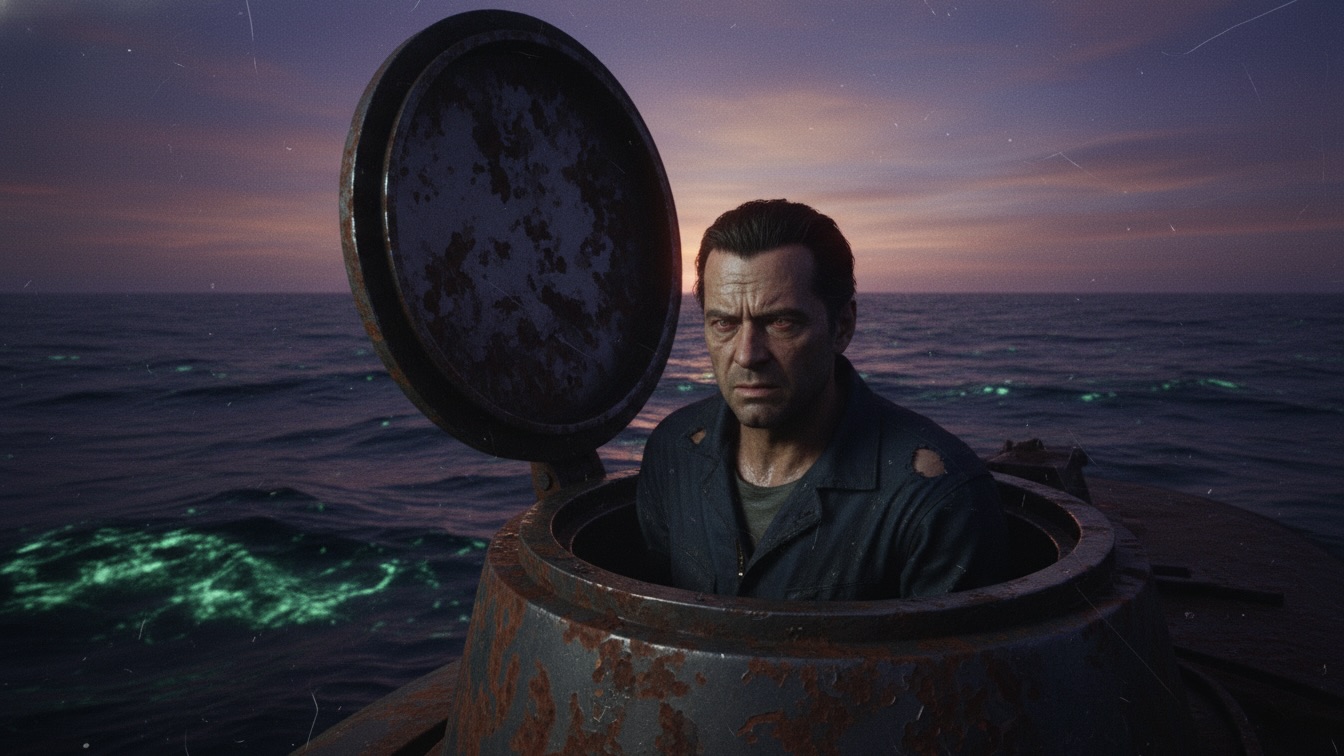
The story follows Joe and a small crew aboard the Deep Reach, a salvaged submarine navigating an ocean turned into a caustic, chemical sludge. As the world’s oxygen levels fail, the crew discovers a massive biological entity known as the Bloom moving with impossible speed through the thick water. This encounter leads to a collision that forces Joe to make a devastating choice, sealing a galley door to save the ship and sacrificing two crew members in the process.
Following the impact, the submarine sinks into a deep trench where it is cushioned by the very organism that is slowly dissolving its hull. Joe realizes that the Bloom is a sentient or semi-sentient filter that is cleaning the ocean of humanity's plastic waste while producing oxygen. Despite the realization that the Bloom's natural process might be the planet's best long-term hope, Joe follows Dr. Cain’s orders to inject a viral payload. This action forces the organism to prioritize immediate oxygen production over its cleaning functions.
The resulting surge of oxygen and thermal energy propels the Deep Reach back to the surface. Joe and the remaining survivors emerge to find a world that has been irrevocably altered. The sky has turned a vibrant purple, and while the air is finally breathable, the human civilization they once knew has largely vanished. Joe is left to contemplate a future where humanity is no longer the master of the planet, but a small part of a new, biological order.
The narrative explores the theme of environmental reclamation through the lens of biological horror and wonder. The ocean is no longer a natural habitat but a "brown slurry" of human failure, filled with the literal rot of industrial civilization. The Bloom represents nature’s aggressive response to this pollution, an organism that has evolved to consume the very toxins humans left behind. It suggests that while the Earth can heal, it will do so in a way that is indifferent, and perhaps even hostile, to human survival.
Sacrifice and moral injury serve as central psychological pillars of the text. Joe is forced to act as an executioner when he seals the galley door, a moment that highlights the cold mathematics of survival in a dying world. This theme is mirrored in the final choice regarding the viral payload. Joe must decide between the immediate survival of his species and the long-term health of the planet's new ecosystem. He chooses humanity, but the cost is the interruption of the Earth’s natural cleaning process.
The story also examines the obsolescence of human technology in the face of ecological collapse. The Deep Reach is described as a "tin can" and a "complaining" metal shell that is being eaten by the environment it was designed to traverse. This reflects a broader sense of civilizational decay, where the tools of the past are insufficient for the challenges of the present. The transition from the mechanical sub to the biological "forest" of the Bloom signifies a shift from a world of machines to a world of raw, uncontrollable life.
Joe is the narrative's emotional anchor, a man defined by his sensory awareness and the crushing weight of responsibility. His physical reactions, such as his aching eyes and shaking hands, reveal a character pushed to the brink of psychological exhaustion. He functions as the pragmatic executor of the mission, yet he is haunted by the human cost of his actions. The act of pressing the emergency seal button leaves him with a profound sense of "moral injury" that he carries to the surface.
Psychologically, Joe experiences a shift from fear to a form of weary transcendence. Initially, he views the ocean and the Bloom as monsters to be feared and avoided. By the end of the story, however, he recognizes the beauty in the Bloom's "forest" and the necessity of its existence. His final realization that the green light of the organism has stained his skin suggests that he has been permanently changed. He is no longer just a survivor of the old world but a citizen of the new, purple-skied reality.
Dr. Lee Cain represents the desperate, cold-blooded drive of scientific pursuit during an extinction event. She is driven by the need to find "The Origin," viewing the Bloom primarily as a resource to be exploited for human breath. Her focus is narrow and intense, evidenced by her stained lab coat and her willingness to push Joe into a suicidal EVA mission. She functions as the intellectual catalyst for the crew's survival, providing the "only plan" left to them.
While she appears clinical, Cain’s grief is visible in the "ghost" of her voice after the loss of Sarah and Mike. She suppresses her emotions to maintain the mission’s momentum, embodying the archetype of the leader who must remain functional while the world falls apart. Her insistence on the viral payload shows a character who prioritizes the immediate needs of her species over the abstract health of the planet. She is the one who forces Joe to choose the present over the future.
Aris serves as the youthful observer, providing a sense of wonder that contrasts with Joe’s cynicism and Cain’s clinical focus. He is the first to recognize that the Bloom is "talking," suggesting a level of empathy or openness to the new world that the older characters lack. His emotional volatility, described as being "about to cry," highlights the vulnerability of the younger generation facing an apocalypse. He represents the part of humanity that is still capable of being awed by the unknown.
Although her time in the narrative is brief, Sarah represents the personal stakes of the mission and the tragedy of the "greater good." Her voice, crackling over the radio as the water rushes in, serves as the catalyst for Joe’s most significant trauma. She is not a nameless casualty but a friend whose death is a direct result of a calculated decision. Her acceptance of her fate in her final moments adds a layer of sacrificial nobility to her character.
The author utilizes a gritty, claustrophobic prose style that emphasizes sensory discomfort. The opening descriptions of "damp sweat," "hot, thick air," and "old soup" create a visceral sense of the crew's misery. These tactile details make the submarine feel like a tomb even before the hull is breached. The use of short, punchy sentences during the collision and the galley door scene mirrors Joe’s frantic internal state. This pacing heightens the tension and forces the reader to experience the urgency of the moment.
Color plays a vital role in the narrative’s symbolic progression. The story begins with the "green light" of the sonar that makes Joe’s eyes ache, representing a sterile, failing technology. This shifts to the "neon green" and "pure white" of the Bloom, which is vibrant and overwhelming. Finally, the "vibrant purple" of the sky at the end signifies a complete departure from the natural order. These shifts in the color palette mark the transition from a dying world to a strange, new beginning.
The tone of the story is one of melancholic triumph. While the crew succeeds in their mission to restore oxygen, the victory is hollowed by the loss of their companions and the death of the world they knew. The narrative voice remains grounded in Joe’s perspective, ensuring that the epic scale of the Bloom is always balanced by the intimate reality of human suffering. The final image of the "bruised pink" sunrise leaves the reader with a sense of beauty that is inseparable from the pain of extinction.


