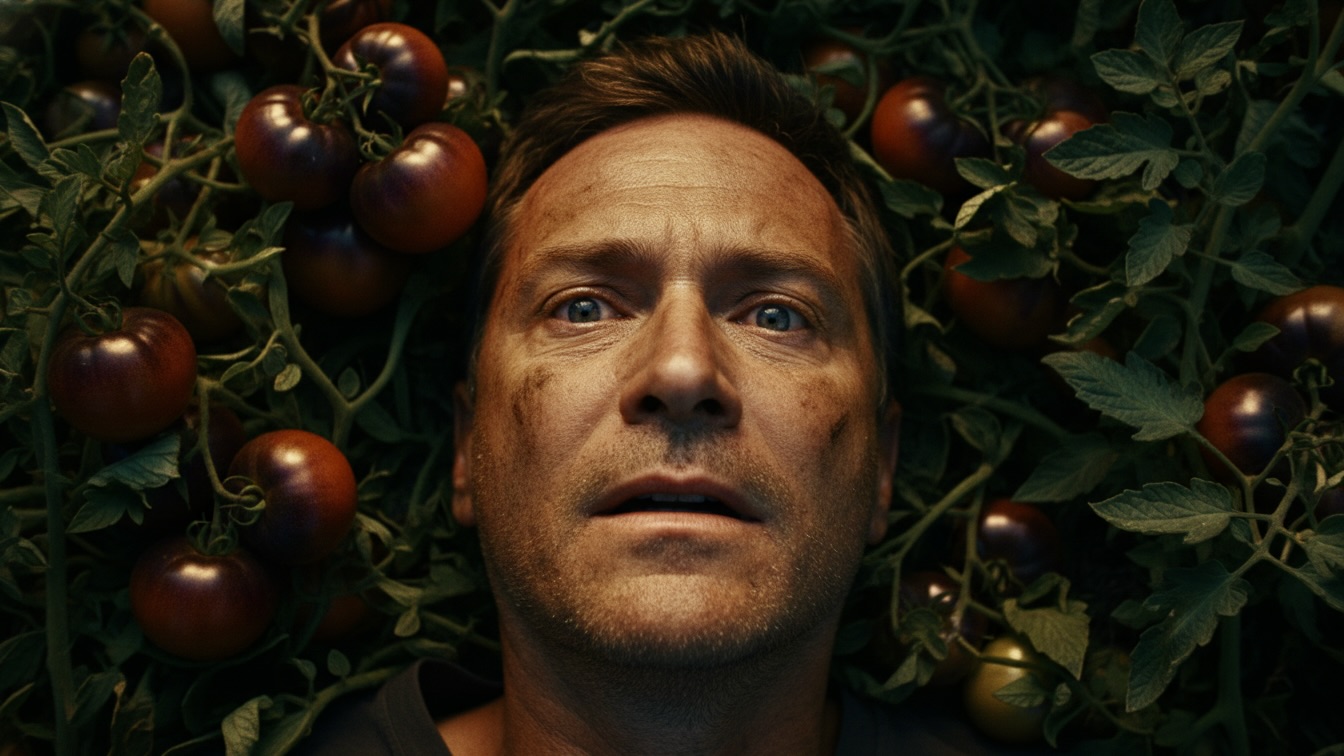
The story follows Trent, the cynical manager of a community garden in a struggling Winnipeg neighborhood, who is desperate to meet a production quota to secure his job and funding. Under the oppressive heat of a stagnant July, he accepts a suspicious donation of "blood meal" fertilizer from a mysterious driver claiming to be from a local slaughterhouse. Trent spreads the steaming, dark material across his failing tomato plants, hoping for a miracle to satisfy the municipal spreadsheets he serves.
The miracle arrives with terrifying speed as the garden transforms overnight into a pulsing, aggressive ecosystem of massive, blood-red fruit and sentient vines. After witnessing a young neighborhood boy named Kyle fall ill from eating the fruit and an elderly gardener named Barb being literally consumed by the soil, Trent discovers that the slaughterhouse source is a long-abandoned ruin. He returns to the plot to destroy the monstrosity, only to be confronted by the mutated remains of the community he failed to protect. In the end, the garden claims Trent as its final nutrient source, leaving his bureaucratic mind focused on the successful metrics of the harvest even as he is pulled into the earth.
The central theme of the narrative explores the dehumanizing nature of modern bureaucracy and the "metric-driven" life. Trent is a man who has replaced his empathy with an Excel spreadsheet, viewing the people he is supposed to serve as mere variables that complicate his data. His obsession with the "seventy-five pounds" of produce required for his grant reflects a broader societal tendency to prioritize quantifiable results over human well-being. This detachment is ultimately what blinds him to the supernatural danger of the fertilizer, as he is willing to overlook obvious red flags in pursuit of professional survival.
The story also delves into the concept of predatory consumption, both literal and metaphorical. The community garden, intended to be a source of life and sustenance for a neglected neighborhood, becomes a literal predator that feeds on the very people it was meant to nourish. This mirrors the way the municipal system "feeds" on the labor and desperation of individuals like Trent and Kyle. The "blood meal" is not just a gardening additive; it is a symbol of the cost of success in a system that values output over the lives of the producers.
Furthermore, the setting of Point Douglas serves as a backdrop for themes of urban decay and the "husk" of industrialization. The discovery that Kildonan Meats is a charred, condemned property highlights the abandonment of the working class and the hollow promises of urban renewal. The horror in the story arises from the idea that when a community is neglected by its institutions, something primal and monstrous will inevitably rise to fill the vacuum. The garden’s aggressive growth represents a nature that has been corrupted by the violence of the slaughterhouse, turning the act of cultivation into an act of predation.
Trent is a protagonist defined by his psychological burnout and a profound lack of empathy. He views his role not as a community leader, but as a victim of a rigid municipal structure that threatens his basic security, such as his dental plan and salary. His internal monologue is dominated by the language of the office—metrics, grants, and spreadsheets—which acts as a psychological shield against the harsh reality of the poverty surrounding him. This bureaucratic focus allows him to justify his coldness toward Kyle and his reckless decision to use the unregulated fertilizer.
Psychologically, Trent is a man who has "opted out" of the human experience to avoid the pain of his environment. He describes himself as being "entirely out of empathy," a state of emotional exhaustion that makes him the perfect vessel for the garden's horror. Even in his final moments, his mind clings to the "phenomenal metrics" of the harvest. This indicates a complete assimilation of his identity into the system that eventually kills him, suggesting that his humanity was lost long before the vines wrapped around his waist.
Kyle serves as the tragic foil to Trent’s cold professionalism, representing the desperate "community" that the garden is supposed to subsidize. He is characterized by his hunger and his petty thefts, which are actually cries for help that Trent chooses to interpret as mere data loss. Kyle’s physical state—his heavy hoodie in the heat and his waxy skin—hints at a life of systemic neglect and possible substance abuse, making him a vulnerable target for the parasitic plants.
His transformation into a "husk" is a literal manifestation of how Trent and the city view him: a mindless consumer and a nuisance. When Kyle lunges at Trent at the end of the story, he mimics Trent’s own cynical words, showing that the boy has been entirely erased and replaced by the garden’s collective consciousness. He becomes a physical manifestation of the resentment and hunger that Trent ignored, eventually forcing Trent to face the consequences of his lack of compassion.
Barb represents the innocent, unsuspecting element of the community that is caught in the crossfire of Trent’s ambition. As a retired schoolteacher, she is the only character who maintains a sense of wonder and traditional care for the garden, calling the monstrous growth a "miracle." Her presence highlights the tragedy of the situation, as her kindness and dedication are met with a violent, predatory end. She is the "blood" in the blood meal, providing the initial organic spark that allows the garden to move from passive growth to active predation.
Her death is particularly significant because she is the only person Trent seems to show a flicker of genuine concern for, yet even that concern is fleeting and ineffective. The fact that her voice is used as a lure to trap Trent at the end of the story emphasizes the garden's cunning nature. It uses the remnants of her gentle personality to facilitate a final act of violence, showing that in this corrupted ecosystem, even memories of kindness are repurposed as predatory tools.
The narrative employs a heavy, oppressive atmosphere that mirrors the "stagnant, breathless summer" of Winnipeg. The author uses sensory details to create a sense of visceral discomfort, focusing on the "hot soup" air, the "metallic taste of old pennies," and the "gagging reek of meat left in the sun." These descriptions serve to ground the supernatural elements in a gritty, physical reality, making the body horror feel more immediate and disturbing. The transition from a mundane story about a community garden to a full-scale horror piece is handled through a slow, rhythmic buildup of tension.
Pacing in the story is expertly controlled, beginning with the slow, sluggish heat of the afternoon and accelerating as the plants begin to pulse with a heartbeat. The use of "capillary action" and "soil physics" as pseudo-scientific explanations provides a brief moment of rationalization before the story plunges into the irrational. This stylistic choice reflects Trent's own psychological journey, as he tries to maintain a sense of order through his clipboard and invoice before the overwhelming reality of the monsters breaks his composure.
The narrative voice is cynical and detached, matching Trent’s internal state, which makes the final shift into terror more impactful. The author uses vivid, anatomical imagery—such as vines thicker than wrists and tomatoes like blood blisters—to emphasize the biological nature of the threat. The ending is particularly effective because it maintains this detached tone; even as Trent is being swallowed by the earth, the prose remains focused on the "phenomenal" metrics. This creates a chilling irony that leaves the reader with a sense of lingering dread about the true cost of administrative success.


