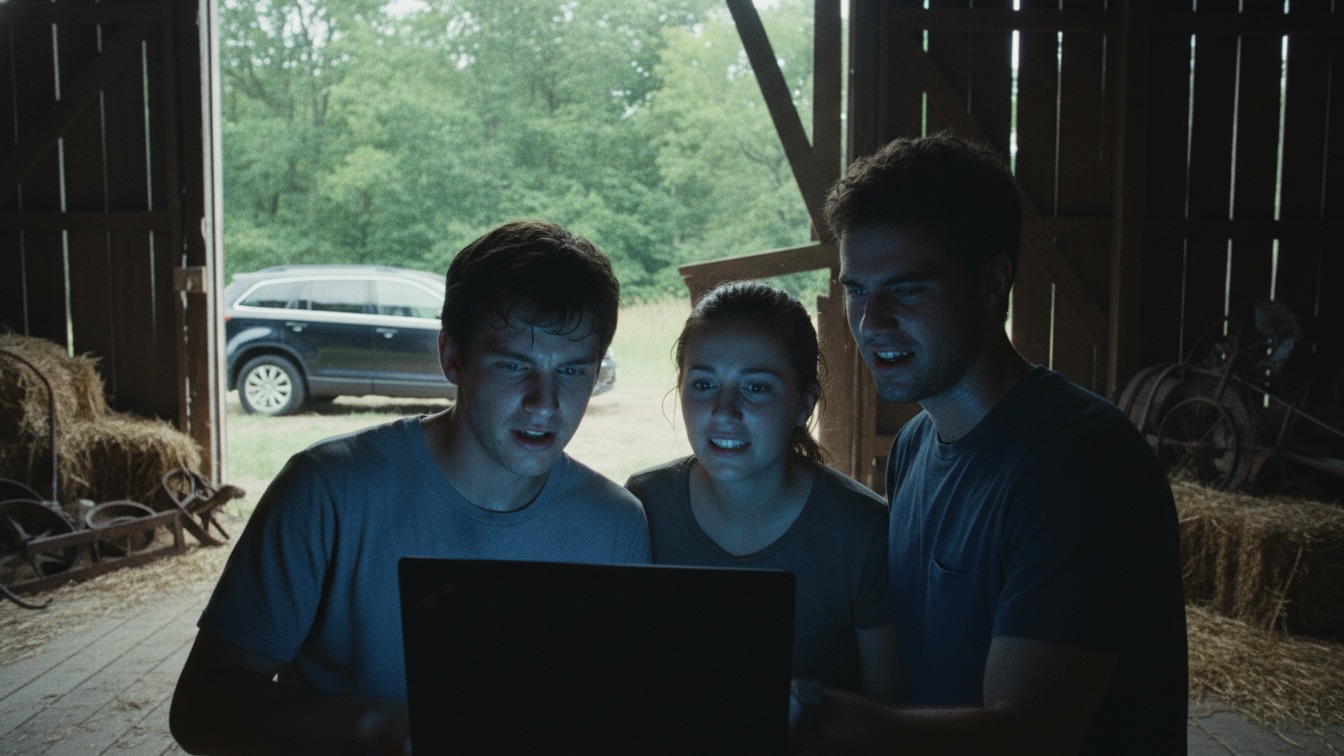
The chapter begins with Moe, Andrea, and Toby parked on a sweltering highway shoulder, discovering that their father’s inheritance is actually a massive, predatory debt. They realize the laptop they took from the fair contains a ledger showing that Jerry mortgaged their family home to a local mogul named Simon Thomas. This debt reached its grace period just days after their father’s funeral, effectively rendering them homeless.
Upon discovering they are being tracked via a GPS ping on the laptop, the siblings decide to return to the family farm to retrieve a physical backup of the ledger. They use their rental car as a rolling distraction to draw out Thomas’s enforcers who have already occupied the house. Once inside the cellar, they find a diary and documents proving that Jerry was keeping books for Thomas’s illegal activities, including environmental fraud related to a toxic waste site.
After a messy confrontation in the cellar involving fermented fruit and a narrow escape through a coal chute, the siblings steal the enforcers’ high-end SUV. They race to the local fairgrounds to use a secure uplink to upload the incriminating files before a midnight auction of the family land. Despite a final standoff with an enforcer named Elias, they successfully distribute the data to the authorities and the media, destroying Thomas's deal and cementing their status as fugitives.
The central theme of the story is the crushing weight of inherited trauma and debt. Jerry does not leave his children a traditional legacy of wealth or stability; instead, he leaves them a "target on their backs" and a web of financial ruin. This suggests that the sins of the father are literally visited upon the children, forcing them to navigate a world where their very identities are collateral for someone else's greed.
Another prominent theme is the intersection of technology and corporate corruption. The conflict is mediated through digital ledgers, GPS trackers, and crypto keys, highlighting how modern power is exercised through surveillance and data manipulation. Simon Thomas represents a predatory corporate force that uses legal and digital loopholes to strip individuals of their history and property.
The narrative also explores the idea of "messiness" as a form of survival. Moe recognizes that their father raised them to be chaotic and unpredictable, which becomes their greatest advantage against the "professional" and "tailored" efficiency of Thomas’s men. By embracing their father’s messy nature, the siblings find a way to fight back against a system designed to exploit their perceived weaknesses.
Finally, the story touches on the loss of the American pastoral dream. The family farm, once a symbol of independence, is revealed to be a toxic waste site hidden beneath layers of fraudulent permits. This subversion of the "home" suggests that the idyllic rural life is often built on a foundation of rot and secrets that eventually demand a reckoning.
Moe functions as the tactical leader of the group, balancing his fear with a burgeoning sense of pragmatic ruthlessness. He is the one who recognizes that Jerry’s "messiness" is not a flaw but a survival strategy designed for their current predicament. His decision to use the fermented peaches as a weapon demonstrates his ability to think outside the box when traditional methods fail.
Throughout the chapter, he experiences a psychological shift from a victim of his father’s choices to an active participant in the family’s defense. He stops viewing the inheritance as a burden to be endured and starts seeing it as a weapon to be wielded. By the end of the chapter, he has fully embraced his role as a fugitive, showing a grim satisfaction in the chaos they have unleashed.
Andrea serves as the group’s anchor, providing the technical expertise and the driving force—both literally and figuratively—behind their escape. She is characterized by her competence and her struggle to maintain control in an increasingly uncontrollable situation. Her initial resistance to the "messiness" of their plan reflects her desire for a more orderly, conventional life that has been permanently denied to her.
Her psychological journey is marked by the realization that her father’s life was far more dangerous and complex than she ever imagined. As she uploads the files to the state bureau, she effectively burns down her own bridge to a normal future. Her laughter at the end of the chapter signifies a breaking point where she finally accepts the absurdity of their new reality.
Toby represents the vulnerability and the untapped potential of the youngest sibling. While he initially appears to be a "Gen Z cliché" who is out of his depth, he proves his worth through his technical curiosity and his willingness to engage in physical confrontation when necessary. His use of a simple screwdriver to break into the cellar highlights his resourcefulness.
His character provides a sense of emotional grounding for the group, as his simple desires—like wanting a funnel cake—contrast sharply with the life-or-death stakes of their mission. He is the most visibly shaken by the violence and the threats, yet he remains loyal to his siblings. His growth is seen in his transition from a passive passenger to an active participant in the theft of the SUV.
Although Jerry is deceased, his presence looms over the entire chapter as a manipulative and perhaps protective ghost. He is characterized as a man who was "a drunk, but not a poet," suggesting that his actions were driven by a harsh, practical logic rather than sentimentality. His decision to leave his children such a dangerous inheritance reveals a complex psychological profile of a man who knew his enemies were coming.
Jerry’s motivations remain ambiguous; he may have been trying to save his children by giving them the tools to fight Thomas, or he may have simply been using them to settle his own scores from beyond the grave. Regardless of his intent, he successfully molded his children into the exact kind of "messy" survivors needed to dismantle Thomas’s empire. He remains a figure of both resentment and inspiration for his offspring.
The pacing of the chapter is relentless, mirroring the frantic heartbeat of the hazard lights described in the opening scene. The author uses a "ticking clock" mechanic with the midnight deadline to maintain a high level of tension. This rapid movement between locations—the highway, the farm, and the fairgrounds—creates a sense of kinetic energy that keeps the reader engaged.
Sensory details are used effectively to establish a stifling, claustrophobic atmosphere. The "wall of heat" and the "suffocating warmth" of the rural night serve as physical manifestations of the pressure the siblings feel. Descriptions of the foul-smelling fermented peaches and the gritty soot of the coal chute add a layer of visceral realism to the more abstract digital conflict.
The narrative voice is sharp and cynical, often using dark humor to undercut the tension. The juxtaposition of a high-stakes corporate chase with a "Choose Life" bumper sticker on the rental car highlights the absurdity of the situation. This tone reflects the siblings' internal states as they navigate a world that has suddenly turned hostile and surreal.
Dialogue is used to reveal character dynamics and provide exposition without slowing down the action. The banter between the siblings feels authentic to their shared history, balancing long-standing frustrations with a deep, unspoken bond. The contrast between Elias’s polite, corporate speech and the siblings' desperate, raw communication emphasizes the clash between the two worlds.


