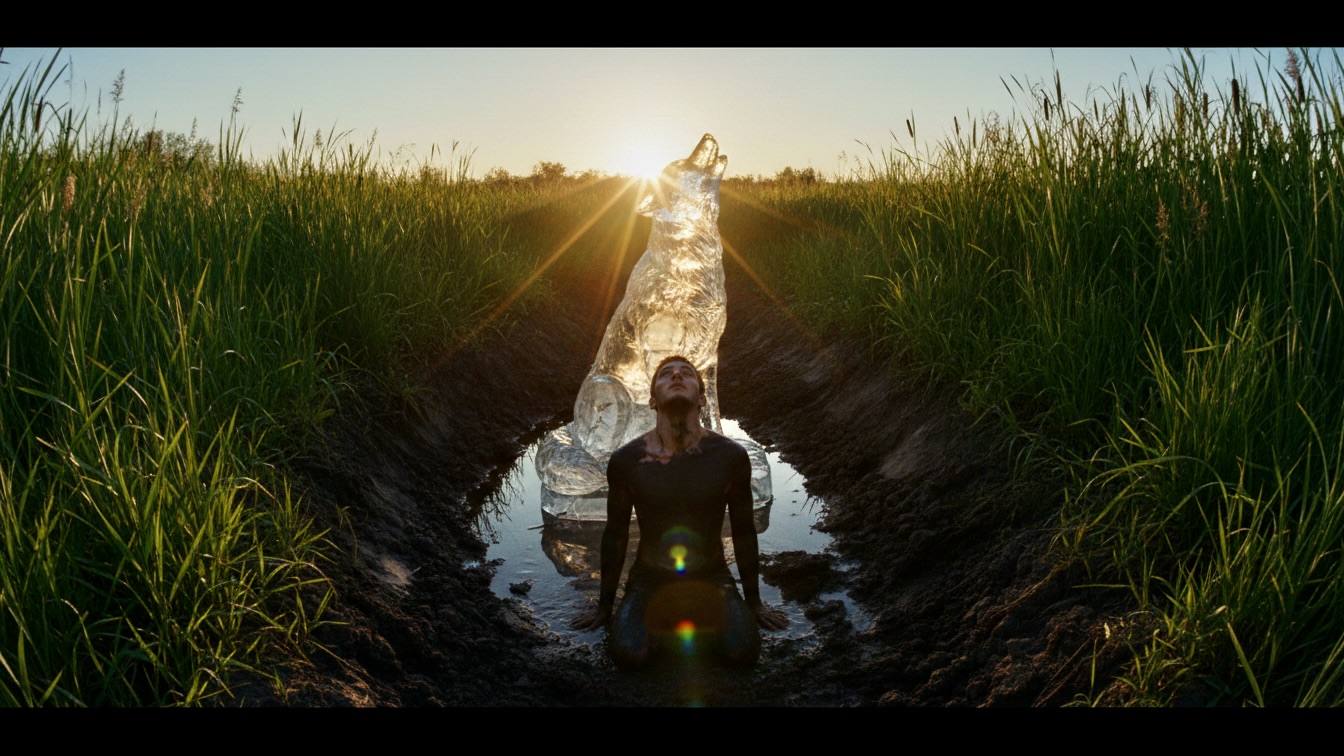
Benji returns to his family home in Winnipeg after a grueling and emotionally depleting year at college. The atmosphere is immediately established as one of stagnant heat and domestic tension. His mother, preoccupied with administrative demands and a broken air conditioner, directs him to clear a clogged drainage ditch in the backyard. While laboring in the oppressive mud and heat, Benji unearths a surreal object: a life-sized coyote sculpture made of ice that refuses to melt despite the thirty-degree weather.
The discovery of the ice coyote acts as a catalyst for various family and neighborhood conflicts. His sister, Matti, views the object through the lens of social media clout, while his father sees it as a liability that threatens their financial stability. The situation escalates when a city official issues a fine and a neighbor, Mr. Lennox, threatens to destroy the sculpture, believing it to be toxic waste. Benji finds himself in the role of a desperate guardian, staying out in a violent summer storm to protect the inexplicable miracle from those who wish to neutralize it.
The narrative reaches its climax at dawn when Mr. Lennox attempts to smash the sculpture with a sledgehammer. Benji physically intervenes, leading to a confrontation that draws his father out of the house. In a surprising turn, his father defends Benji against the neighbor but remains witness to the sculpture’s sudden end. As the first rays of direct sunlight hit the coyote, it shatters and dissolves into ordinary slush. The story concludes with a moment of quiet reconciliation between Benji and his father, suggesting that the "miracle" served its purpose by breaking the emotional stagnation of the household.
The primary theme of the story is the tension between the mundane and the miraculous. Benji’s world is defined by "peeling paint," "stagnant water," and "rotting vegetation," a landscape where nothing ever changes. The ice coyote represents a rupture in this grey reality, a literal and figurative "anomaly" that defies the laws of thermodynamics. Its presence forces every character to confront something they cannot explain, revealing their core anxieties and desires in the process.
Another significant theme is the burden of domestic and social conformity. The father and Mr. Lennox are obsessed with liabilities, property values, and municipal bylaws. To them, the coyote is not a wonder but a "hazard" or an "installation" that threatens the precarious order of their lives. This highlights a psychological tendency to destroy what cannot be categorized or controlled. The sculpture’s refusal to melt in the sun serves as a metaphor for personal integrity in the face of a crushing, conformist environment.
The narrative also explores the theme of generational disconnect and the search for meaning. Benji and Matti represent two different ways of processing the world; Benji seeks a visceral, protective connection to the object, while Matti seeks to mediate her experience through a screen. However, both are united in their recognition that the coyote is "beautiful." The eventual destruction of the sculpture suggests that while miracles are fleeting, the impact they have on human relationships can lead to a "thaw" in otherwise frozen emotional dynamics.
Benji begins the story in a state of psychological burnout, described as having "eighty tabs open" in a brain that refuses to load. He is a young man struggling with the weight of expectations and the realization that his efforts at college have left him "hollowed out." The task of digging in the mud is a physical manifestation of his internal state, as he feels mired in a life that smells like "failure." The discovery of the coyote provides him with a sudden, singular focus that clears the "cognitive static" of his depression.
His transformation from a passive, exhausted student to a fierce protector reveals a deep-seated need for something sacred. By choosing to sit in the mud and the storm to guard the sculpture, he is essentially guarding his own capacity for wonder. He is willing to endure physical pain and social ostracization to keep the "miracle" intact. This suggests that Benji is a character who values intrinsic beauty over practical utility, a trait that sets him at odds with the adult world around him.
Matti serves as a foil to Benji, representing a younger generation that interprets reality through digital performance. Her first instinct is to "document" the anomaly and use internet slang to describe a phenomenon that should evoke silence and awe. She views the world as a series of "content" opportunities, which initially makes her appear shallow. However, as the story progresses, her genuine concern for the sculpture and her brother reveals a more vulnerable side.
Despite her reliance on "modern communication," Matti is the only one who validates Benji’s sense of wonder. She helps him move the heavy object and stands by him during the confrontation with their father and Mr. Lennox. Her character arc suggests that while her language is filtered through social media, her emotional core remains capable of recognizing and defending the extraordinary. She provides the necessary support system that allows Benji to maintain his vigil.
The father, John, is a man defined by the "mortgage on this dirt" and the constant pressure of maintaining a household. He is portrayed as a man whose imagination has been cauterized by the demands of labor and the fear of financial ruin. His immediate reaction to the ice coyote is one of annoyance and aggression, as he views it as a "liability" rather than a work of art. This reflects a psychological defense mechanism where anything unknown is perceived as a threat to one's livelihood.
However, the father undergoes a subtle but vital shift in the final act. When he sees his son covered in mud and fighting the neighbor, his paternal instinct overrides his concern for property values. By taking the hammer away from Lennox and telling him to leave, he chooses his son over his fear of the "toxic." His final smile at the end of the story indicates a moment of shared humanity and a temporary release from the rigid, joyless role he has been forced to play.
The pacing of the story is masterfully handled, moving from the sluggish, heavy atmosphere of the opening to a frantic, high-stakes confrontation. The author uses the weather as a narrative engine, where the "wet towel" heat gives way to a "monsoon" that mirrors the rising tension between the characters. The transition from the stagnant afternoon to the violent nighttime storm heightens the sense of isolation and urgency. This environmental shift serves to strip away the characters' social masks, leaving them raw and reactive.
Sensory details are used with surgical precision to ground the magical realism of the ice coyote in a gritty, visceral reality. The reader can smell the "stagnant water" and feel the "stiff gardening gloves" and the "biting cold" of the ice. The contrast between the "brown and murky" water of the ditch and the "completely clean" ice creates a powerful visual metaphor for purity emerging from filth. These details ensure that the coyote feels like a physical presence in the world rather than a mere hallucination or symbol.
The narrative voice is lean and direct, avoiding overly flowery prose in favor of sharp, punchy sentences that reflect Benji’s exhaustion. This "minimalist" style makes the moments of beauty, such as the coyote "glowing like a prism," stand out with greater intensity. The use of sound—the "wet sucking sound" of the mud, the "rattle" of the fan, and the "rifle shot" crack of the ice—creates an immersive auditory landscape. Ultimately, the style reinforces the story’s central theme: that even in a world of mud and rust, there is a sharp, clear resonance to be found if one is willing to dig for it.


