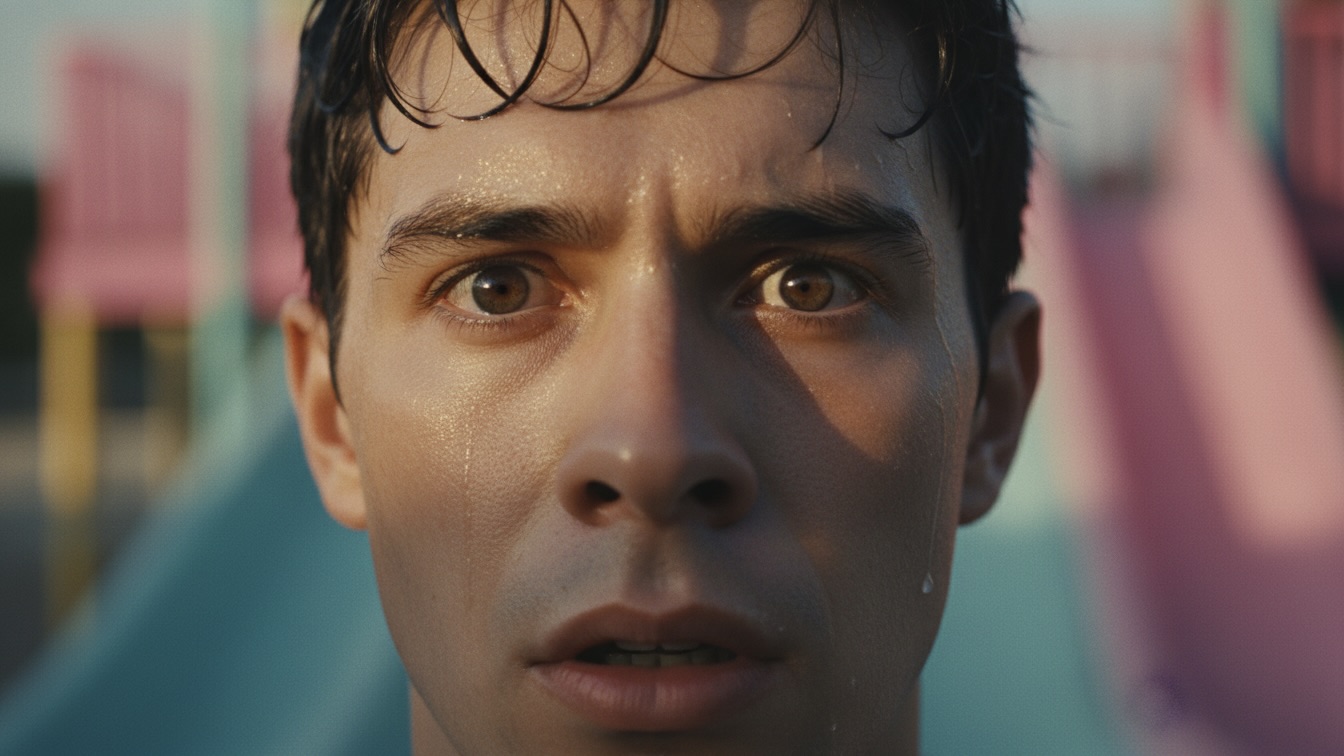
The story follows a group of four friends who break into an abandoned waterpark known as Neptune's Chokehold on a stiflingly hot July afternoon. After a tense exchange and a fifty-dollar bet, Ryu agrees to slide down the "Black Hole," a dilapidated and supposedly unfinished enclosed slide. When he fails to emerge from the bottom and instead falls from the sky, he claims to have spent hours wandering a liminal, 1990s-style shopping mall. The reality of the park begins to disintegrate as the sun freezes on the horizon, the friends transform into terrifying, mannequin-like entities, and the environment repeats into an infinite grid. In a final twist, the narrator realizes he is the one who entered the slide, and the entire surreal sequence was a psychological construct masking his terminal descent into a dark, endless void.
One of the primary themes explored in this text is the horror of liminality and the psychological weight of "dead" spaces. The waterpark, once a site of vibrant childhood joy, is reimagined as a sterile, rotting graveyard that exists outside the normal flow of time. This setting taps into the "Backrooms" aesthetic, suggesting that when a space loses its purpose, it becomes a glitch in reality. The transition from a recognizable summer day to an infinite loop of wave pools highlights the fragility of human perception when faced with the unknown.
The narrative also delves into the theme of existential stagnation and the desire to escape a mundane reality. The characters are trapped in low-wage retail jobs and a dying town, viewing their lives as a series of repetitive, soul-crushing tasks. Ryu and Mosha express a deep-seated resentment toward their daily routines, which makes the allure of the "Black Hole" slide a metaphorical escape. However, the story suggests that the escape from a mundane prison may lead to a much more terrifying, infinite void where identity itself is erased.
Finally, the story examines the concept of reality as a digital or simulated construct. Through the use of terms like "lagging," "rendering," and "noclipped," the author suggests that the universe operates on a set of fragile laws that can be broken. The transformation of the friends into featureless plastic mannequins serves as a metaphor for the loss of the soul in a simulated environment. This theme heightens the sense of isolation, as the narrator realizes that his companions are no longer human, but merely corrupted data points in a failing system.
The narrator serves as the psychological anchor for the reader, providing a grounded perspective that slowly unravels as the story progresses. He initially displays a sense of detached boredom, a common defense mechanism against the stagnation of his environment. As the reality of the park shifts, his internal state moves from mild anxiety to a profound, existential terror that manifests in physical symptoms. He eventually undergoes a traumatic realization that his memories are a fabrication designed to protect him from the reality of his own terminal fall.
Ryu functions as the catalyst for the story's descent into the surreal, representing the vulnerability of the human ego. He is driven by a need to prove his bravery, yet his experience in the "mall" leaves him psychologically shattered and stripped of his confidence. When he returns from the sky, he is a harbinger of the world's collapse, his wide pupils and frantic breathing signaling his loss of connection to the physical world. His eventual transformation into a plastic figure symbolizes the total consumption of his individuality by the void of the slide.
Mosha is characterized by her cynicism and her reliance on substances to cope with the drudgery of her retail life. She uses her skepticism as a shield, mocking the supernatural possibilities of the park until she is forced to confront them herself. Her "reverse crawl" out of the yellow slide is a visceral representation of her psychological break, as she literally moves backward against the natural order of things. The black sludge leaking from her mouth suggests that her internal humanity has been replaced by a cold, synthetic substance.
Tyler embodies a disturbing form of existential apathy, reacting to the disintegration of reality with a chilling lack of concern. Even as his eyes transform into black voids, he remains fixated on mundane grievances like Spotify algorithms and the smell of popcorn grease. This suggests that he represents the narrator's own numbness and the part of the psyche that attempts to normalize horror to avoid total collapse. His calm demeanor while dragging the narrator toward the drain makes him perhaps the most unsettling figure in the group.
The pacing of the chapter is masterfully executed, beginning with a slow, atmospheric build-up that emphasizes the oppressive heat and decay of the park. The author uses sensory details, such as the "metallic clink" of a lighter and the "thick" air, to ground the reader in a gritty, realistic world. This realism makes the subsequent shift into surrealism much more jarring and effective. As the logic of the setting fails, the pacing accelerates, mirroring the narrator’s escalating panic and the breakdown of his mental defenses.
Sensory imagery plays a vital role in establishing the story’s tone of "liminal horror." The visual of the "frozen orange sun" and the "razor-sharp" shadows creates a sense of wrongness that is both beautiful and terrifying. The use of sound, particularly the backward speech and the "low, deafening frequency" of the vibration, adds a layer of auditory discomfort that heightens the reader's immersion. These details work together to create a world that feels both familiar and fundamentally alien, a hallmark of the New Weird genre.
The narrative voice is characterized by a blend of adolescent cynicism and hauntingly poetic descriptions. The narrator's observations about the "rotting" town and the "biohazard" of retail work provide a social context that makes the supernatural elements feel like an extension of his daily life. The use of modern digital terminology to describe metaphysical horrors gives the story a contemporary edge. This stylistic choice suggests that for the modern individual, the ultimate nightmare is not a ghost or a monster, but a glitch in the very fabric of existence.


