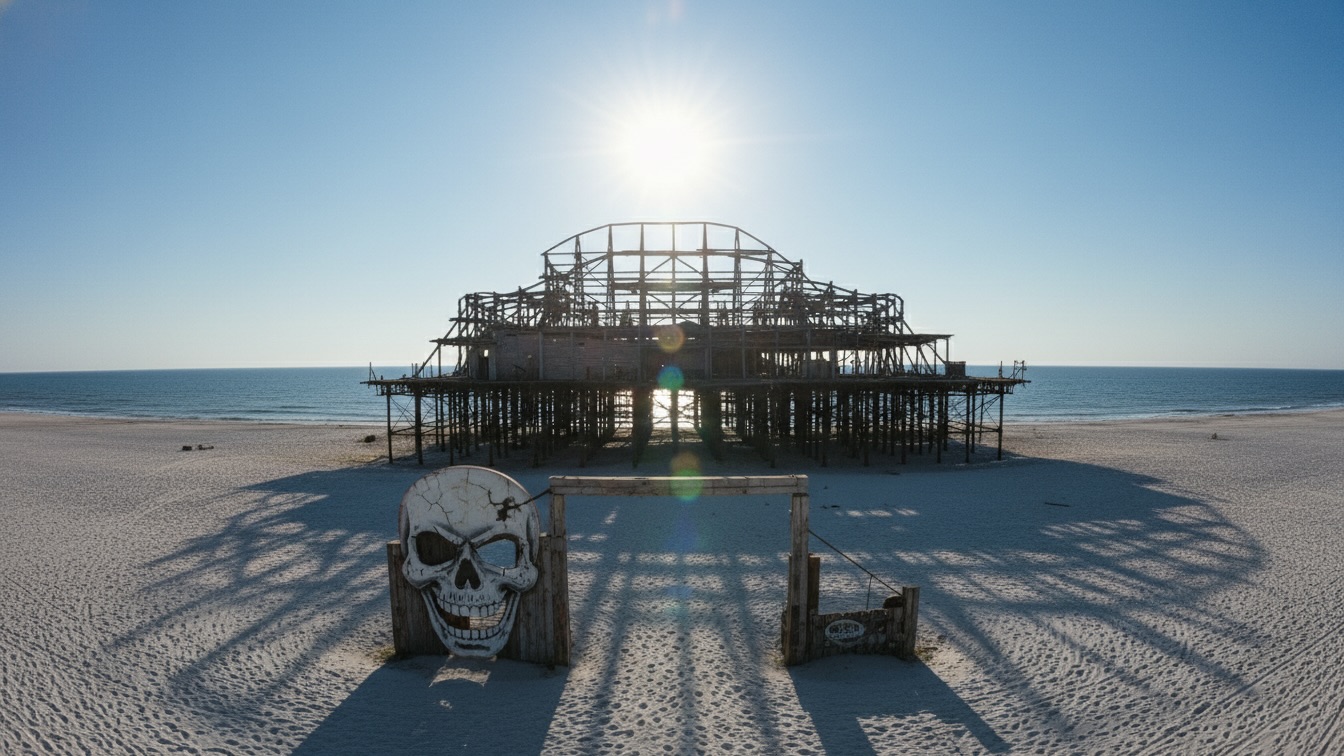
The story begins in the oppressive, sweltering heat of a summer afternoon, where Andrea and her companion, Leo, watch the slow destruction of a local landmark. Captain Salty’s Pier and Carnival, a decaying relic of the past, has been purchased by a mysterious conglomerate known as OmniCorp. While Andrea scrolls through her phone to escape the crushing boredom and heat, Leo remains fixated on the corporate activity, convinced that the company is hiding a more sinister motive than simple real estate development. They are confronted by Bryce, a corporate manager who dismisses their presence and historical attachment to the pier as inefficient nostalgia.
Driven by Leo’s suspicions and Andrea’s lingering emotional connection to her late mother’s memory, the pair returns to the pier under the cover of night. They break into the Hall of Mirrors and discover a massive, illegal cryptocurrency mining operation hidden in a secret sub-basement. This industrial server farm is the true cause of the town’s recent power failures, as OmniCorp is siphoning municipal electricity to fuel their digital greed. Their discovery is interrupted by Bryce and his security team, leading to a tense confrontation in the artificial heat of the server room.
In a desperate bid to create a distraction, Leo sabotages the power grid using an old animatronic machine, triggering a fire and a hazardous gas suppression system. Andrea and Leo narrowly escape the suffocating fumes by climbing a service shaft that leads to the top of a rotting wooden rollercoaster. From this high vantage point, Andrea captures photographic evidence of the illegal power tap and uploads it to a journalist. The story concludes a week later with the heatwave broken and OmniCorp’s plans dismantled by legal injunctions, leaving the pier as a quiet, preserved monument to the town’s personal history.
The central theme of the narrative is the violent collision between corporate parasitism and human nostalgia. OmniCorp, personified by the cold and calculated Bryce, views the world through a lens of "synergy" and "optimization," where anything that does not produce a financial yield is considered a "dying asset." This perspective stands in stark contrast to Andrea and Leo, for whom the pier represents a repository of memory and identity. The story suggests that corporate entities often use the language of progress to mask exploitative practices, treating local communities as "excess capacity" to be drained.
Another prominent theme is the physical and psychological weight of stagnation. The relentless one-hundred-and-three-degree heat serves as a metaphor for the suffocating nature of the characters' lives and the town’s decline. Andrea is trapped in a cycle of digital apathy and grief, while Leo is stuck in a loop of aging and conspiracy. The heatwave creates a pressurized environment that necessitates a literal and figurative explosion—the fire in the Hall of Mirrors—to break the tension and allow the "cool wind" of change and justice to finally arrive.
Finally, the story explores the concept of "The Ghost in the Machine." The high-tech server farm hidden beneath the rotting, low-tech carnival highlights the disparity between the digital future and the physical past. The use of the Zoltar machine to bring down the server farm is a poetic irony; a discarded relic of old-fashioned "fortunes" is the very thing that destroys a facility dedicated to mining the "future" of global finance. This suggests that the past cannot be so easily discarded or "optimized" away without consequences.
Andrea serves as the emotional anchor of the story, characterized by a profound sense of protective apathy. At the start of the narrative, she uses her phone as a shield against the harsh reality of her environment and the painful memories associated with the pier. Her internal state is defined by a "swallowed stone" of grief, specifically linked to her mother’s death and the loss of the vibrant woman she once was. She initially resists Leo’s investigative urges, not because she lacks curiosity, but because she is exhausted by the weight of her own history.
As the plot progresses, Andrea undergoes a transition from a passive observer to an active participant in her own life. When she kicks in the door of the Hall of Mirrors, she is not just breaking into a building; she is breaking through her own shell of indifference. Her decision to climb the rollercoaster and capture the evidence shows a newfound sense of agency. By the end of the story, she has replaced her digital scrolling with a tangible connection to her surroundings, finding peace in the preservation of the "eyesore" that holds her mother's laughter.
Leo functions as the narrative’s catalyst, representing the stubborn resistance of the working class against corporate overreach. He is a man defined by his physical limitations—his titanium knees and bald head—yet he possesses a sharp, intuitive mind that sees through corporate obfuscation. His obsession with "the strings" and "shell corporations" initially makes him appear like a stereotypical conspiracy theorist, but the narrative validates his paranoia. He is the guardian of the town’s history, refusing to move his car from a spot his grandfather claimed decades ago.
Psychologically, Leo is driven by a need to be useful and to protect the world he knows from being erased. His act of sabotage with the Zoltar machine is a moment of reckless bravery that bridges the gap between his physical fragility and his inner strength. He does not care about the legalities of "breaking and entering" because he operates on a moral code that prioritizes communal resources over private profit. By the end, his desire to "fix the gate" signifies his transition from a man fighting a losing war to a man tending to a garden he has successfully defended.
Bryce is the quintessential corporate antagonist, a man who has completely internalized the dehumanizing jargon of late-stage capitalism. He is introduced as a figure literally out of place, trudging through sand in expensive shoes, which highlights his disconnect from the physical reality of the town. His arrogance is rooted in a belief that he is an agent of "progress," viewing the locals as "slow children" who cannot grasp the complexity of his "synergized" vision. He lacks genuine empathy, seeing the displacement of the town's power as a mere "friction" in the pursuit of capital.
His psychological profile is one of clinical detachment and a pathological need for control. When the fire breaks out, his first instinct is to command his security team to "confiscate their phones" rather than addressing the immediate physical danger. He is a man who thrives in the artificial, dry heat of the server farm but is visibly defeated by the chaotic, unpredictable nature of the fire and the subsequent legal fallout. Ultimately, Bryce is revealed to be as disposable as the assets he manages, becoming a "scapegoat" for the very corporation he served so zealously.
The narrative voice is characterized by a gritty, sensory-heavy realism that emphasizes the physical discomfort of the setting. The author uses the heat as a recurring motif, describing it as a "physical weight" and a "suffocating blanket." This creates a visceral experience for the reader, making the transition to the "blindingly bright" and "deafening" server farm feel like a descent into a modern industrial hell. The contrast between the "thick, wet" air of the beach and the "dry, synthetic heat" of the sub-basement reinforces the alien nature of OmniCorp’s intrusion.
Pacing in the story is expertly handled, beginning with a slow, languid crawl that mirrors the lethargy of a heatwave. The dialogue is sparse and clipped, reflecting the characters' exhaustion and the tension between them. However, once Andrea and Leo enter the Hall of Mirrors, the pacing accelerates into a high-stakes thriller. The use of short, punchy sentences during the fire and the escape up the rollercoaster creates a sense of urgency and breathlessness that contrasts sharply with the sluggish opening of the chapter.
The imagery of the story is particularly striking, often blending the macabre with the nostalgic. The "pirate skull missing its lower jaw" and the "demonic clowns" on the Hall of Mirrors create a sense of gothic decay that hangs over the entire narrative. This is juxtaposed with the "blue-white LED work lights" and "green blinking lights" of the server farm, creating a visual clash between the old world and the new. This stylistic choice underscores the theme of the pier as a "corpse" being reanimated by a digital parasite, making the final victory feel like a true exorcism of the corporate influence.


