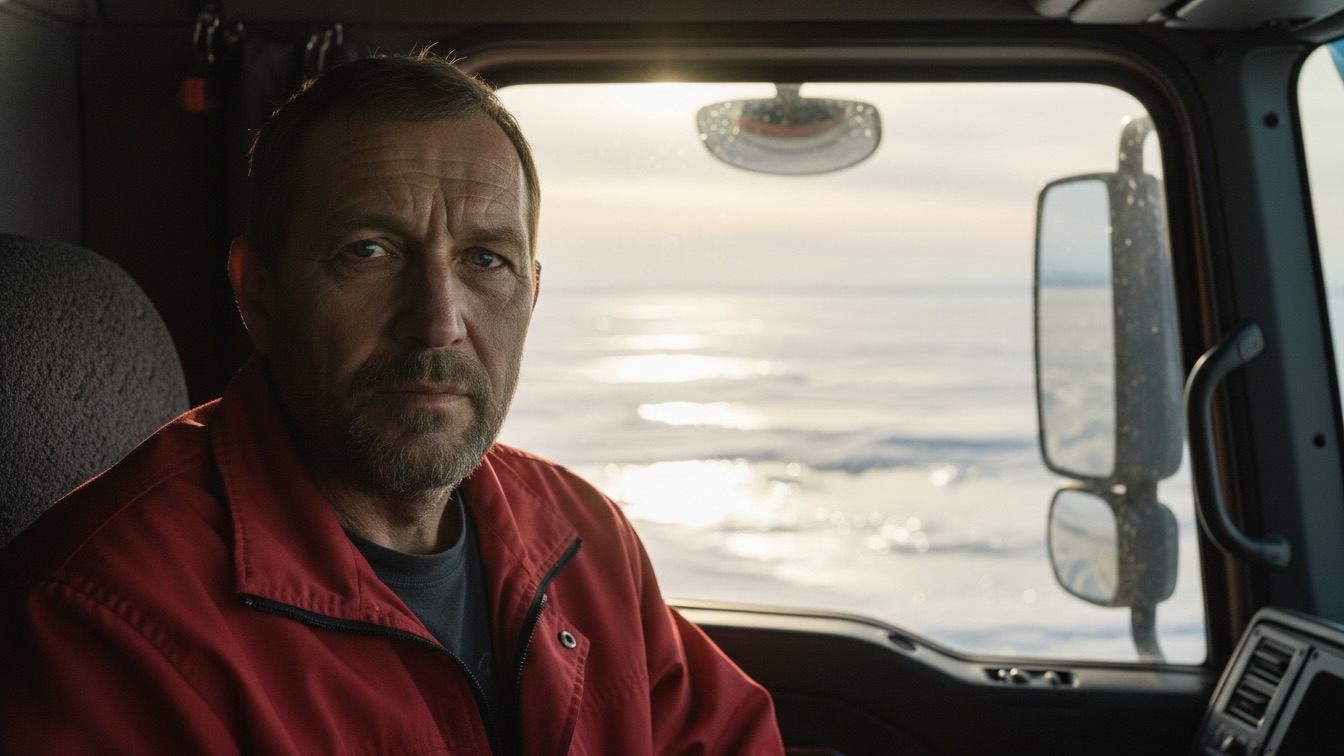
The story opens in a quiet diner where Harlan, a weary truck driver, contemplates a broken yellow mug that symbolizes his own fractured life. Outside, an unnatural summer freeze has gripped the land, turning the world into a landscape of ice and desperation. The Chief of the Oji-Cree Nation approaches Harlan with a plea for help, explaining that his town is freezing because their generators have run out of fuel. Although the ice road is rotting and dangerous, Harlan accepts the mission, driven by a combination of extreme debt and a simmering resentment toward the government’s indifference.
The journey across the frozen lake is a harrowing ordeal marked by the constant threat of the ice giving way. Harlan experiences auditory and visual hallucinations of his late wife, Sarah, suggesting a mind frayed by grief and exhaustion. He successfully navigates a treacherous pressure ridge, only to have the back of his tanker break through the ice moments later. Through sheer mechanical force and desperation, he manages to pull the rig free, though the truck sustains damage. This near-death experience highlights the thin line Harlan walks between survival and a subconscious desire for release.
Before reaching the town, Harlan encounters a stranded family whose vehicle has failed them in the sub-zero temperatures. Despite his initial anger and focus on his own survival, he provides them with his essential emergency gear, sacrificing his own safety net. Upon arriving at the Oji-Cree Nation, he delivers the fuel, and the town is momentarily saved as the lights flicker back to life. However, the victory is bittersweet, as the Chief acknowledges that the changing climate will eventually force the community to abandon their ancestral home. Harlan departs via a longer land route, finally accepting that the era of the ice road is coming to an end.
The central theme of the narrative is the pervasive nature of "brokenness," manifesting in the environment, the economy, and the human psyche. The weather is described as "broken," with an unnatural cold invading a summer month, reflecting a world out of balance due to climate change. This environmental decay mirrors Harlan’s internal state, represented by his attachment to a broken mug and his grief over his deceased wife. The story suggests that when the external structures of the world fail, individuals are forced to operate within the ruins of what remains.
Economic abandonment and institutional neglect serve as a secondary thematic pillar. The government’s refusal to assist the Oji-Cree Nation because of "paperwork" and "cost" highlights a cold, bureaucratic indifference to human life. Harlan’s hatred for the "men in clean suits" stems from his own experience with a bank that threatens to seize his only remaining possession. The story portrays a world where the marginalized must risk their lives to solve problems created by the negligence of the powerful, turning survival into a form of high-stakes gambling.
The narrative also explores the weight of memory and the process of moving through grief. Sarah’s presence in the empty passenger seat indicates that Harlan is not just driving a truck; he is carrying the burden of his past. His decision to help the stranded family, despite his own precarious situation, marks a shift from isolation to a reluctant re-engagement with the world. By the end of the story, his choice to take the long dirt road instead of the ice suggests a burgeoning acceptance of reality and a move away from the "suicide trips" of his mourning.
Harlan is a man defined by stoicism and a deep-seated sense of loss. He is physically and emotionally "thick" and "tired," qualities that allow him to endure the harshness of the north but also isolate him from others. His attachment to his truck is not merely professional; it is a psychological anchor to his late wife, Sarah. Without the truck, he believes he would have nothing, suggesting that his identity is entirely wrapped up in his ability to provide and endure in a hostile environment.
Psychologically, Harlan exhibits signs of complicated grief and perhaps a subconscious death wish. He describes the mission as a "suicide trip" yet accepts it anyway, indicating that he values the survival of his rig over his own life. His hallucinations of Sarah act as a moral compass and a source of conflict, as he argues with her memory about the necessity of his actions. This internal dialogue reveals a man who is lonely to the point of fragmentation, seeking validation from a ghost because he cannot find it in the living world.
However, Harlan’s interaction with the stranded family reveals a flickering spark of altruism beneath his crusty exterior. By giving away his survival gear, he demonstrates a transition from a man who only cares about his debt to a man who recognizes the sanctity of life. This act of sacrifice is the true turning point for his character. When he rests his hand on the empty passenger seat at the end, it is no longer an act of desperation but one of quiet acknowledgment, showing he is finally ready to drive into the future.
The Chief represents the heavy burden of communal responsibility in the face of systemic failure. He is described through his exhaustion, with red eyes and an old, ripped coat that signifies the lack of resources available to his people. Unlike Harlan, who is driven by individual survival and debt, the Chief is motivated by the collective survival of his town. He is forced into the humiliating position of begging a lone driver for help because the formal structures of society have turned their backs on his nation.
His character serves as a bridge between the harsh reality of the ice and the human cost of the changing climate. He is pragmatic and honest, admitting to Harlan that the ice is "mush" and that the trip might result in death. This honesty creates a bond of mutual respect between the two men, as they both understand the stakes of their environment. The Chief’s final admission that the town cannot afford Harlan next year is a moment of profound sorrow, marking him as a leader who is witnessing the slow death of his community’s way of life.
The narrative style is marked by a heavy use of sensory detail and a rhythmic, almost percussive pacing. The author employs onomatopoeia, such as the "squeak" of boots and the "BOOM" of the ice, to create an immersive and threatening atmosphere. These sounds emphasize the physical reality of the setting, making the environment feel like an active antagonist in the story. The descriptions of the "yellow and sick" ice and the "burnt dirt" taste of the coffee reinforce a tone of decay and hardship that permeates every scene.
The pacing of the story mirrors the tension of driving on thin ice, alternating between slow, contemplative moments and bursts of high-stakes action. The scene where the truck breaks through the ice is written with short, punchy sentences that heighten the sense of panic and urgency. Conversely, the scenes in the diner and the delivery at the town are slower and more atmospheric, allowing the reader to feel the weight of the characters' exhaustion. This fluctuation keeps the reader off-balance, much like Harlan as he navigates the unpredictable road.
The narrative voice is third-person limited, staying close to Harlan’s perspective to emphasize his isolation. This choice allows the reader to experience his hallucinations and internal struggles firsthand, creating a deep sense of empathy for a character who is otherwise quite guarded. The personification of the engine as an "angry bear" and the wind as a "flat wooden board" adds a mythic quality to the prose. These metaphors elevate the story from a simple survival tale to a modern folk tragedy about the end of an era.


