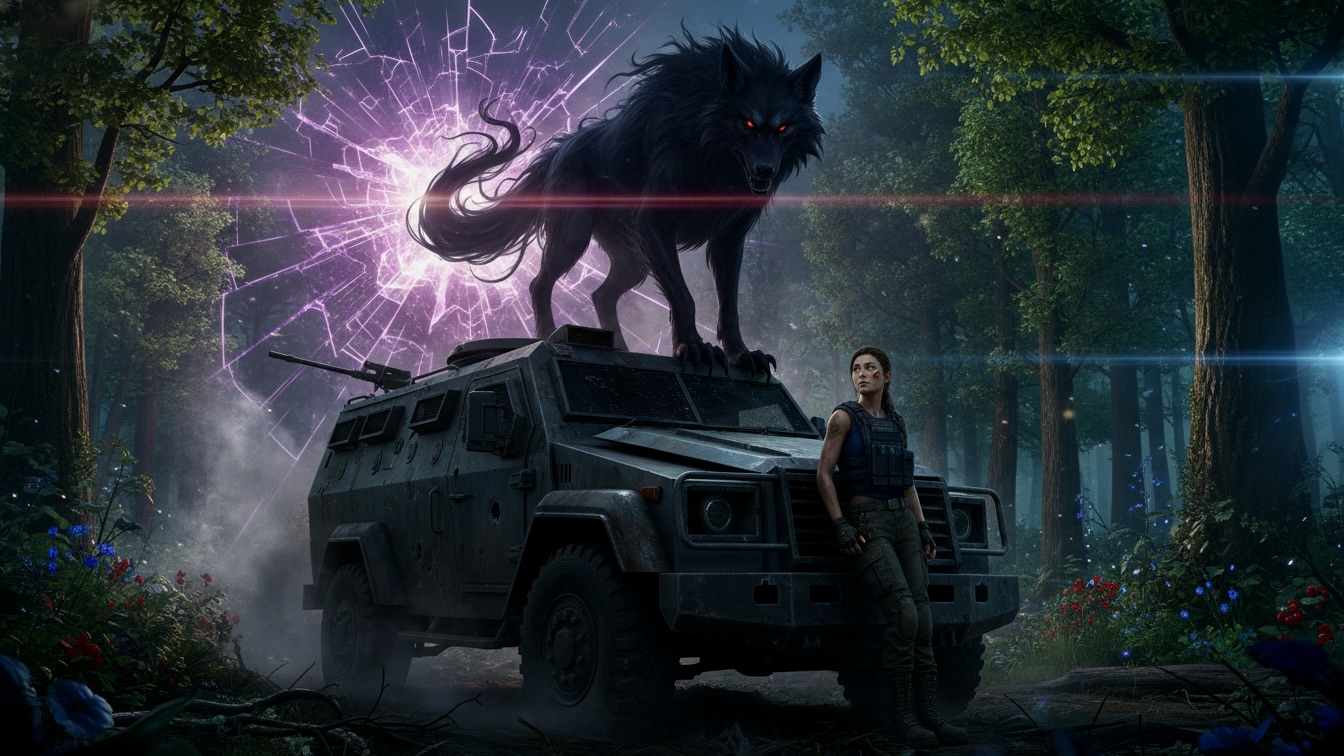
The truck was a coffin of smoking metal, and the border was a shimmering line behind us in the dark.
The steering wheel was a jagged crescent of plastic and heat. My forehead hit the rim with a sound like a wet sack of flour hitting a sidewalk. Everything went white, then a static-filled grey, then the world rushed back in with the scream of a cooling engine. The dashboard hummed. It was a low, dying vibration that made my teeth ache. Smoke—grey and thick—curled from the hood of the Ministry transport, obscuring the dark wall of pine trees ahead. I tried to move my fingers. They felt like distant objects, cold and heavy, despite the ninety-degree humidity pressing against the cracked windshield.
"Max?" I tried to say the name, but it came out as a dry rasp. My throat was sandpaper. I tasted iron. I tasted the copper tang of the blood magic I'd burned through back at the railyard. It was a metallic residue that sat on the back of my tongue like a battery.
I reached for the door handle. The reinforced metal was warped. I kicked it. Once. Twice. The third time, the hinge groaned and the door popped open, sagging toward the asphalt. I spilled out onto the road. The ground was hard. It didn't have the give of the city pavement. It felt older. Meaner. The summer air here wasn't filtered by air conditioning or tempered by the Lake Ontario breeze. It was stagnant, heavy with the moisture of a thousand rotting logs and the vibrating heat of the engine.
I dragged myself up using the door frame. My tactical vest was shredded at the shoulder. I looked back at the cargo area. The heavy doors were slumped open. Max—or the thing Max had become—wasn't there.
"Max!" I yelled, louder this time. The sound was swallowed by the trees. The forest didn't echo. It just took the noise and buried it.
I heard a low, rhythmic thudding from the ditch. A shape moved in the tall, yellowed grass. It was the wolf. He was still in the shadow-form, his fur looking like a hole cut out of the night. He was pacing, his movements jerky and uncoordinated. He looked like a video game character with a corrupted animation file. His head would twitch to the left, then his back legs would slip.
"Max, hey. It's me." I stepped toward the ditch, my boots crunching on broken glass and plastic housing from the truck's headlights. "We made it. We're across."
The wolf stopped. He turned his head toward me. His eyes were still that terrifying, luminous amber, but the pupils were narrow slits. He let out a sound that wasn't a growl and wasn't a whimper. It was a glitchy, vocalized sob.
I knelt at the edge of the asphalt. My knees stung. I could feel the grit of the road digging into my skin. "You need to come back, kid. The border barrier... it did a number on the truck. I don't know if the Ministry can cross, but I don't want to be sitting on the highway when they figure it out."
He took a step toward me, then collapsed. The shadow-fur seemed to evaporate, peeling away from his skin like burnt paper in a breeze. Underneath, his human body was pale, slick with sweat, and curled into a tight ball. He was naked, his hoodie and jeans long since shredded by the expansion of his bones. He looked small. Too small for the amount of wreckage we'd just left behind us.
I stripped off my tactical vest, leaving me in just the grey t-shirt. I threw the vest into the grass and unbuttoned my outer utility shirt, draped it over my arm, and slid down into the ditch.
"Don't look at me," Max whispered. His voice was a wreck.
"I've seen worse things in the Northern Zones, Max. A lot worse. Put the shirt on."
I handed it to him. He grabbed it with shaking hands. His fingernails were still long, jagged, and tipped with dried blood. He fumbled with the buttons, his motor skills shot to hell. I didn't help him. I let him have the dignity of the struggle. He needed to feel like he had hands again. He needed to remember how to be a person who wears clothes and follows the laws of physics.
"Where are we?" he asked, pulling the oversized shirt over his head. It hung down to his mid-thighs.
"The unceded territories. Somewhere north of the 50th parallel. The GPS died three miles back, but the barrier we hit? That was the line. We're in the woods now. No Ministry. No parents. Just us and the bugs."
I looked up at the sky. The stars were too bright. In Toronto, you get a muddy orange glow. Here, the sky was a cold, sharp vacuum of black and white. It felt exposing. Like the universe was watching us through a microscope.
I went back to the truck. I needed supplies. I reached into the cab and grabbed my medkit—a hard-shell plastic box that had survived the impact. I found my backup sidearm, a standard-issue kinetic pistol, and tucked it into the waistband of my pants. I grabbed two bottles of lukewarm water from the floorboards and a bag of protein bars that had been crushed into dust.
"Can you walk?" I asked, sliding back down to him.
Max stood up. He was wobbly. His legs looked like they belonged to a newborn deer. "I think so. Everything feels... loose. Like my joints are held together by rubber bands."
"That's the shift residue. It'll pass. We need to get off the road. The Ministry drones might not be able to cross the barrier, but they have long-range thermal. If we stay on the asphalt, we're a heat signature on a silver platter."
I handed him a water bottle. He drank the whole thing in three seconds, water spilling down his chin and onto the dirt-stained shirt.
"Thanks," he said, wiping his mouth with the back of his hand. He looked at the smoking truck. "What happens if they come through?"
"They won't. Not tonight. Crossing a sovereign magical border without a treaty is an act of war. Even the Ministry isn't that stupid. They'll wait for the lawyers to find a loophole. We have maybe six hours before they start getting creative."
I turned toward the tree line. The pines were dense, a wall of needles and shadow. There was no trail. No sign. Just the heavy, humid silence of a summer night in the wilderness.
"Keep close," I said. "And don't step on anything that looks like it's breathing."
We stepped over the bent guardrail and vanished into the dark.
The first mile was a physical assault. The forest floor was a chaotic mess of fallen cedar, waist-high ferns, and moss that felt like wet sponge. Every step was a gamble. My boots sank into the rot, the humidity clinging to my skin like a plastic wrap. I could feel the sweat pooling under my bra, stinging the places where the tactical vest had chafed my shoulders raw. Max was behind me, his breathing heavy and rhythmic. He tripped every few minutes, his bare feet catching on roots, but he didn't complain. He was too tired to complain.
"You still with me?" I asked, not looking back. I was using a small penlight, the beam narrow and focused on the ground two feet in front of me. I didn't want to signal any drones, but I also didn't want to fall into a sinkhole.
"Yeah," Max panted. "Just... everything is loud. The bugs. The trees. I can hear the sap moving. Is that normal?"
"For a Shifter? Probably. Your senses are calibrated for the wolf. You're going to have to learn how to dial it back. Think of it like a volume knob. Turn it down, or you'll burn out your nervous system before sunrise."
I stopped by a massive, lightning-scarred oak. I needed to check my orientation. I didn't have a compass—the Ministry gear was all digital, and the digital stuff was currently bricked by the barrier's EMP pulse. I looked for the North Star through the canopy, but the branches were too thick.
"Talia," Max said softly. He was leaning against a tree, his face pale in the dim light of my penlight. "Why did you do it?"
"Do what?"
"Shoot Hughes. Ruin your life. You could have just... given me the shot. I would have been out of your hair in five minutes. You'd have your pension."
I looked at him. Really looked at him. He was sixteen. He had the same look in his eyes I'd seen in the eyes of soldiers who knew their CO had sold them out. A hollow, flat kind of betrayal.
"I don't like bullies, Max. And I really don't like people who forge signatures on death warrants. Besides, the coffee at the Ministry office was terrible. I was looking for an excuse to quit."
"You're a bad liar," he said. He managed a tiny, weak smile.
"Maybe. But I'm a great shot. Now keep moving. We're looking for a creek. Water means a trail, and a trail means people. Even the outcasts need a way to get around."
We pushed through a thicket of raspberry bushes. The thorns tore at my pants and Max's bare legs. He hissed in pain but kept going. The heat was oppressive, a physical weight that made every breath feel like a chore. The air was dead. No wind reached the forest floor. It was a stagnant chamber of growth and decay.
I started to notice things that didn't belong. A scrap of blue tarp caught in a branch. A rusted tin can sitting on a stump. Signs of life. Not Ministry life. Not civil life. This was the debris of people who lived on the margins.
Suddenly, the ground dropped away. We were standing at the edge of a steep ravine. At the bottom, a thin ribbon of black water snaked through the rocks. The sound of it was a low, constant murmur, like a crowd whispering just out of reach.
"Down there," I pointed.
We slid down the embankment, dirt and loose shale cascading around us. I hit the bottom and nearly twisted my ankle on a smooth river stone. The air was slightly cooler by the water, a mercy I hadn't expected.
I knelt by the stream and splashed cold water on my face. It felt like a reboot. The stinging in my eyes faded. Max followed suit, dunking his entire head into the current. He came up gasping, his hair plastered to his skull.
"Better?" I asked.
"Cold," he said. "It feels like needles. But good."
I checked my watch. 2:00 AM. We'd been walking for two hours and had covered maybe three miles. In the city, that's a twenty-minute stroll. Here, it was a marathon.
"We follow the water downstream," I said. "Usually, the settlements are near the larger forks. They need the power for the small-scale hydro-generators."
"How do you know so much about this place?" Max asked, wringing out the hem of my shirt. "I thought you were a city medic."
"I spent three years in the Northern Zones during the Integration Riots," I said, standing up. "The Ministry doesn't like to talk about it, but the border was a mess back then. I spent a lot of time patching up people who didn't want to be found. You learn the geography when you're looking for places to hide a field hospital."
We started walking along the bank. The rocks were slippery, covered in a fine layer of silt. The moon was lower now, casting long, distorted shadows across the water.
"Do you think my parents are still at the legislature?" Max asked after a long silence.
"Probably. They'll milk the cameras as long as the lighting is good. By tomorrow morning, they'll be on the talk show circuit. The 'Stolen Son' narrative is a gold mine for the Notification movement."
Max kicked a stone into the water. Plink. "They hate me. They actually hate me. I thought they were just... old-fashioned. But they wanted me dead."
"They didn't want you dead, Max. They wanted the problem to go away. People like your dad... they don't see individuals. They see categories. You shifted, and you moved from the 'Son' category to the 'Monster' category. It's easier for them to process a tragedy than a transition."
"That's dark, Talia."
"Welcome to the real world, kid. It's not a spreadsheet."
We rounded a bend in the creek, and the trees opened up slightly. Ahead, I saw a flicker of light. Not a drone. Not a flashlight. It was the orange, flickering glow of a real fire.
I held up a hand. Max froze.
I reached for the kinetic pistol in my waistband. I didn't draw it, but I kept my thumb on the grip.
"Stay behind me," I whispered. "And let me do the talking. These people aren't exactly fans of the Ministry uniform."
"I'm wearing your shirt," Max pointed out.
"Exactly. You look like a refugee. I look like a problem."
We approached the light. It wasn't just a campfire. It was a gate. A crude fence made of sharpened pine logs and rusted chain-link stood across the narrowest part of the ravine. A small wooden shack sat perched on the bank, a single window glowing with lantern light.
On the gate, a sign was painted in jagged white letters: *NO MINISTRY. NO EXCEPTIONS. WE SHOOT BACK.*
"Subtle," Max muttered.
"Effective," I countered.
I stepped into the light of the fire, holding my hands out away from my body. "Hello the house!" I yelled. "We're travelers. We need medical aid and a place to sit for an hour."
There was a long silence. The only sound was the crackle of the fire and the rush of the creek. Then, a floorboard creaked inside the shack. The door swung open, and a man stepped out.
He was old, his skin the texture of a dried tobacco leaf. He was wearing a faded flannel shirt and a pair of heavy work pants held up by rope. In his hands, he held a long-barreled hunting rifle. He didn't point it at us, but he wasn't exactly inviting us to dinner either.
"You're wearing government boots, lady," the man said. His voice was like two pieces of sandpaper rubbing together. "And that kid looks like he just crawled out of a blender."
"The boots were part of a job I no longer have," I said, keeping my voice steady. "And the kid is a Shifter. He just crossed the barrier. He's crashing hard."
The man's eyes narrowed. He looked at Max, then back at me. He spat a glob of tobacco juice into the dirt.
"Shifter, huh? We get a lot of those. Usually, they're older. Usually, they don't have a Ministry medic acting as a bodyguard."
"I'm not his bodyguard," I said. "I'm his ride. And right now, the truck is a wreck on the highway. We need shelter."
"Shelter costs," the man said. "What you got?"
I reached into my pocket and pulled out my medkit. I held it up. "Antibiotics. Suture kits. High-grade magical suppressants—the kind that actually work without melting your brain. And I'm a trained combat medic. I can fix whatever's wrong with that leg you're favoring."
The man paused. He looked down at his right leg, which was stiff. He looked back at the medkit.
"Name's Silas," he said, lowering the rifle slightly. "The kid stays in the barn. You can come in the shack. But if you touch that pistol in your belt, I'll have your head on a pike before you can pull the trigger."
"Fair enough," I said.
I looked at Max. He looked exhausted, his eyes glazed over.
"Go to the barn, Max. Get some sleep. I'll be right inside."
He nodded, too tired to argue. Silas gestured toward a low, sagging structure behind the shack. Max trudged toward it, his shoulders slumped.
I followed Silas into the shack. The air inside was dry and hot, filled with the sharp, resinous scent of pine wood. It was a single room—a cot, a table, and a wood-burning stove that was currently cold.
"Sit," Silas said, gesturing to a rickety chair. "And let's see those antibiotics."
I sat. My body finally realized how tired I was. My muscles began to twitch, a delayed reaction to the adrenaline dump. I opened the medkit and laid it on the table.
"Life's about to get real complicated for you, Talia," Silas said, leaning his rifle against the wall. "You don't just walk into the Unceded Woods and expect a warm welcome. The Ministry is one thing. The things that live out here? They're another."
"I'll take my chances," I said, pulling out a vial of amoxicillin. "The things out here don't have a PR department."
Silas laughed, a dry, hacking sound. "Not yet they don't. But give 'em time. Everyone wants to be a brand these days."
I looked at the window. The sky was starting to turn a bruised, pre-dawn purple. We had survived the night. But the summer was just beginning, and the heat was only going to get worse.
The morning light didn't bring relief. It brought the flies. They were large, black, and relentless, buzzing around the window of Silas's shack with a frantic energy that mirrored my own internal state. I hadn't slept. I'd spent the last three hours cleaning a jagged, festering ulcer on Silas’s calf. It wasn't a magical wound; just a nasty infection from a piece of rusted rebar he’d stepped on two weeks ago.
"You're lucky you didn't lose the leg," I said, taping a fresh bandage over the site. "Another forty-eight hours and the sepsis would have hit your bloodstream."
Silas grunted, pulling his pant leg down. He looked better. The grey pallor of his skin had been replaced by a flush of actual blood flow. "Perks of living off the grid. You get to die of things they cured in the nineteenth century. Thanks, doc."
"Don't call me doc. I was a tech. A glorified band-aid applier."
"Whatever you say." Silas stood up, testing his weight. He didn't wince. "The kid's awake. He's been pacing the barn for an hour. You might want to check on him before he decides to eat one of my goats."
I grabbed my medkit and stepped outside. The sun was already high enough to bake the moisture out of the ground. The ravine felt like a steam room. I walked across the dirt yard to the barn. It was a skeletal structure, the wood grey and weathered.
Inside, the air was slightly cooler, but it felt thick. Max was standing in the center of the dirt floor, staring at his hands. He was wearing my shirt and a pair of oversized work pants Silas had tossed him. They were cinched at the waist with a piece of twine.
"Max?"
He looked up. His eyes weren't amber anymore, but they had a strange, metallic sheen to them. "I can't get it to stop, Talia."
"Get what to stop?"
"The hum. It's like... there's a hive of bees living under my skin. I can feel the magic trying to push out. It's not painful like before, but it's... itchy. I want to run. I want to bite something. Is this what it's like? Always?"
I sat down on a hay bale. "You're unbound now, Max. The suppression charms are gone. Your body is trying to find its new equilibrium. You've spent sixteen years being told you were one thing, and now you're two things. It's going to take time for the two halves to stop fighting for space."
"I don't want to be a monster," he said, his voice cracking.
"You're not a monster. You're a biological anomaly. There's a difference. Monsters enjoy the damage they cause. You're just trying to survive the shift."
I opened a protein bar and handed him half. He ate it in one bite, barely chewing.
"Silas says there's a settlement further north," I said. "A place called The Reach. It's a sanctuary for Shifters and rogue mages. They have teachers there. People who can show you how to control the volume knob."
"Are we going there?"
"We have to. We can't stay here. Silas is a nice guy, in a 'I'll shoot you if you touch my stuff' kind of way, but he can't protect us if the Ministry sends a recovery team."
"How far is it?"
"Two days. Maybe three, given the terrain. We follow the creek until it hits the Ozhige-Sipi river, then head upstream."
Max looked at the door of the barn. "The Ministry... they're going to come, aren't they? They won't just let us go."
"No. They won't. I cost them a lot of money and a lot of face. Reddard is probably halfway through a six-pack of rage-suppressants right now, planning his next move. But we have the advantage of the woods. Their tech doesn't work well here. The ambient magic in the soil messes with the sensors."
I stood up and walked to the barn door. I looked at the perimeter fence. Silas had hung hundreds of empty tin cans from the wire. They rattled in the slight breeze—a low-tech alarm system. It was primitive, but in a place where drones were blind, it was more reliable than a motion sensor.
"We leave at dusk," I said. "The heat is too much during the day. We'll make better time when the sun is down."
"Talia?" Max called out as I started to walk away.
I turned back.
"Thanks. For, you know. Not letting them kill me."
"Don't thank me yet, kid. We're not out of the woods. Literally."
I spent the afternoon helping Silas reinforce the tin-can fence. It was mindless work, and it kept my hands busy so they wouldn't shake. The heat was a physical presence, a humid blanket that made every movement feel sluggish. I watched the treeline. Every time a crow took flight or a branch snapped, my hand went to the pistol at my waist.
Around 4:00 PM, Silas came out with two tin mugs of something that looked like swamp water but tasted like bitter chicory.
"You're high-strung, girl," he said, leaning against a post. "You keep looking for ghosts."
"I'm looking for Enforcers. They're worse than ghosts. Ghosts can't put a kinetic slug through your lungs."
"True. But you're in the Unceded now. The rules are different. The Ministry thinks they own the world, but the world has a way of reminding them it was here first. You ever wonder why they haven't just paved this place over?"
"Lack of resources?" I guessed.
"Nah. It's the friction. Magic and machines don't mix. Not really. The Ministry uses 'integration,' but that's just a fancy word for 'strangulation.' Out here, the magic is raw. It eats microchips. It rusts steel in a week. They can't maintain a presence because the environment is literally allergic to them."
I looked at my kinetic pistol. It was a high-tech piece of hardware. "Does that mean this is going to jam?"
"Eventually. It'll start misfiring. The crystals will crack. If I were you, I'd find a nice heavy piece of iron. Iron doesn't care about magic."
He was right. I could already feel a slight grit in the slide of the pistol, a fine dust that wasn't there this morning.
As the sun began to dip below the horizon, the forest changed. The birds went quiet, and the insects took over—a vibrating, high-pitched chorus that seemed to pulse with the heat. The shadows elongated, stretching across the yard like grasping fingers.
I went to the barn to get Max. He was ready. He looked more alert, his movements more fluid. He’d found a pair of old boots in the corner of the barn that almost fit him.
"Ready?" I asked.
"Ready," he said.
We walked back to the shack. Silas was waiting by the gate. He handed me a small, leather-bound pouch.
"Dried venison and some medicinal moss. Wrap it on any cuts. It’ll stop the bleeding faster than that chemical spray you got in your box."
"Thanks, Silas. For everything."
"Just keep the kid safe. We need more of his kind out here. The Ministry's been thinning the herd too long."
He opened the gate, the rusted hinges screaming. We stepped through and back into the ravine.
"Keep to the water," Silas called out. "And if you see the blue light in the trees... don't follow it. It ain't a flashlight."
We didn't look back. We followed the creek north, the sound of the water our only guide. The night was even more humid than the day, the air so thick it felt like walking through a pond.
About an hour into the trek, Max stopped. He tilted his head, his nostrils flaring.
"What is it?" I whispered, drawing my pistol.
"Something's following us," he said. "Not on the ground. In the air."
I looked up. I couldn't see anything through the canopy. No lights. No hum.
"Are you sure?"
"I can hear the air moving around it. It's small. Fast."
"A scout drone," I cursed. "They must have launched a high-altitude unit and dropped sub-probes. If it sees us, it'll relay our coordinates via satellite before the magic can fry it."
"What do we do?"
"We need cover. Real cover. Something the thermal can't penetrate."
I looked around. The ravine was narrowing. The walls were steep, covered in thick mats of ivy and moss.
"There!" I pointed to a dark fissure in the rock wall. It looked like an old drainage pipe or a small cave.
We scrambled up the bank and ducked into the opening. It was narrow, barely wide enough for both of us to sit side-by-side. The air inside was cold and damp. It smelled like wet stone and ancient dust.
Seconds later, a faint, high-pitched whine passed overhead. A thin beam of blue light swept across the creek, illuminating the rocks for a fraction of a second before moving on.
Max was shaking. I could feel the heat radiating off him. He was close to a shift. The stress was acting as a catalyst.
"Focus, Max," I hissed, grabbing his arm. "Control the volume. Don't let it out."
He gritted his teeth, his jaw muscles bulging. "It's... so... loud."
We sat in the dark for what felt like hours. The drone passed back and forth three more times, its search pattern getting tighter. They knew we were in the area. They just couldn't pin us down through the interference of the ravine walls.
Finally, the whining sound faded into the distance.
Max let out a long, ragged breath. He slumped against the stone wall. "Did it leave?"
"For now. But they'll send more. We can't stay on the creek. They've mapped the water routes."
I looked at the map in my head. If we left the ravine, we'd have to climb the ridge. It was harder terrain, but the tree cover was denser.
"We go up," I said. "We stay in the thickest brush we can find. We don't stop until we hit the river."
"Talia?" Max's voice was small in the darkness.
"Yeah?"
"Back in the truck... when you used the blood magic. I saw things. In your head. I saw a girl. She looked like you, but younger. She was wearing a uniform like yours."
I froze. My heart hammered against my ribs. "The connection goes both ways, Max. I told you that."
"Who was she?"
I looked out at the dark forest, the moonlight silvering the leaves. "Her name was Elena. She was my partner in the Northern Zones. She didn't make it across the border."
Max didn't say anything. He didn't have to. The silence in the cave was heavy with things we couldn't change.
"Let's move," I said, my voice flat. "The sun doesn't wait for anyone."
We crawled out of the fissure and started the long, brutal climb up the ridge. The summer night pressed down on us, a weight of heat and history, as we fought our way deeper into the wild.
By the time we reached the crest of the ridge, my lungs felt like they were filled with hot ash. The humidity had broken into a localized summer thunderstorm—no thunder, just a sudden, violent downpour that turned the dirt into a slick, treacherous slurry. It wasn't cooling; it was like being sprayed with warm tea.
Max was struggling. The shift was leaning on him again. Every few steps, his gait would change, his spine arching as the magic tried to force the skeletal restructuring. I had to keep a hand on his shoulder, guiding him through the dense thickets of cedar.
"Almost there," I lied. I had no idea how far we were, but the ground was starting to slope downward again. In the distance, through the sheets of rain, I could hear a new sound. A deep, heavy roar that wasn't the wind. The Ozhige-Sipi river.
We hit a small clearing, and I saw them.
Three figures in black tactical gear. They weren't moving. They were standing in a triangle formation around a hovering relay station—a tripod-mounted device that was pulsing with a soft, rhythmic green light.
Enforcers.
They had leapfrogged us. They must have used a transport VTOL to drop a team ahead of our projected path.
"Get down," I hissed, pulling Max into the shadow of a fallen log.
We were thirty yards away. The rain was helping us, muffling our footsteps and blurring our heat signatures, but that relay station was a problem. It was a signal booster. It was how they were getting around the magical interference. If they established a network, the drones would have a clear picture of the whole sector.
"I can take them," Max whispered. His eyes were flashing amber. The wolf was right there, just under the surface, begging for the leash to break.
"No. There are three of them, and they're carrying high-output spell-casters. You charge in there, they'll turn you into a rug before you hit the first one. We do this quiet."
I checked my pistol. The slide was sluggish. I pulled it back, and it made a gritty, grinding sound. It was going to jam. I knew it.
I reached into my medkit. I didn't have any grenades, but I had a roll of copper suture wire and a high-capacity battery for my medical cauterizer.
"What are you doing?" Max asked.
"Improvising."
I stripped the insulation off the ends of the copper wire. I looped one end around the battery terminals and the other around a heavy iron bolt I'd scavenged from the truck wreckage. It was a crude short-circuit. If I could get it close to that relay station, the electrical surge would fry the sensitive crystals inside.
"I'm going to circle around to the left," I said. "When I throw this, it's going to make a lot of sparks and a very loud pop. That's your cue. Don't shift. Just run. Head for the river. I'll be right behind you."
"Talia—"
"Do not argue with me, Max. Just run."
I crawled through the mud, the rain soaking through my shirt. My heart was a frantic drum in my chest. I reached the edge of the clearing. The Enforcers were talking, their voices distorted by their helmet comms.
"...signal is still spotty. The ambient levels are spiking. We need to recalibrate the core."
"Just get it done. Reddard wants a lock before the storm clears."
I took a breath, counted to three, and hurled the battery-and-wire mess at the relay station.
It hit the tripod with a metallic clack.
For a second, nothing happened. Then, a bright, blinding blue arc of electricity jumped from the battery to the relay's casing. The green light turned a violent, screaming red. A sharp crack echoed through the clearing, followed by a plume of acrid white smoke.
The relay station buckled, the tripod legs melting into the mud.
"Contact!" one of the Enforcers yelled, spinning around.
Max didn't run.
He didn't shift either. He did something worse. He lunged out of the brush and tackled the nearest Enforcer, using the momentum to drive the man's head into a tree trunk.
"Max, no!" I screamed, leaping up and firing my pistol.
Thud. The gun jammed on the first shot.
The second Enforcer raised his spell-caster. A bolt of red energy hissed through the rain, missing my head by inches and charring the wood of the log behind me.
I threw the useless pistol at his face. It hit his visor, cracking the glass. He stumbled back, and I was on him. I didn't use magic. I used the combat knife I'd pulled back in the subway. I drove the blade into the gap in his armor at the shoulder. He groaned, dropping his weapon.
Across the clearing, the third Enforcer was aiming at Max.
Max was pinned under the first guy, struggling to get his footing in the slick mud.
"Hey!" I yelled, drawing the Enforcer's attention.
He turned the spell-caster on me. I saw the muzzle glow. I closed my eyes, waiting for the impact.
It never came.
A massive, dark shape slammed into the Enforcer from the side. It wasn't Max. It was another wolf. This one was grey, scarred, and twice the size of Max's shadow-form. It tore the spell-caster out of the Enforcer's hands and tossed it into the brush like a toy.
Then, more shapes emerged from the rain. Five, six, seven people. They weren't wearing tactical gear. They were wearing furs, leathers, and heavy canvas. They carried bows, iron spears, and rusted machetes.
The Enforcers didn't stand a chance. Within seconds, they were disarmed and pinned to the ground.
The grey wolf shimmered, the form dissolving into a tall, muscular woman with close-cropped hair and a jagged scar running from her ear to her chin. She looked at me, then at Max, who was slowly pulling himself out of the mud.
"You're a long way from the city, medic," she said. Her voice was deep, resonant.
"We're looking for The Reach," I said, trying to stop my hands from shaking.
She looked at Max. She walked over to him, her eyes searching his face. She reached out and touched the amber glow still fading from his pupils.
"A latent who broke the charms," she murmured. "Impressive. Usually, they just pop like a grape."
"He's strong," I said.
"He's a mess," she corrected, looking back at me. "And you're bleeding. Again."
I looked down at my hand. The cut from the blood magic had reopened. The rain was washing the blood away, but the wound was deep and white at the edges.
"I'll live."
"Maybe. The Ministry doesn't like losing their toys. They'll be back with a bigger hammer next time."
She gestured to her people. They started stripping the Enforcers of their gear, throwing the high-tech weapons into the creek.
"I'm Sarah," the woman said. "I lead the scouts for The Reach. We saw the flash from the barrier. We've been tracking you since you hit Silas's fence."
"Is he okay?" Max asked.
"Silas is fine. He's too mean to die. Come on. The river's just down the hill. We have boats. We'll be at the sanctuary by morning."
We followed them. The rain started to let up, leaving the forest dripping and steaming in the humid night. We reached the banks of the Ozhige-Sipi. It was a massive, churning artery of black water, the surface broken by white-capped rapids.
Two long, low-slung wooden boats were tucked into the reeds. We climbed in, and the scouts took up the oars.
As we pushed off into the current, I looked back at the ridge. The green light of the relay station was gone. The forest was dark again.
Max sat next to me in the boat. He looked at the water, his hand trailing in the wake. "Do you think they'll ever stop coming?"
I looked at my bandaged hand. I looked at the knife on my belt. "I don't know, Max. But for the first time, they have to find us first."
The boat hit a patch of rough water, dipping and swaying. I closed my eyes, listening to the rhythmic splash of the oars. The summer air was still hot, still heavy, but the weight felt different now. It didn't feel like a cage. It felt like a shield.
We drifted around a bend, and the trees opened up. In the distance, nestled in a valley between two jagged peaks, I saw lights. Real lights. Not the cold, flickering LED of the city, but the warm, steady glow of a thousand lanterns.
The Reach.
I leaned my head back against the wooden hull. My body was screaming for sleep, but my mind was finally quiet. We had crossed the line. We were in the wild now.
Suddenly, the water around the boat began to glow. A soft, bioluminescent blue light rose from the depths, illuminating the fish darting beneath the keel.
Max gasped, leaning over the side. "What is that?"
"Magic," I said. "The real kind."
But as I looked back at the dark ridge we’d just left, I saw a single, pinpoint red light blinking on the horizon. It wasn't a star. It wasn't a lantern. It was a lens.
“But as I looked back at the dark ridge we’d just left, I saw a single, pinpoint red light blinking on the horizon.”