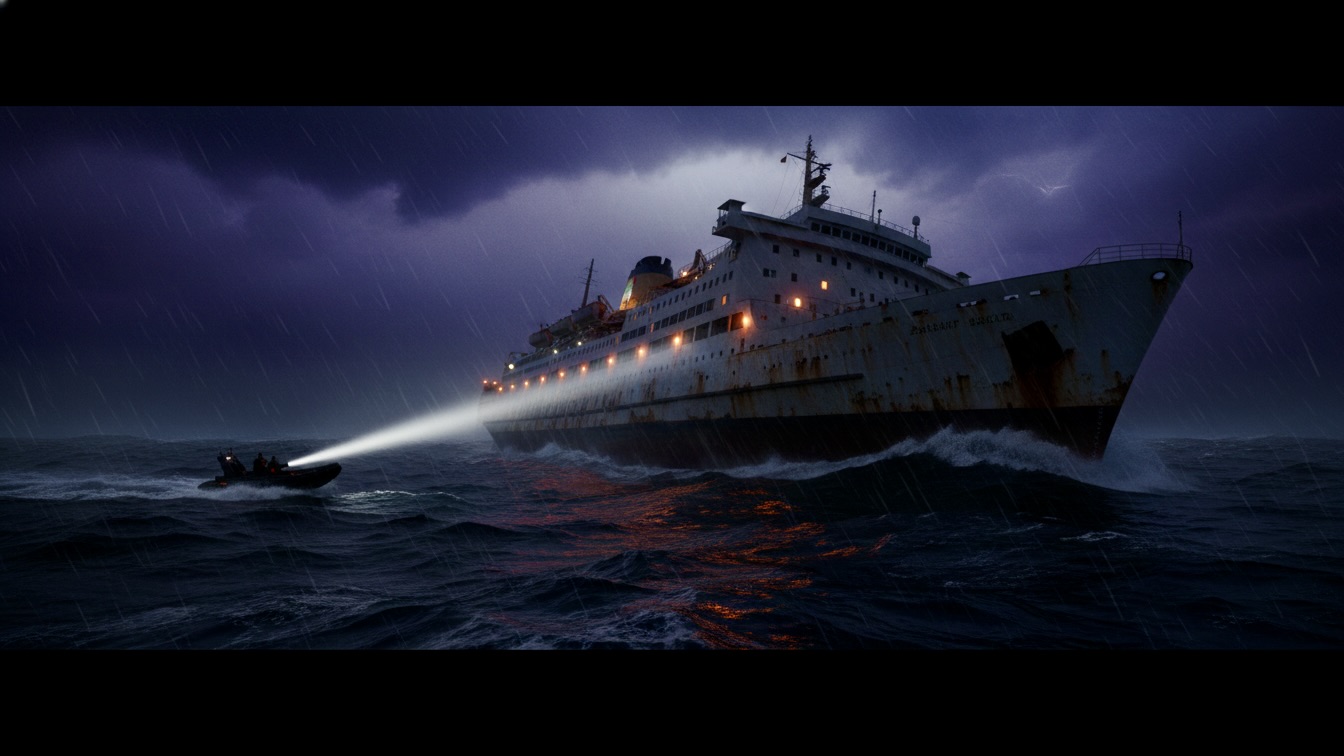
Mitch Reed is a suspended police officer who remains obsessed with the Meridian Airport heist, an unsolved case involving forty million dollars in vanished gold bullion. While the official narrative suggests the gold left the country, Mitch is convinced it remains local. He follows a lead onto the Queen of Avery ferry during a burgeoning summer squall, where he observes a nervous passenger clutching a heavy duffel bag. His professional instincts are validated when a tactical team in unmarked gear boards the vessel under the guise of a security drill, promptly executing the passenger and seizing control of the ship.
Retreating from the hostile cabin, Mitch encounters Casey, a young ferry deckhand who witnessed the execution. Casey reveals that the mercenaries have targeted a semi-truck parked over a specific cargo hatch designed to drop ballast directly into the water. Mitch realizes the heist involves a submersible waiting beneath the ship to catch the gold. Despite his suspension and a nagging knee injury, Mitch coordinates with Casey to sabotage the operation. Using a high-pressure fire hose and the emergency cargo release, they send the gold, the winch equipment, and the lead mercenary into the depths of the strait. Although the ferry reaches safety and the immediate threat is neutralized, Mitch discovers an unsent message on a recovered phone, confirming that the true mastermind behind the operation is still at large and aware of his interference.
The narrative explores the tension between institutional failure and individual agency. Mitch is introduced as a man discarded by the system, carrying a suspension letter that symbolizes the bureaucracy's desire to silence uncomfortable truths. Despite being stripped of his official authority, his internal moral compass and professional "habit" drive him to intervene where the law has failed. This suggests that true justice often exists outside the confines of formal structures, relying instead on the intuition and grit of those willing to risk everything for the truth.
The story also examines the concept of "dead weight," both literal and metaphorical. The gold bullion represents a physical burden that threatens to capsize the ferry, just as the secret of the Meridian heist weighs heavily on Mitch’s psyche and career. By purging the gold into the sea, the ship regains its balance, mirroring the temporary relief Mitch finds in taking action. However, the ending suggests that some weights cannot be so easily discarded, as the conspiracy remains unresolved and the protagonist continues to carry the burden of his knowledge.
Class and professional perception play a significant role in the interactions between the characters. Casey’s initial dismissal of Mitch as a "mall cop" or a "guy sleeping in his car" highlights the disconnect between appearance and capability. The mercenaries, too, view the civilians as "meat" or "prey," demonstrating a predatory worldview based on power and weaponry. The ultimate victory of the suspended cop and the vaping deckhand serves as a subversion of these hierarchies, proving that resourcefulness and local knowledge can overcome superior firepower and ruthless professionalism.
Mitch Reed is a classic noir protagonist defined by his physical and psychological weariness. His "bad knee" and the "burnt copper" taste of diner coffee establish him as a man who has been battered by his profession, yet he possesses an irrepressible investigative instinct. He is a man of deep cynicism, evidenced by his dismissal of the "bureaucratic noise" of his superiors, yet he remains tethered to a sense of duty that transcends his employment status. Psychologically, Mitch appears to be suffering from a degree of hyper-vigilance, as his habit of scanning the room never turns off, suggesting a life spent in constant anticipation of conflict.
His motivation is not rooted in a desire for recovery of the gold, but rather in a dogged pursuit of the truth. He is driven by the need to prove his intuition right, even if it costs him his career or his life. This obsession makes him a dangerous man to his enemies but also a lonely one, as he operates in the shadows of the very system he once served. His willingness to partner with Casey shows a pragmatic side, but his internal monologue reveals a man who is fundamentally isolated by his experiences and his skepticism of those in power.
Casey serves as the narrative’s foil to Mitch’s jaded veteran persona, representing the unexpected resilience of the common man. Initially portrayed as a terrified youth hiding in a locker to vape, he quickly evolves into a capable ally under pressure. His transition from swinging a flashlight in "raw terror" to making a calculated decision to release the cargo hatch demonstrates a high level of adaptive intelligence. He provides the necessary local expertise that Mitch lacks, grounding the high-stakes action in the mundane reality of his daily labor.
Psychologically, Casey exhibits a modern brand of stoicism, notably when he dismisses the mercenary’s predatory rhetoric with a colloquial retort. This moment signifies a refusal to be intimidated by the villain’s self-important grandiosity. While he is clearly shaken by the violence he witnesses, he does not freeze, suggesting a hidden depth of character that contradicts Mitch’s initial assessment of him. By the end of the encounter, he has earned Mitch’s respect, moving from a kid to a partner who can steer the boat toward safety.
The narrative style is heavily influenced by hardboiled detective fiction, utilizing short, punchy sentences and a gritty, sensory-focused vocabulary. The author uses the environment as a psychological extension of the protagonist’s internal state, with the "bruised, ugly purple" sky and "suffocating" heat mirroring Mitch’s agitation and the impending violence. Sensory details such as the "burnt copper" taste of coffee and the "stale air" of wet wool and spilled beer create a visceral, immersive atmosphere that grounds the thriller elements in a tangible reality.
Pacing is handled with a careful build-up of tension that explodes into rapid-fire action once the lights fail. The transition from the slow, humid observation in the car to the chaotic, water-soaked battle on the vehicle deck is managed through shifting sentence lengths and urgent dialogue. The use of technical maritime and tactical terminology, such as "thirty degrees starboard" and "drop-leg holsters," adds a layer of authenticity that heightens the stakes. This contrast between the mundane setting of a public ferry and the high-tech violence of the mercenaries creates a jarring, effective sense of a hostile atmosphere.
The narrative voice is strictly first-person, providing a direct window into Mitch’s cynical and observant mind. This perspective allows the reader to experience the "shadow mass" of a room turning hostile alongside the protagonist, making the psychological tension more intimate. The ending shifts the tone from immediate survival to a lingering sense of dread, as the focus moves from the physical threat of the mercenaries to the intellectual threat of the unseen mastermind. This stylistic choice ensures that the resolution of the physical conflict does not provide a complete emotional catharsis, leaving the reader as unsettled as the protagonist.


