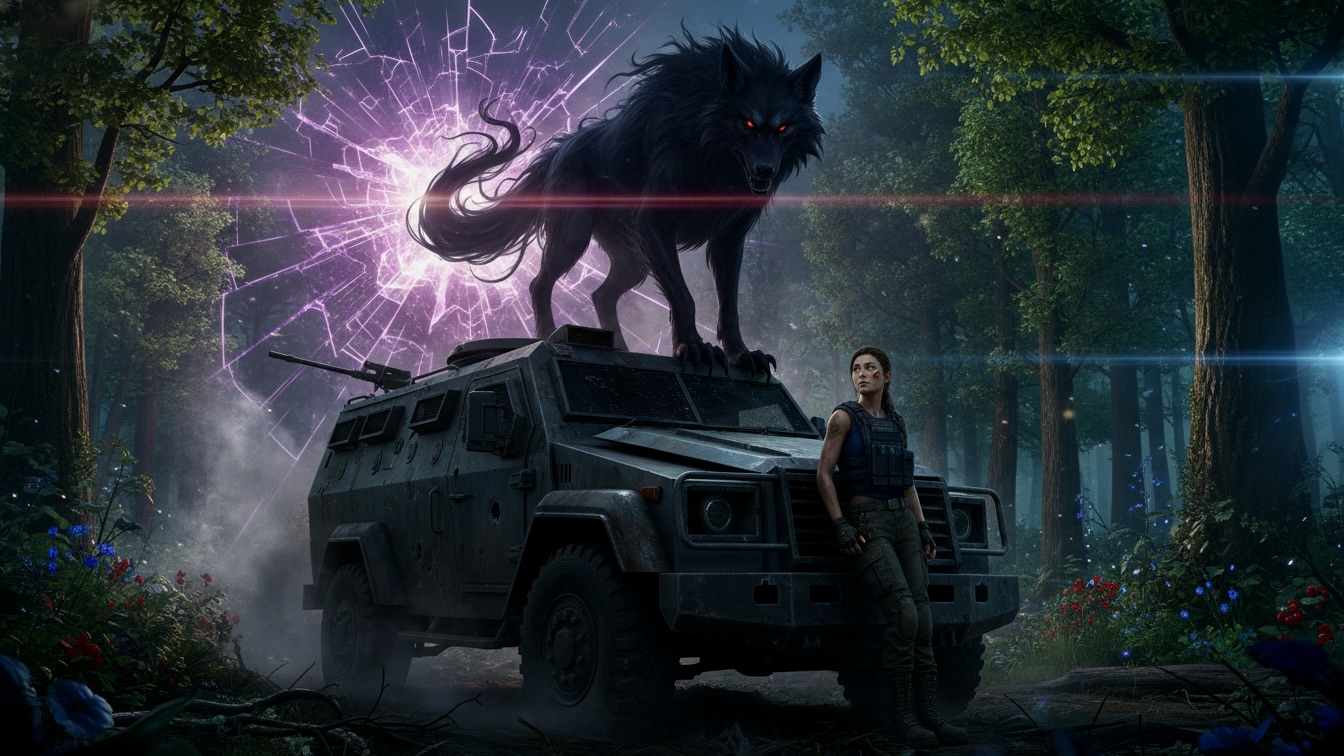
The story follows Talia, a disillusioned caseworker for the Ministry of Health, as she attends a mandatory assessment for a sixteen-year-old latent shifter named Max. In a sterile, sweltering assessment room, Talia discovers that Principal Hughes has forged the boy’s consent for the Elysian Draught, a state-sponsored euthanasia meant to eliminate "problematic" magical individuals. Horrified by the systemic cruelty and the physical agony Max is enduring due to forced suppression, Talia chooses to abandon her career and security. She incapacitates Hughes and leads Max on a desperate escape through the city’s forgotten underground tunnels.
As they flee, they are pursued by Agent Reddard and a team of Ministry Enforcers who view Max as a dangerous anomaly. Inside an abandoned subway car, Talia realizes that Max’s body is failing because he is fighting his natural transformation. She performs a forbidden act of blood magic to stabilize his mind, allowing him to finally embrace his wolf form and fight back against their pursuers. After a violent confrontation in a rail yard, the pair steals an armored transport and races toward the border of the unceded magical territories. Despite a high-speed pursuit by drones, they crash through a kinetic barrier to find sanctuary in the sovereign forest.
The narrative explores the dehumanizing nature of bureaucracy and the "banality of evil" within a structured society. The Ministry of Health is depicted not as a failing institution, but as one functioning exactly as intended by prioritizing budgets and social order over human life. This is most evident in the character of Principal Hughes, who views the execution of a child as a "humane" solution to a logistical problem. The story suggests that when a system treats people as spreadsheets, the only moral response is total rebellion.
Identity and self-actualization serve as the emotional core of the text, specifically through the lens of Max’s struggle with his shifter nature. His pain is not caused by his magic, but by the societal and parental pressure to suppress it. The "physical dysphoria" mentioned in the text acts as a powerful metaphor for anyone forced to hide their true self to appease a hostile environment. Max’s eventual transformation is portrayed not as a descent into monstrosity, but as a liberation that grants him the strength to survive.
The story also examines the cost of moral integrity and the weight of "moral injury." Talia is a woman haunted by her past as a combat medic, and she initially views her government job as a way to find peace. However, she realizes that her silence makes her a "glorified grim reaper," complicit in the state’s violence. Her decision to use blood magic—a permanent, life-altering crime—symbolizes the ultimate sacrifice of one's social standing to preserve one's soul. She chooses a life as a fugitive over a life of comfortable complicity.
Talia is a protagonist defined by her transition from passive cynicism to active resistance. Her background as a combat medic provides her with a pragmatic, almost clinical approach to violence, yet she possesses a deeply buried reservoir of empathy. She views her tactical vest as a "straightjacket," indicating that her role within the Ministry has been a form of self-imposed imprisonment. When she shoots Hughes, she is not just saving Max; she is reclaiming her own agency and rejecting the "pension plan" that bought her silence.
Psychologically, Talia exhibits signs of a woman seeking redemption for the "bullet holes" she used to patch up in war zones. She understands the mechanics of trauma and uses this knowledge to guide Max through his transformation. Her use of blood magic is a pivotal moment of character development, showing she is willing to endure physical and legal ruin to provide Max with the "apex" life he deserves. By the end of the chapter, her sense of "drowning" vanishes, replaced by the clarity of a woman who has finally aligned her actions with her values.
Max represents the vulnerability of youth caught in the crosshairs of ideological and systemic warfare. He is introduced in a state of total collapse, his body literally breaking under the weight of suppression magic. His psychological state is one of internalized self-hatred, fueled by his parents’ rejection and the school’s clinical coldness. He views himself as "broken" and "defective," illustrating how effectively the Ministry’s propaganda has dismantled his self-esteem.
His character arc is one of rapid, forced maturation. He begins the story as a trembling victim who begs for death, but through Talia’s intervention, he learns to "break the box" of his own fear. The moment he embraces his wolf form, he transitions from a "freak" to an "apex" predator, gaining the power to protect the woman who saved him. His howl at the end of the story is a primal scream of reclaimed identity, signaling that he is no longer a ward of the state or a disappointment to his parents.
Principal Hughes serves as the embodiment of institutional coldness and the administrative face of the Ministry’s cruelty. He is not a mustache-twirling villain, but a man who believes he is being "humane" by facilitating a child’s death to save a school budget. His smile, which does not reach his eyes, highlights his complete lack of genuine human connection. He uses legal jargon like the "Notwithstanding clause" to mask the moral vacuum of his actions.
His decision to forge Max’s consent reveals a man who values procedure over truth and efficiency over ethics. To him, Max is not a student but a liability that threatens the school board's financial stability. Hughes represents the danger of those who "understand the reality of public infrastructure" at the expense of their own humanity. His swift removal from the story via Talia’s stunner emphasizes that his brand of bureaucratic evil cannot stand against raw, decisive moral action.
Agent Reddard functions as the physical extension of the state’s monopoly on violence. He is a hunter who uses "fake sympathy" to manipulate his targets, showing a sophisticated understanding of psychological warfare. Unlike Hughes, who hides behind folders, Reddard is comfortable with the "lethal containment" he is authorized to provide. He views magic as something to be controlled or destroyed, evidenced by his derogatory comment calling Max "just a dog."
Reddard’s character highlights the hypocrisy of the Ministry, which employs "augmented" individuals to hunt down "rogue" magic users. He represents the immovable wall of the status quo, a man who cannot be reasoned with because he is entirely invested in the system that empowers him. His defeat at the hands of a "dog" and a "rogue" social worker is a significant blow to the Ministry’s aura of invincibility. He is left bleeding in the dirt, a symbol of the system’s failure to contain the very forces it seeks to suppress.
The narrative voice is grounded in a "hard-boiled" noir aesthetic, characterized by a cynical first-person perspective and gritty sensory details. The opening description of the "dead" air conditioning and the "metallic tang of suppressed magic" immediately establishes a mood of stagnation and underlying tension. The author uses the heat of a Toronto August as a physical manifestation of the pressure building within the characters. This atmospheric weight mirrors the "crushing physical dysphoria" Max feels, making the eventual escape into the "cool night air" feel like a visceral relief for the reader.
The pacing of the chapter is expertly handled, beginning with a slow, claustrophobic tension in the assessment room before exploding into a high-stakes chase. The transition from the "sterile white box" of the Ministry to the "decaying concrete" of the tunnels and finally the "vast, dark expanse" of the forest mirrors the expansion of Max’s power. Short, punchy sentences during combat sequences heighten the sense of urgency and chaos. In contrast, the prose becomes more fluid and evocative during the blood magic ritual and the final moments of the escape, reflecting a shift from survival to transcendence.
Sensory details are used to emphasize the visceral nature of the magical transition. The "wet cracking sound" of Max’s ribcage and the "copper tang" of blood provide a grounded, almost biological reality to the fantasy elements. The author avoids flowery language in favor of "matte-black" tactical gear and "rusted rebar," which helps maintain the story's gritty, urban fantasy tone. This stylistic choice makes the "shimmering, kinetic energy barrier" of the border feel more alien and significant when the characters finally encounter it.


