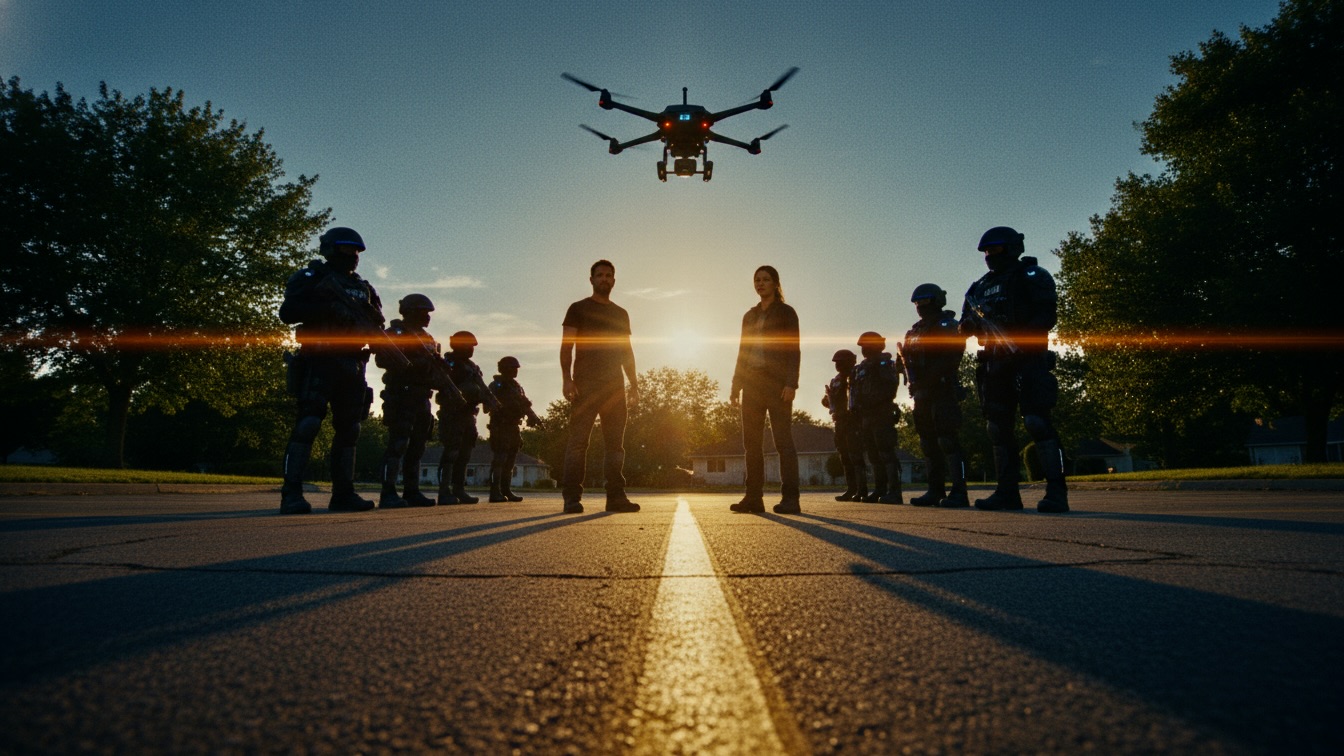
A summer protest turns into a legal trap as new intimidation laws redefine the boundaries of public dissent.
The sun was heavy today. It wasn't just heat; it was a heavy, golden pressure that made the asphalt of the Jackfish Community Center parking lot feel soft under my boots.
I shifted the weight of my sign, the wooden handle digging a fresh groove into my palm. It was July 2026, and the air didn't move. It just sat there, vibrating with the hum of a thousand invisible air conditioners. The sky was so blue it looked fake, a hyper-saturated backdrop for the glitchy reality we were currently inhabiting. The world felt like it was running on a slightly overclocked processor—everything was a little too bright, a little too sharp, and a lot more dangerous than it had been a year ago.
Sarah stood next to me, her face a mask of calculated neutrality. She wasn't sweating, which always amazed me. She just looked focused, her eyes tracking the movement of the black SUVs parked near the main entrance. We were here because the school board decided that the new curriculum was 'mandatory community integration,' which was a fancy way of saying they were ignoring every parent’s input on how our kids were being taught. But the rules of engagement had changed. The 'Safe Access Act' had turned the three hundred feet surrounding this building into a legal minefield. One wrong step, one 'intimidating' look, and the local PD didn't need a warrant or a green light from the state capital to ruin your life.
"Keep your toes behind the yellow line, Leo," Sarah said, her voice low and tight. She didn't look at me. She kept her gaze on the double glass doors of the center. "The sensors are active. I saw the tech team calibrating the perimeter drones twenty minutes ago."
"I'm behind the line," I said, glancing down at the faded paint on the concrete. "Barely. My heels are practically hovering over the 'Aggression Zone.' It’s a hell of a way to spend a Tuesday, isn't it?"
"It’s the only way," she replied. "If we aren't here, they win by default. They want the silence. They’re practically begging us to cross that line so they can call us extremists on the six o’clock news. Don’t give them the satisfaction."
I looked at my sign. It was a simple piece of poster board with a historical crest from our county’s founding—a symbol of local autonomy that had been around since the 1800s. Last week, the 'Symbolic Reform Committee' had flagged it as a potential hate symbol because of its association with some fringe group three states away. It was a reach, a total fabrication of context, but under the new laws, 'context' was whatever the person feeling intimidated said it was. To me, it was just the flag my grandfather had flown. To the drone hovering thirty feet above us, it was a Level 3 violation of the sensitivity buffer.
Gabe, a guy I’d known since little league, was standing five feet to my left. He was holding a sign that just said 'LET US SPEAK.' He looked like he was about to vibrate out of his skin. He was a jittery man by nature, but the heat and the sight of the tactical units by the doors were pushing him over the edge. "They’re filming us," Gabe hissed, his eyes darting toward the small black spheres mounted on the light poles. "They’re running facial recognition right now. My phone just gave me a proximity alert. It says I’m 'engaging in un-permitted expressive activity in a sensitive corridor.'"
"Turn your phone off, Gabe," I said. "We talked about this. Data trails are how they build the 'intimidation' narrative. If you aren't on the grid, you’re just a body in a space."
"I can't," Gabe said, his voice cracking. "If I turn it off, my kid’s school can’t reach me. What if something happens?"
"Nothing is going to happen except a lot of sweating and a lot of being ignored," I told him, though I didn't entirely believe it. The atmosphere was too brittle. It felt like one loud noise would shatter the whole afternoon. The 'Bright Glitch' was in full effect—that weird sensation where the world looks perfect, like a high-def postcard, but you can feel the gears grinding underneath. The community center was a beautiful, modern building with cedar slats and floor-to-ceiling glass, but right now it looked like a fortress. The flowers in the planters were too red. The grass was too green. It was a stage set for a tragedy we were all pretending wasn't happening.
A woman walked past us toward the entrance. She was carrying a briefcase and wearing a lanyard that identified her as a board consultant. As she neared our line, she slowed down. She didn't look at us, but she pulled her shoulders in, clutching her bag to her chest in a choreographed display of fear. She stopped, looked at the police officer near the door, and pointed a trembling finger toward Gabe. I watched the officer’s hand drop to his belt. My stomach turned over. This was the 'subjective intimidation' clause in action. It didn't matter that Gabe was just standing there with a piece of cardboard. If she felt intimidated, the law was on her side.
"Stay still," Sarah whispered, her hand brushing against my elbow. "Do not move toward him. Do not say a word to her."
"She's performing," I muttered, the words barely leaving my lips. "She’s literally acting out 'fear' for the cameras."
"It doesn't matter if it's an Oscar-winning performance or a high school play," Sarah said. "The record will show a state employee was obstructed and intimidated while trying to enter a sensitive site. That’s the play, Leo. They’re baiting the trap."
The officer, a guy named Miller who I used to see at the grocery store, started walking toward us. He didn't look like the Miller who gave me tips on grilling brisket. He looked like a machine in a blue uniform. His eyes were hidden behind mirrored shades, reflecting the blistering sun and our small, pathetic group of protesters back at us. He stopped exactly two feet from the yellow line, his boots polished to a mirror shine despite the dust.
"Gentlemen, Ma'am," Miller said. His voice was flat, devoid of the neighborly tone he’d used six months ago. "We’ve received a complaint of aggressive posturing and the display of prohibited exclusionary symbols within the restricted buffer zone. You are currently in violation of the Public Order Ordinance 402."
"We’re behind the line, Miller," I said, trying to keep my voice steady. "You know the law. We’re in the designated free expression corridor."
"The corridor is subject to the sensitivity of the site," Miller replied, his hand resting near his holster. Not on it, but near enough. "The Jackfish Center is currently hosting a youth cultural exhibit in Wing B. That reclassifies this entire grounds as a sensitive educational environment. Your signs are visible from the Wing B windows. That constitutes a 'visual assault' on a protected space."
"A visual assault?" Gabe laughed, a high, panicked sound. "It’s a flag! It’s the county flag!"
"It’s a symbol that has been identified as causing distress to the community members currently inside," Miller said. "You have sixty seconds to stow the signs and move across the street to the secondary zone, or you will be processed for intimidation of a public space."
I looked across the street. The 'secondary zone' was a patch of dirt behind a chain-link fence, a quarter-mile away from the entrance. If we went there, we might as well be in another state. No one would see us. No one would hear us. The board would vote, the curriculum would pass, and we’d be relegated to the 'extremist' pile in the digital archives. The sun beat down on my neck, the heat stinging my skin. I could feel the sweat trickling down my spine, cold despite the temperature. This was the moment where the logic of the world simply stopped making sense, and we had to decide if we were going to play along with the glitch or let it swallow us whole.
Sixty seconds is a long time when you’re staring at a man who has the power to erase your professional life with a single citation. I looked at Sarah. Her jaw was set, a small muscle jumping in her cheek. She was the one who had organized this. She was the one who had spent nights reading the fine print of the new ordinances, looking for the gaps they’d left for us to breathe through. But the gaps were closing. The 'youth cultural exhibit' in Wing B was a brilliant piece of legal maneuvering. By putting a few finger paintings in a side room, they’d effectively turned a public meeting into a high-security lockdown zone.
"Miller, come on," I said, lowering my voice, trying to find the human being behind the badge. "We’re not hurting anyone. We’re parents. My kid goes to school with yours. You know we aren't 'visually assaulting' anyone."
Miller’s face didn't twitch. "Forty-five seconds, Leo. This isn't personal. It’s the buffer. The drone has already logged the symbols. If I don't act, the system flags me for non-compliance. You want to lose your job? I don't want to lose mine."
"So that’s it?" Gabe snapped. "We’re all just following the algorithm now? If the drone says we’re scary, we’re scary?"
"The drone follows the law, Gabe," Miller said. "The law says this is an intimidated space. Move. Now."
Around us, the other parents were starting to waver. A few of them began to fold their signs. The heat was breaking them as much as the threat of arrest. I saw Mrs. Gable, who taught Sunday school, looking at the ground as she tucked her 'SAVE OUR CHILDREN' poster under her arm. She looked ashamed, her shoulders slumped. The psychological weight of being labeled a public threat was doing its work. It was a slow-motion collapse of dissent, happening under the unrelenting glare of a summer sky that felt like it was cheering for the other side.
"We aren't moving," Sarah said. Her voice wasn't loud, but it carried. It had that sharp, crystalline quality that made people stop and look. "We are standing in a public space, on a public sidewalk, during a public meeting. If the sight of a historical crest is 'intimidating,' then the problem isn't the symbol. The problem is the fragility of the people inside."
"Sarah, don't," I whispered. "He’s looking for a reason."
"He has his reason, Leo," she said, finally looking at me. Her eyes were bright, almost glowing in the harsh light. "He’s going to arrest us anyway. Look at the SUVs."
I looked. Two more black vehicles had pulled up, blocking the exit of the parking lot. Men in tactical vests—not local police, but some kind of regional 'Rapid Response' unit—were stepping out. They weren't carrying zip-ties; they were carrying the new 'compliance emitters,' those sleek, silver rods that could drop a grown man to his knees with a focused burst of high-frequency sound. This wasn't a warning anymore. This was a sweep.
"Thirty seconds," Miller said. He looked genuinely pained for a fleeting second, his eyes shifting toward the tactical team. "Leo, take her and go. Please."
"We can't go, Miller," I said, the realization settling into my bones. "If we go, we’re admitting that the buffer is real. We’re admitting that they can just reclassify a building and erase our rights. If we go across the street, we’re already in prison. It’s just a bigger cell with better lighting."
I felt a strange sense of calm. The fear was still there, a cold knot in my gut, but it was being pushed aside by a weary sort of clarity. The 'Bright Glitch' was just the truth revealed: the world had become a series of programmed responses, and we were the bugs in the code. I gripped the handle of my sign tighter. The wood was rough, real. It was the only thing in this hyper-real landscape that felt like it had any history.
"Fifteen seconds," Miller called out. He reached for his radio. "Initiating dispersal protocol for Zone Alpha. Subject group is non-compliant. Displaying Level 3 restricted iconography."
"He’s doing it," Gabe whimpered. He dropped his sign. It hit the pavement with a hollow thud. "I’m sorry, Leo. I can't. I have a mortgage. I have a kid."
"Go, Gabe," I said. "Nobody blames you."
Gabe turned and ran, not toward the secondary zone, but toward his car. He didn't look back. Two other parents followed him, their faces pale and sweating. That left me, Sarah, and a handful of others who were too stubborn or too angry to move. The sun felt like it was zooming in on us, a cosmic magnifying glass. The silence that followed was heavy, broken only by the whine of the drones as they descended, their red lights blinking in syncopation.
"Five seconds," Miller said. He didn't look at us anymore. He looked through us. "Four. Three."
I reached out and took Sarah’s hand. Her grip was iron. We stood there, two adults in the middle of a suburban parking lot, waiting for the world to break. The air seemed to shimmer, the Cedar slats of the community center warping in the heat haze. It was a beautiful day for a disaster. The grass was manicured, the sky was a masterpiece, and we were about to become 'extremists' for the sake of a historical crest and a curriculum meeting.
"Two," Miller whispered.
"One."
The high-pitched whine of the compliance emitters began, a sound that wasn't a sound so much as a vibration in my teeth. The world didn't explode. It didn't go dark. It just got louder, more intense, until the only thing I could feel was the heat of the sun and the pressure of Sarah’s hand in mine. We were the glitch, and the system was finally trying to patch us out.
The emitter hit me like a physical wall. It wasn't pain, not exactly. It was a sensory overload that made my vision swim and my stomach lurch. It felt like my nervous system was being tuned to a frequency it wasn't meant to handle. I dropped to one knee, the asphalt burning through my jeans. The sign fell from my hand, the historical crest face-up on the ground, mocking the situation with its stoic, old-world dignity. Beside me, Sarah was struggling to stay upright, her face contorted, her eyes squeezed shut.
"Get down!" a voice boomed, magnified by a megaphone that made the words feel like stones. "Lie flat on the ground with your hands behind your head! You are in violation of the Public Order Ordinance!"
I tried to breathe, but the air felt thick, like I was inhaling wool. The tactical team was moving in now, their movements fluid and practiced. They looked like astronauts in their gear, detached from the summer heat and the human mess they were cleaning up. I saw Miller standing back, his head bowed slightly. He was the local face of a system that had gone global, a man who had traded his conscience for a paycheck and a quiet life. I didn't hate him. I pitied him. He had to go home and look at his kids knowing he’d spent the day buzzing his neighbors like pests in a garden.
One of the tactical guys reached me. He didn't say a word. He just grabbed my arm and twisted it behind my back. The zip-tie hissed as it tightened, the plastic biting into my wrists. It was a sharp, grounding pain that cut through the haze of the emitter. I was hauled to my feet, my legs feeling like they were made of jelly. I looked over and saw Sarah being handled with the same clinical efficiency. She wasn't fighting. She knew the drill. Any resistance would just add 'assault on a peace officer' to the list of charges.
"Subject 1 secured," the man holding me said into his helmet mic. "Processing for Level 2 Intimidation. Historical symbol seized as evidence."
"It’s a flag!" I managed to croak out, my throat feeling like it was lined with sandpaper. "Check the county archives!"
"Archives are being updated, sir," the man replied, his voice muffled by his mask. "Current status: Exclusionary. Move."
They marched us toward the black SUVs. As we moved, I saw a news crew from the local affiliate setting up across the street. They weren't filming the arrest; they were filming the 'youth cultural exhibit' sign, then panning over to us. I could already see the headline in my head: EXTREMISTS DISRUPT CHILDREN'S ART EVENT AT Jackfish. The truth was a secondary concern. The narrative was already written, baked into the very air of this weird, glitchy summer. We were the villains because the law said the space was sensitive, and we were the intruders because we dared to have an opinion that didn't fit the script.
"You okay?" I called out to Sarah as they shoved her into the back of the other SUV.
"I'm fine, Leo!" she shouted back, her voice defiant even as she was pushed down. "Don't say anything! Wait for the lawyer!"
"Quiet!" my handler barked, shoving me into the dark interior of the vehicle.
The door slammed shut, cutting off the blinding light of the sun. The interior was freezing, the air conditioning cranked up to a degree that felt like a mockery of the heat outside. I sat there in the dark, my hands throbbing, the silence ringing in my ears. The 'Bright Glitch' had moved indoors. In here, everything was black leather and sterile plastic. The world outside—the summer, the protest, the community center—felt like a dream I was waking up from.
I leaned my head against the cold glass of the window. Through the tint, the world looked gray and lifeless. I watched Miller walk back toward the community center doors. He stopped to pick up my sign. He looked at the crest for a long moment, his thumb brushing against the wood. For a second, I thought he might hesitate, might see the absurdity of it all. But then he tossed it into a large plastic bin labeled 'BIOHAZARD/RESTRICTED MATERIALS' and walked inside.
The SUV began to move. We weren't going to the local precinct. I could tell by the direction we were headed. We were going to the regional processing center, a windowless block of concrete on the edge of the county. That was where they took the 'intimidation' cases. No Attorney General consent was needed anymore. The local prosecutor could file charges based on the 'perceived threat' alone. It was a fast-track to a criminal record, a digital scarlet letter that would follow us every time we tried to log into a bank account or apply for a job.
"Why?" I asked the back of the driver’s head. He didn't answer. He just kept his eyes on the road, a silhouette in a world of shadows.
I thought about my daughter, Mia. She was ten. She was the reason we were out there. She’d come home a month ago crying because her teacher told her that her family’s history was 'problematic' and that she should be ashamed of the flag in her grandfather’s study. We tried to explain it to her, tried to tell her that history is complicated and that symbols change meaning, but that doesn't make the people who lived under them evil. But the school had a different story. They had the 'New Perspective' guidelines. And now, they had the law.
I closed my eyes and tried to remember the smell of the grass in the park before all of this started. I tried to remember a time when a summer day was just a day, not a tactical environment. But the memory was fading, replaced by the throb in my wrists and the hum of the SUV’s engine. The glitch wasn't just in the sky or the laws; it was in us. We had allowed the world to become a place where 'feeling safe' was more important than being free, and now we were paying the price in the back of a black car, speeding toward a future that looked a lot like a cell.
The processing center was a symphony of humming fluorescent lights and the smell of industrial-grade bleach. They stripped us of everything—phones, wallets, belts, even our shoes. I felt small and vulnerable standing on the cold linoleum in my socks. The 'Rapid Response' guys were gone, replaced by bored-looking clerks who moved with the soul-crushing lethality of bureaucrats. They didn't look at me as they took my fingerprints. They didn't look at me as they took the retinal scan. I was just a string of data being categorized.
"Name?" the clerk asked. She was young, maybe twenty-five, with a small tattoo of a butterfly on her wrist. It felt jarringly human in this place.
"Leo Miller," I said. "No relation to the officer."
She didn't smile. She didn't even blink. "Leo David Miller. Address confirmed. You are being charged under the Safe Access Act, Section 9. Intimidation of a sensitive site, display of prohibited iconography, and failure to disperse. Do you understand the charges?"
"I understand that they’re nonsense," I said. "I was standing on a sidewalk."
"That’s not what the drone log says," she replied, her fingers dancing across the keyboard. "The log shows you were within the 300-foot buffer during a protected youth event. It also shows a 'Visual Assault' alert triggered by your handheld device."
"My handheld device was a piece of wood and cardboard," I said. "And the 'youth event' was a bunch of finger paintings in a room I couldn't even see."
She finally looked up. Her eyes were tired, ringed with dark circles. "It doesn't matter what you saw, Mr. Miller. It matters what the system registered. The system doesn't have a political bias. It just follows the parameters set by the board. You triggered the parameters."
"Who sets the parameters?" I asked.
"The board," she repeated, as if I were a slow child. "Now, stand against the wall. Eyes on the red dot."
I stood against the wall. The red dot was a tiny, unblinking eye in the center of a black camera lens. I wondered how I would look in the mugshot. Sweaty, tired, angry. Exactly how they wanted me to look. The 'extremist' aesthetic. I thought about the irony of it—the people who wrote these laws talked about 'inclusion' and 'safety,' but they were using the most exclusionary and unsafe methods possible to enforce them. They were building a world of walls and calling it an open field.
Click.
The flash blinded me for a second. When my vision cleared, the clerk was already looking at her screen. "Your preliminary hearing is scheduled for Thursday morning. You are being released on 'Digital Recognizance.'"
"What does that mean?" I asked.
"It means your digital ID is flagged," she said, handing me a small plastic card. "You are restricted from entering any 'Sensitive Zone' until your case is resolved. That includes schools, government buildings, and certain public parks. If your GPS enters one of those zones, the local authorities will be notified automatically. Your bank accounts have been placed on 'Observation Status.' Any transaction over five hundred dollars will require manual approval."
I felt a surge of cold fury. "You’re freezing my life? For a protest?"
"We’re ensuring the safety of the community, Mr. Miller," she said, her voice dropping back into that flat, robotic drone. "Your behavior has been flagged as high-risk. These are standard precautionary measures."
They gave me back my shoes and led me to the exit. Sarah was already there, leaning against the concrete wall of the vestibule. She looked exhausted, but her eyes were still sharp. She held up her plastic card. "I’m flagged, too," she said. "I tried to call my mom. The call was intercepted. A recorded voice told me that my communications are being monitored for 'safety compliance.'"
"They’re turning us into ghosts, Sarah," I said, walking toward her. "We’re still here, but we can't touch anything."
"We can still talk," she said, her voice dropping to a whisper. "They haven't figured out how to stop that yet."
We walked out of the processing center and into the evening air. The sun was finally setting, painting the sky in shades of bruised purple and electric orange. It was beautiful, in a tragic, final sort of way. The 'Bright Glitch' was fading, replaced by the long shadows of the night. The heat hadn't broken; it had just settled into the earth, radiating back up from the pavement.
As we walked toward the bus stop—since my car was still in the impound lot—I saw a digital billboard at the edge of the property. It was flashing a series of public service announcements. STAY SAFE. RESPECT THE BUFFER. REPORT INTIMIDATION. And then, our faces appeared. Just for a second. A flickering image of me and Sarah, frozen in our mugshots, under the heading: COMMUNITY ADVISORY: RECENT ARRESTS FOR PUBLIC DISORDER.
I looked at Sarah. She was looking at the billboard, her face illuminated by the shifting lights. "We’re the news now," she said.
"We’re the warning," I corrected.
We stood there for a long time, watching our own faces cycle through the algorithm. The world felt quiet, the usual summer sounds of crickets and distant traffic muffled by the weight of the silence between us. We were home, but we weren't. We were in the buffer now, a space where the rules were invisible but the consequences were absolute.
My phone buzzed in my pocket. I pulled it out, expecting a notification from the school or the bank. Instead, it was a text from an unknown number. Just one sentence, no context, no name.
The crest is still flying in the old quarry. Midnight.
I looked at Sarah and showed her the screen. She read it, then looked back at the billboard. The 'Bright Glitch' wasn't over. It was just shifting into a different frequency. The system thought it had patched us out, but it had only succeeded in creating a new kind of code.
"Are we going?" she asked.
I looked at the digital ID card in my hand, the plastic flickering in the neon light. I thought about the 300-foot buffer, the drones, the compliance emitters, and the clerk with the butterfly tattoo. I thought about the world they were building, a world where every historical symbol was a threat and every dissenting voice was an assault.
"We’re going," I said.
As we turned to walk toward the dark edge of the city, a black SUV pulled up slowly to the curb behind us, its headlights cutting through the dusk like two predatory eyes.
“A black SUV pulled up slowly to the curb behind us, its headlights cutting through the dusk like two predatory eyes.”


