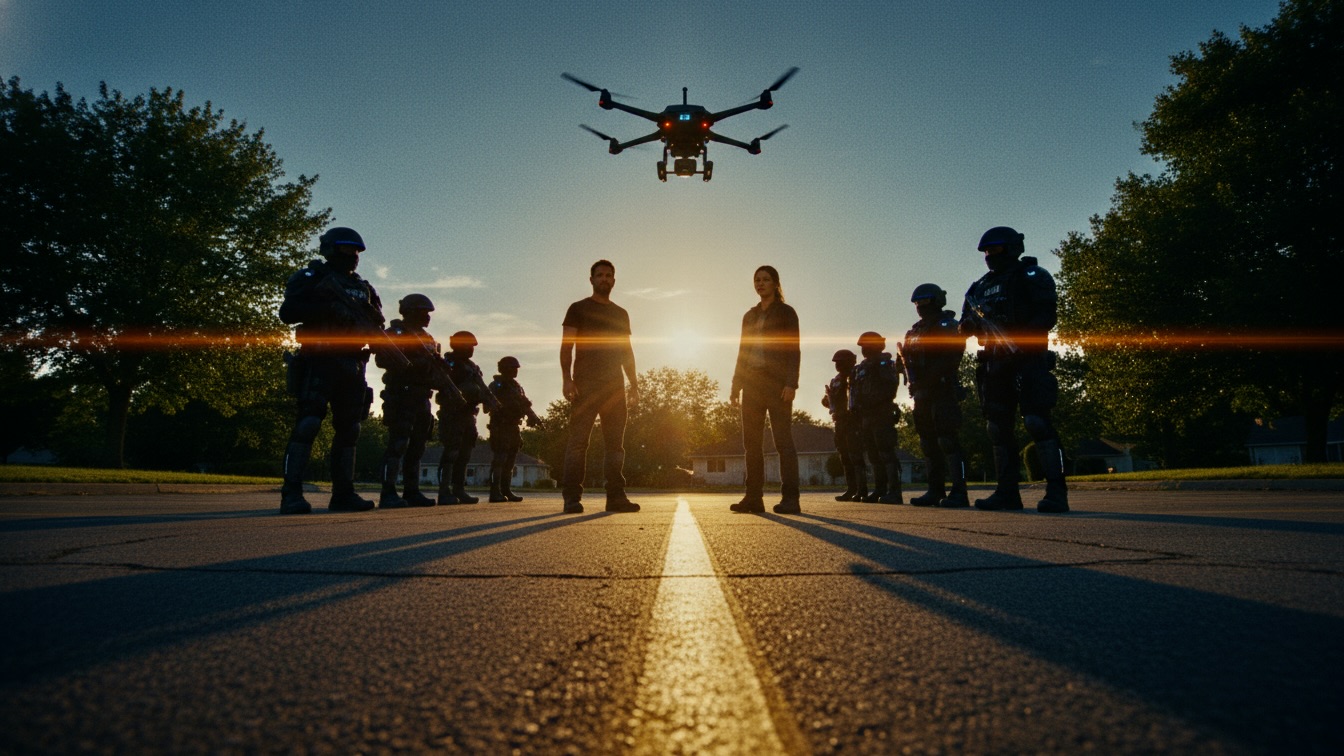
The story unfolds in July 2026 at the Jackfish Community Center, where a small group of parents led by Leo and Sarah are protesting a mandatory school curriculum change. They stand behind a literal yellow line that marks a three-hundred-foot "sensitivity buffer," navigating a landscape where drones and sensors monitor their every move for signs of aggression or intimidation. Despite staying behind the legal boundary, the group is confronted by Officer Miller, a former neighbor who now acts as a cold instrument of the state.
The tension escalates when a board consultant performs a display of fear, triggering a "subjective intimidation" clause that allows the police to intervene. While some protesters flee out of fear for their livelihoods, Leo and Sarah remain steadfast even as tactical units deploy "compliance emitters" to incapacitate them. They are arrested, processed through a sterile regional center, and subjected to "Digital Recognizance," which effectively exiles them from public life and freezes their financial assets. The chapter concludes with the two protagonists being released into a world where they are now labeled as public threats, only to receive a cryptic message suggesting the existence of an underground resistance.
One of the most profound themes explored in this text is the weaponization of subjectivity and the erosion of objective truth. The "Safe Access Act" and its "subjective intimidation" clause represent a dystopian shift where legal guilt is determined not by the actions of the accused, but by the perceived emotional state of a complainant. This creates a reality where "performance" becomes a legal tool, allowing state actors to manufacture crimes through choreographed displays of fear. The psychological impact on the protagonists is a sense of profound gaslighting, as they are punished for "visual assaults" that exist only within a rigged legal framework.
The narrative also delves deeply into the theme of technological authoritarianism and the "Panopticon" effect. The presence of drones, facial recognition spheres, and "compliance emitters" suggests a world where the state no longer needs to argue its position because it can simply "patch out" dissenters like bugs in a computer program. This is encapsulated in the recurring motif of the "Bright Glitch," a sensation where the world appears aesthetically perfect and high-definition while the underlying social and moral structures are grinding toward collapse.
Furthermore, the story examines the erasure of history and local identity in favor of a sanitized, centralized narrative. The county crest, once a symbol of autonomy and family heritage, is reclassified as a "prohibited exclusionary symbol" based on distant and tenuously related events. This highlights how the state uses "symbolic reform" to sever the emotional ties individuals have to their past, making them easier to manage within the current system. By labeling historical artifacts as "biohazards," the regime treats memory itself as a contagion that must be quarantined.
Finally, the text explores the concept of social and digital exile as a modern form of imprisonment. Leo and Sarah are not kept in a physical cell, but their "Digital Recognizance" creates a "bigger cell with better lighting." By restricting their movement through GPS tracking and monitoring their financial transactions, the state effectively turns the entire world into a carceral space. This reflects a psychological shift in control where the threat is no longer just physical violence, but the total erasure of one's ability to participate in modern society.
Leo serves as the emotional and moral anchor of the narrative, representing the "everyman" who is forced into a state of reluctant heroism. He is characterized by a weary clarity and a deep-seated protective instinct for his daughter, Mia, which fuels his willingness to endure physical and social pain. Psychologically, he is highly observant, noting the "glitchy" nature of his reality, which suggests he possesses a level of cognitive dissonance that his more compliant neighbors have suppressed. He struggles with the surreal transition of his world from a place of neighborly brisket-grilling to a tactical environment where his former friends are now his captors.
His internal conflict is defined by the tension between his desire for a quiet, stable life and his inability to ignore the absurdity of the new laws. When he stands his ground against Officer Miller, he is not acting out of a desire for conflict, but out of a fundamental need to remain "real" in a world that feels increasingly artificial. The rough wood of his sign becomes a grounding tool for him, a physical connection to a tangible reality that the digital state is trying to overwrite. By the end of the chapter, Leo has transitioned from a concerned parent to a labeled extremist, accepting this new identity as the only way to remain true to his history.
Sarah is the ideological engine of the protest, possessing a steely resolve and an analytical mind that allows her to see the "trap" the state has set. Unlike Leo, who experiences the situation through a lens of weary observation, Sarah is focused and strategic, having memorized the ordinances to find "gaps to breathe through." She exhibits a remarkable level of psychological control, refusing to sweat or show weakness even when faced with tactical units. Her defiance is not emotional but intellectual; she understands that the "fragility" of the people inside the center is a manufactured weapon used to justify their oppression.
Her role is to prevent Leo and the others from succumbing to the psychological pressure of the "intimidation" narrative. She recognizes that the arrest is inevitable and chooses to face it with her dignity intact rather than retreating into the "secondary zone" of irrelevance. Even after being processed and digitally flagged, her spirit remains unbroken, as evidenced by her immediate focus on what the state has not yet managed to control: private conversation. She represents the resilient intellectual who refuses to let the "system" dictate her sense of self-worth or her perception of reality.
Officer Miller embodies the "banality of evil" within a bureaucratic and technological system. He is a man caught between two worlds: the neighborly past where he shared grilling tips with Leo, and the mechanical present where he is a "machine in a blue uniform." His psychological state is one of forced detachment, evidenced by his flat, robotic tone and his hidden eyes. He uses the "system" as a shield for his conscience, repeatedly telling Leo that the situation "isn't personal" and that he is simply following the parameters set by the drone logs.
Despite his rigid exterior, he shows fleeting moments of human hesitation, such as when he urges Leo to leave before the tactical units arrive. This suggests that he is fully aware of the cruelty of the system he serves but lacks the moral courage to defy it. His final act of tossing the historical crest into a "biohazard" bin symbolizes his total surrender to the state’s narrative. He chooses the safety of compliance over the complexity of his personal relationships, illustrating how authoritarian systems rely on the quiet cooperation of ordinary men who are afraid of losing their own place in the "buffer."
The narrative voice of "The Concrete Buffer" is marked by a heavy, oppressive atmosphere that mirrors the physical heat of the July day. The author uses sensory details—the "vibrating" hum of air conditioners, the "soft" asphalt, and the "hyper-saturated" blue of the sky—to create a sense of hyper-reality. This stylistic choice effectively communicates the "Bright Glitch" to the reader, making the setting feel like a beautiful but menacing stage set. The contrast between the aesthetic beauty of the cedar-slatted community center and the clinical violence of the "compliance emitters" reinforces the theme of a world that has been polished to hide its inherent cruelty.
Pacing in the chapter is masterfully handled, beginning with a slow, simmering tension in the parking lot and culminating in the sharp, mechanical efficiency of the arrest. The countdown provided by Officer Miller creates a ticking-clock element that heightens the reader's anxiety, mirroring the protagonists' own sense of impending doom. Once the arrest occurs, the pacing shifts again to a cold, bureaucratic rhythm during the processing scenes. The transition from the blistering heat of the sun to the "freezing" interior of the SUV and the "bleach-scented" processing center serves as a powerful stylistic metaphor for the state's power to strip away human warmth and replace it with sterile control.
The dialogue is sparse and tight, reflecting the "legal minefield" the characters are navigating. Every word spoken by the protagonists is weighed against the risk of being labeled "aggressive," while the state actors speak in a "flat, robotic drone" that denies any personal connection. This linguistic divide emphasizes the dehumanization inherent in the system. The use of technological jargon, such as "Visual Assault alert" and "Digital Recognizance," integrates the science-fiction elements seamlessly into the emotional core of the story, making the dystopian future feel grounded and terrifyingly plausible.


