Format: Short Film / Anthology Episode | Est. Length: 10-12 minutes
Last Frost serves as a foundational episode for The Glitch, an anthology series exploring a world where reality is slowly losing its structural integrity. Each episode focuses on isolated individuals grappling with localized, unexplained temporal anomalies that mirror their own internal emotional fractures, suggesting that the unraveling of the physical world is inextricably linked to the collective human psyche.
The library clock freezes, and the entire campus experiences a ten-second temporal blackout where the world goes silent and the sky turns a dead, signal-loss grey. As the hum fades and reality resumes, Nancy is left shaken, realizing the world she inhabits is no longer stable.
After a mysterious temporal glitch freezes time on their college campus, a fractured couple attempts to reconcile their failed relationship amidst the literal decay of their environment. They must decide if their love can survive in a world that is losing its grip on reality.
The episode explores the intersection of existential dread and personal grief, using the metaphor of a "glitch" to represent the inability to move on from a past trauma. It delves into the theme of emotional stagnation, where the characters’ refusal to process their breakup mirrors the environment’s failure to transition from winter to spring.
The narrative also touches upon the fragility of human connection in the face of inevitable change. By framing the breakup against the backdrop of a dying world, the story highlights how personal history becomes heavy and burdensome when the future itself begins to dissolve.
Nancy risks losing her sense of reality and her final tether to her past if she cannot reconcile her feelings for Jake. For Jake, the stakes are existential; he fears that his inability to "keep the machine running" has contributed to both the death of their relationship and the decay of the world around him.
The primary conflict is the internal tension between Nancy and Jake, complicated by the external, uncaring force of the "Grey Weight"—a recurring temporal instability that threatens to erase their surroundings. This antagonism is mirrored by the harsh, unyielding winter landscape that refuses to thaw, acting as a physical manifestation of their unresolved resentment.
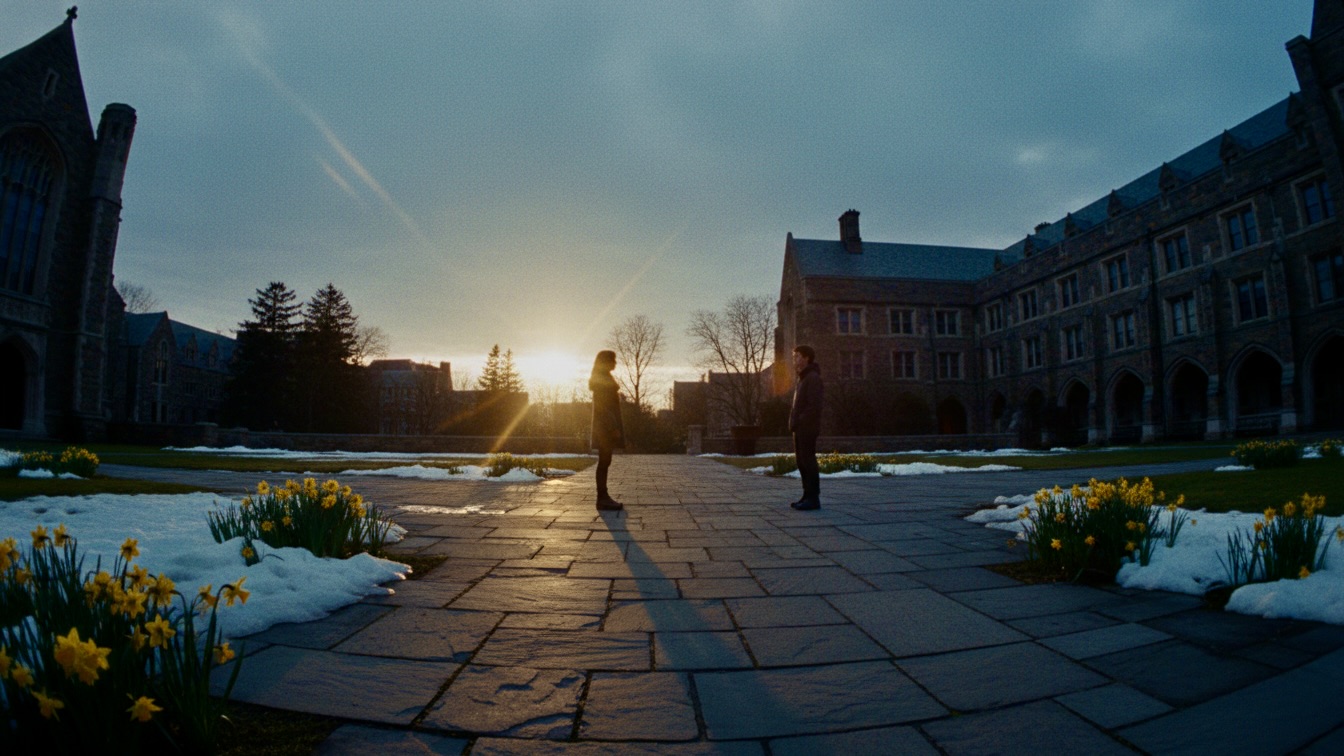
Nancy and Jake meet on a cold, damp campus patio shortly after a reality-altering temporal glitch stops time for the entire student body. Their conversation, intended to be a final exchange of belongings, quickly devolves into a painful post-mortem of their relationship, revealing deep-seated regrets and the suffocating weight of their shared history.
As the sky darkens and the temperature drops, the couple struggles to articulate their lingering love while acknowledging that they have become different, incompatible people. The episode concludes with Nancy walking away into a sudden, unnatural snowstorm, leaving her phone behind and choosing to abandon the past even as the library—and perhaps their shared history—plunges into total darkness.
Nancy begins the episode in a state of defensive denial, attempting to treat the breakup as a simple administrative task of returning books. By the end, she reaches a state of cold, isolated clarity, realizing that staying with Jake would mean trapping herself in a cycle of decay, forcing her to choose self-preservation over reconciliation.
Jake starts as a man defeated by his own passivity, appearing thinner and more haunted than when they were together. His arc is one of desperate, late-stage vulnerability; he attempts to bridge the gap between them, but his failure to do so leaves him abandoned in the literal and figurative cold, forced to confront the void he helped create.
The episode opens in the sterile, quiet library, establishing the eerie atmosphere before the sudden, jarring temporal glitch forces a total stop in time. Nancy’s subsequent walk to the patio is characterized by a sense of dread and physical heaviness, leading to the tense, uncomfortable reunion with Jake.
The midpoint occurs when Jake admits he still loves her, shattering the thin veneer of "just returning books" and forcing the conversation into a raw, emotional confrontation. This realization creates a turning point where the dialogue shifts from petty bickering to a profound acknowledgement of their incompatibility.
The climax arrives when the weather turns, and Nancy refuses to look back as she walks away, leaving her phone and her past on the stone wall. The final beat shows the library lights extinguishing, signaling the permanent erasure of their shared space and the finality of their separation.
The emotional trajectory moves from a state of suppressed anxiety and clinical detachment to a peak of intense, volatile vulnerability. As the environment shifts from a grey, stagnant twilight to a biting, freezing night, the audience experiences a transition from the frustration of a "glitchy" reality to the cold, quiet melancholy of absolute loss.
If expanded, the series would reveal that these glitches are increasing in frequency and duration, eventually leading to a global collapse of reality. Each episode would introduce new characters who notice the "signal drops," slowly building a mystery regarding who—or what—is "pulling the plug" on the world.
The season would culminate in a realization that human emotions are the fuel for these anomalies, forcing characters to confront their deepest regrets to either stabilize or hasten the end of their reality. The overarching arc would focus on the struggle to find meaning in a world that is being systematically deleted.
The visual style is defined by a desaturated, cold color palette, emphasizing the rot of late winter and the harsh, unnatural light of the glitches. The cinematography should utilize tight, claustrophobic framing to highlight the distance between the characters, even when they are standing in close proximity.
The tone is one of grounded, melancholic sci-fi, drawing inspiration from works like Eternal Sunshine of the Spotless Mind and The Leftovers. It prioritizes atmosphere and psychological realism over spectacle, ensuring that the supernatural elements feel like an extension of the characters' internal turmoil.
The target audience is young adults and adults (18-35) who enjoy character-driven dramas with speculative or sci-fi elements. It is tailored for viewers who appreciate slow-burn narratives and stories that explore the intersection of personal relationships and existential dread.
The pacing is deliberate and slow, mirroring the feeling of walking through the "Grey Weight" described in the story. The act structure is compressed, focusing on a single, continuous conversation that builds in intensity until the final, abrupt departure, ensuring the 10-12 minute runtime feels both intimate and expansive.
The production will require subtle but effective VFX to capture the "glitch" moments, specifically the sudden, unnatural stillness of the background extras and the flickering, dead-signal quality of the sky. These effects must remain understated to maintain the grounded, intimate tone of the character drama.
Practical considerations include the use of cold-weather lighting and artificial snow to create a sense of encroaching winter that feels hostile rather than beautiful. The library exterior should be treated as a character itself, with its lighting states—from grey to dark—signaling the progression of the couple’s final interaction.


