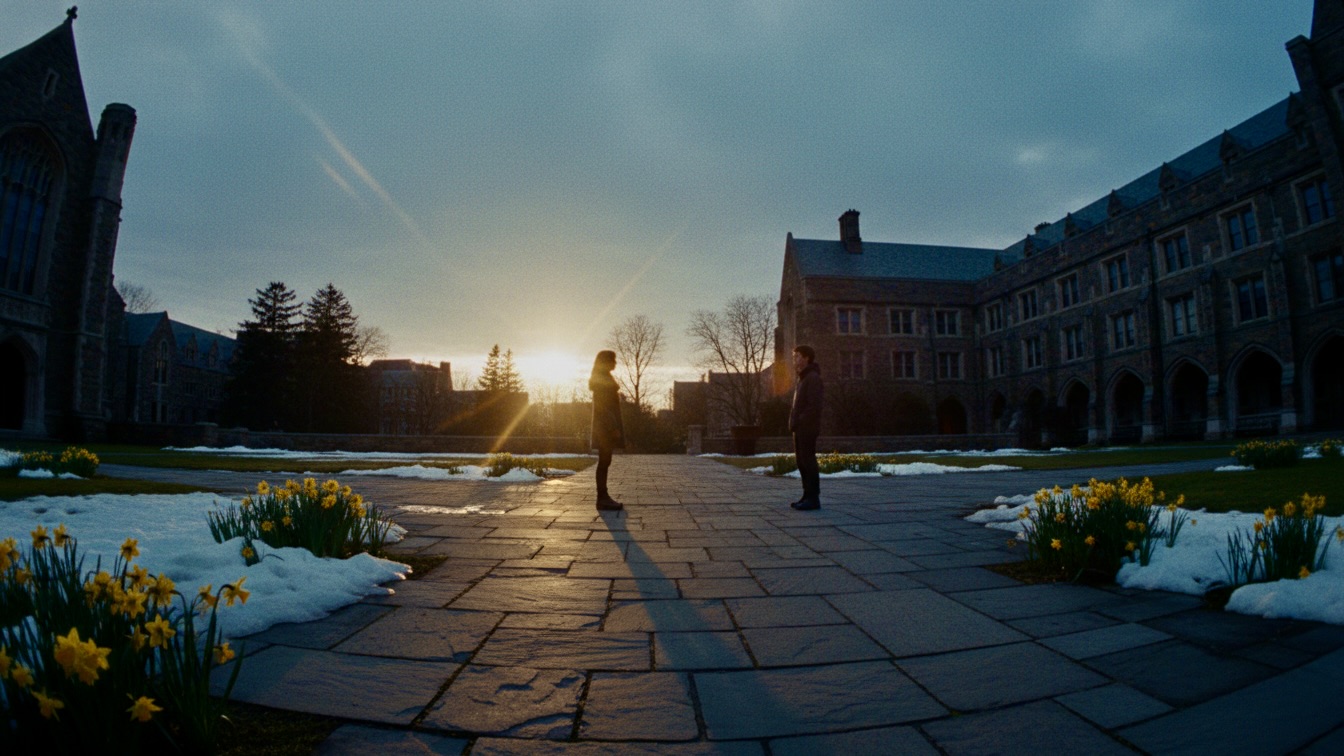
The story follows Nancy during a bizarre, reality-altering moment on her college campus where time seems to glitch and the world pauses. Following this strange occurrence, she meets her ex-boyfriend, Jake, outside the library to return his hoodie. Their interaction is fraught with unresolved tension, lingering affection, and the painful realization that their relationship has reached an irreparable impasse. Despite Jake expressing his ongoing love for her, Nancy chooses to prioritize her need for emotional distance, ultimately leaving the scene while leaving her phone behind. As the environment shifts into a sudden, freezing night, the library lights go dark, signifying an final, irrevocable break from their shared past.
The central theme of this narrative is the intersection of existential uncertainty and personal grief. The glitch that causes the world to stop serves as a profound metaphor for the state of shock that follows a significant romantic rupture. Just as the universe experiences a momentary failure of function, Nancy and Jake struggle to navigate the "system failure" of their own lives. Their inability to reconcile their past intimacy with their present emotional frost highlights the entropy inherent in human connections.
Furthermore, the story explores the concept of emotional inertia. The characters are stuck in the residual habits of their relationship, such as the location where they meet and the exchange of the hoodie, even though the structural integrity of their bond has collapsed. The changing seasons, shifting from a muddy, rotting spring into a sudden, harsh winter, mirror the instability of their transition. The environment reflects the internal coldness they feel toward one another, illustrating that a clean break is often impossible when the landscape of one's life remains tethered to the person they are trying to leave behind.
Nancy embodies the conflict between the desire for closure and the instinct for self-preservation. Her internal state is characterized by a frantic need to distance herself from the "Grey Weight" of her past, yet she finds herself physically and emotionally tethered to Jake. She uses defensive mechanisms, such as sarcasm and the cold act of returning his property, to mask a vulnerability that threatens to overwhelm her. By the end of the chapter, her decision to walk away from her phone—and by extension, her connection to him—marks a desperate, final attempt to reclaim her autonomy from a situation that has become toxic.
Jake functions as a portrait of stagnation and longing. He is depicted as a man who understands the logic of their separation but lacks the emotional strength to finalize it. His dialogue reveals a person who views his life through the lens of a malfunctioning computer, suggesting a dehumanized, exhausted perspective that stems from his inability to process their breakup. His confession of love, while seemingly romantic, acts as an anchor that prevents both of them from moving forward. He is trapped in the role of the one who "pulled the plug," yet he remains paralyzed by the silence that followed his own decision.
The narrative voice is clinical yet deeply evocative, utilizing modern, technological metaphors to capture the feeling of psychological dissociation. By describing the sky as a dead screen and the world as a system with a "background process," the author effectively conveys the characters' sense of alienation from reality. This tone complements the pacing, which feels like a slow, rhythmic descent into a colder, darker state of being. The transition from the high-pitched hum of the glitch to the crushing silence of the snowy night creates a stark auditory contrast that underscores the emotional stakes.
Sensory details are employed with precision to heighten the reader's immersion in the scene. The smell of cedar and detergent, the static shock of their skin touching, and the wet thud of the book bag provide a grounded, physical reality that clashes with the surreal nature of the campus-wide freeze. The prose remains disciplined, avoiding excessive sentimentality in favor of sharp, biting observations. This stylistic choice mirrors Nancy's own efforts to remain composed and detached, making the eventual collapse of her resolve feel both inevitable and earned.


