Format: Short Film / Anthology Episode | Est. Length: 10-12 minutes
Imagine a world where every "natural" wonder is a corporate product designed to harvest human emotion and map the geography of desire. This story serves as a standalone entry in The Bio-Tag Chronicles, an anthology series exploring the intersection of surveillance capitalism and ecological manipulation in a near-future dystopia where even the air is a commodity. Each episode follows a different "Low-Frequency" individual who sees through the shimmering corporate veil to the cold, industrial machinery beneath.
Harv, a cynical teen with a jury-rigged sensor, detects a massive surge of "wishes" near a crumbling bookstore, only to find the town’s residents blissfully inhaling mind-altering, tracking-enabled pollen. He watches as a girl smiles through tears, unaware that her deepest feelings are being converted into real estate data points.
A tech-savvy loner uncovers a corporate conspiracy to map human happiness for luxury development using bio-engineered pollen. He must choose between a comfortable life of lies and a cold, dangerous truth when his own sister becomes the face of the deception.
The primary theme is the commodification of emotion—how corporate entities exploit human desire and "wellness" for gentrification and control. It explores the tension between artificial bliss and harsh reality, questioning whether ignorance is truly strength when it leads to the loss of one's home and autonomy.
Secondary themes include the erosion of privacy and the corruption of nature. The story posits that "magic" in the modern age is often just sophisticated hardware disguised as biology, used to pacify a population while their heritage is dismantled.
For Harv, the stakes are existential and material; if he fails to protect his data and escape, his community will be demolished to make way for elite housing, and his sister will remain a puppet for the company that destroyed them. For the townspeople, their very memories and feelings are being harvested as data points to facilitate their own displacement. The ultimate risk is the total loss of "the real," as the town is replaced by a gated paradise built on the bones of the residents' stolen dreams.
The external conflict is a David-vs-Goliath struggle against CEO Edgemont and his "Gated Greenery" project, represented by the industrial Springboard machines and the "Bloom Brigade." Internally, Harv battles the isolation of being the only person "awake" in a dreaming world, struggling with the urge to succumb to the pollen's comfort. His primary personal antagonist is his sister, Astrid, who represents the seductive pull of corporate-sponsored security and the betrayal of familial bonds for the sake of survival.
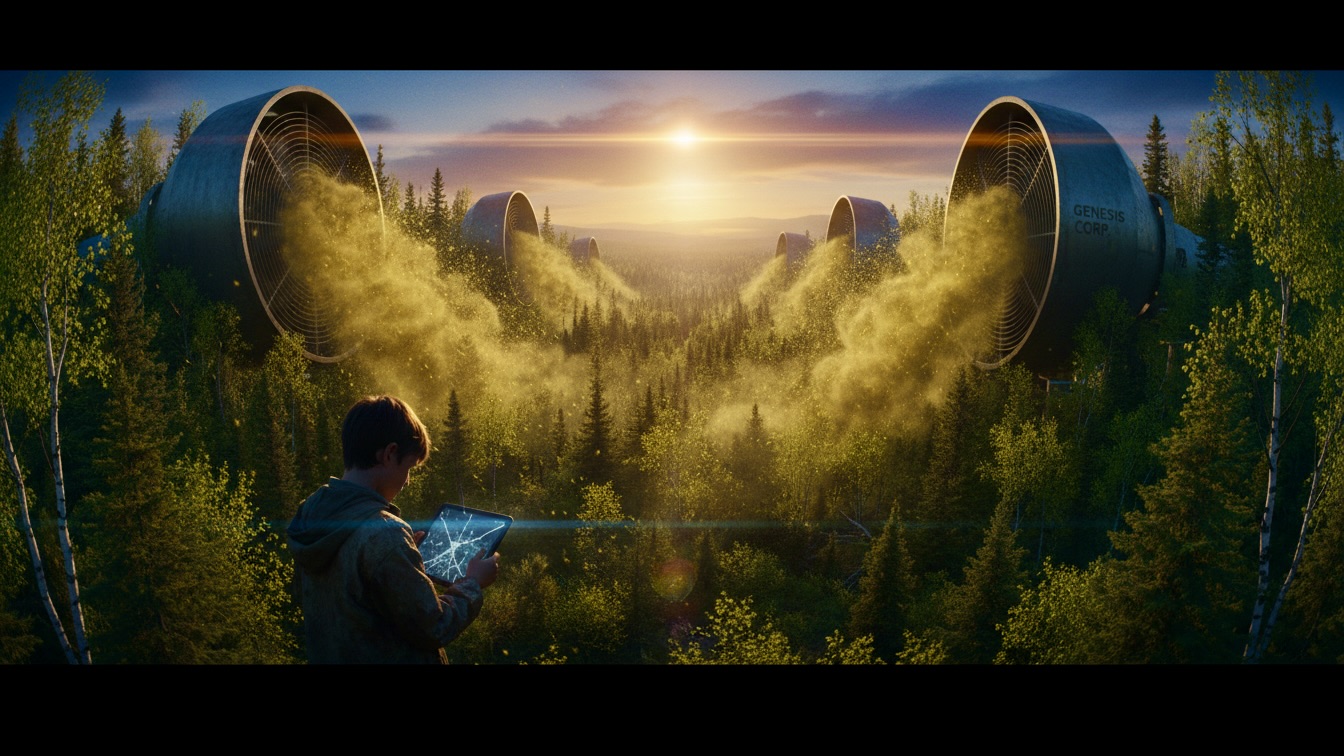
Harv is a scavenger in a town obsessed with "Wish Walking," a practice of following yellow pollen clouds released by the Boreal Springboard trees. While the townspeople believe the pollen is a magical connection to nature, Harv’s "Sniffer" device reveals it is actually a network of bio-tags used by the Edgemont corporation to track emotional "hotspots" for future luxury development. After witnessing the delusional state of a young "Walker," Harv realizes the corporate bigwigs are sucking up every feeling the residents have to determine where to build the next set of high-priced condos.
He infiltrates a construction site for "tiny homes" that are actually shells for the upcoming "Boreal Heights" project, where he discovers blueprints marking the town's landmarks for destruction. He is confronted by his sister, Astrid, the face of the corporate "Bloom Brigade," who tries to bribe him into silence with the promise of a luxury apartment. Recognizing that her "pure aura" is just a marketing tool and her crown is a tracking antenna, Harv rejects her offer. He escapes into the freezing woods with his ledger of evidence, choosing the cold, hard truth over a comfortable, manufactured lie.
Harv: A cynical, resourceful 16-year-old who values truth over comfort and possesses a genius-level aptitude for jury-rigging hardware. He starts the story as a bitter outsider hiding in the shadows and ends as a fugitive whistleblower, having sacrificed his last family connection to preserve the evidence of Edgemont's fraud. His psychological arc moves from passive observation to active resistance.
Astrid: Harv's older sister and the "Face of Spring," who has traded her integrity for a position in the Bloom Brigade to escape poverty. She begins as a symbol of hope and beauty but is revealed to be a desperate collaborator who believes selling out is the only way to survive the coming winter. Her arc is one of tragic stagnation, as she chooses the "vibe" of the corporation over the reality of her brother's struggle.
Harv calibrates his "Sniffer" in the town square, witnessing the "Wish Walkers" in their drug-like stupor as they inhale the shimmering yellow dust. He encounters a delusional girl who views the tracking tech as "love," highlighting the depth of the corporate brainwashing and the high signal-count of the "wish cluster." This interaction establishes the immediate threat of the pollen and Harv’s role as the lone observer of the truth.
Harv infiltrates the "Gated Greenery" construction site and discovers blueprints proving the town's landmarks, including his own home, are being replaced by "Boreal Heights" luxury condos. He realizes the "wishes" are actually data points used to determine where the most valuable land sits, turning human joy into a map for gentrification. The hum of the metal Springboard fans in the woods underscores the industrial reality behind the "natural" facade.
Astrid confronts Harv in a half-finished home, revealing her role in the scheme and attempting to bribe him into silence with a promise of a luxury unit. Harv rejects her offer, realizing her flower crown is actually a giant antenna and that she has become a literal mouthpiece for CEO Edgemont. He jumps from a window into the cold, muddy woods to escape with the data, choosing the "honest scent of damp pine" over the fake smell of flowers.
The episode begins with a sense of gritty, grounded cynicism that clashes with the ethereal, "soft" vibe of the Wish Walkers. As Harv moves deeper into the woods, the mood shifts from mystery to high-stakes betrayal, peaking with the chilling realization that his sister is his primary obstacle. The final notes are somber but resolute, leaving the audience with a feeling of cold, hard clarity as the artificial warmth of the "wishes" fades away.
If expanded, the season would follow Harv as he joins an underground resistance of "Un-Wishers" attempting to sabotage the Springboard machines and broadcast the truth to the dreaming populace. The narrative would escalate as Edgemont deploys more aggressive bio-tech, such as "Memory Moss," which begins to rewrite the history of the town in the minds of the residents.
The seasonal climax would involve a confrontation at the "Boreal Heights" inauguration, where Harv must decide whether to release a counter-pollen that will wake the town but cause them to experience years of suppressed grief all at once. Astrid’s character would evolve from a spokesperson to a tragic figurehead who eventually realizes she is as disposable to the corporation as the bricks of the old bookstore.
The visual style utilizes a high-contrast color palette: the "Wish" areas are saturated with golden, hazy light, lens flares, and soft focus to mimic a dream state. In contrast, Harv’s world and the construction site are rendered in cold blues, sharp edges, and industrial textures, emphasizing the "honest" grime of reality. The camera work should be handheld and frantic during Harv's movements, smoothing out into eerie, stabilized pans whenever the "Wish Walkers" are on screen.
The tone is "Solar-Punk Dystopia," blending the aesthetic of a lush, green future with the underlying rot of a corporate police state. Tonal comparables include the social commentary of Black Mirror and the "low-life, high-tech" grit of Children of Men, but with a unique focus on ecological deception.
This episode targets young adults and fans of speculative fiction (ages 16-35) who enjoy "Black Mirror" style social commentary and "Cyberpunk" themes reimagined through an environmental lens. It appeals to viewers interested in themes of gentrification, tech-skepticism, and the struggle for authenticity in a curated, digital-first world.
The pacing is brisk, moving from a slow-burn atmospheric opening to a tense, thriller-inspired second half. The 12-minute runtime utilizes a tight three-act structure: the discovery of the "cluster" (0-4 mins), the infiltration and blueprint revelation (4-8 mins), and the final confrontation and escape (8-12 mins). Every scene is designed to heighten the sensory contrast between the "fake" spring and the "real" cold.
The "yellow dust" should be a mix of practical gold powder and CGI enhancement to give it an unnatural, shimmering quality that seems to hang in the air longer than normal pollen. The Springboard machines require a unique sound design—a low-frequency mechanical hum that contrasts with the "airy" voices of the Walkers to underscore the artificiality of the environment.
The "Sniffer" device should be a practical prop made from a modified vintage e-reader with exposed copper wiring and a flickering green LED screen to ground the technology in a "lo-fi" aesthetic. Location scouting should focus on contrasting a decaying, brick-heavy urban environment with a sterile, wood-and-plastic construction site to visually represent the "old world" being overwritten.


