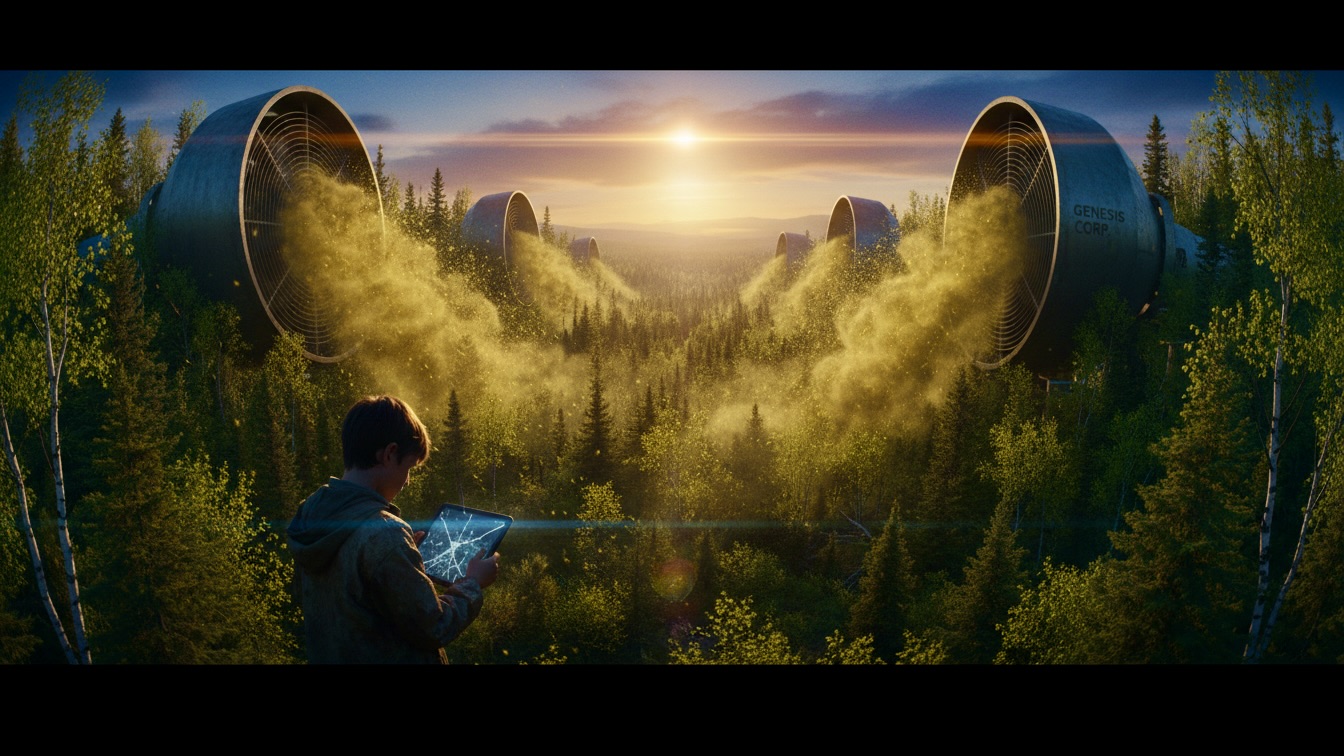
The story follows a cynical and technically gifted young man named Harv, who navigates a dystopian town where nature has been co-opted by corporate interests. Using a makeshift device he calls the "Sniffer," Harv detects that the "magic" pollen from the Boreal Springboard trees is actually a network of bio-tags used for data collection. While the townspeople, known as Wish Walkers, drift through the streets in a drugged, euphoric state, Harv uncovers a more sinister plot involving the CEO of Edgemont. He finds blueprints revealing that the corporation is tracking people's emotional responses to identify prime real estate for luxury developments.
During his investigation, Harv confronts his sister, Astrid, who has become the public face of the corporate campaign. She attempts to persuade him to sell his research and join the elite, promising a life of comfort and warmth. Harv recognizes that her beauty and "pure aura" are merely tools of the corporation, and he refuses to compromise his integrity for a manufactured sense of security. The chapter concludes with Harv fleeing into the cold, damp woods, choosing the harsh reality of the truth over the golden lies of the corporation. He remains committed to his data, finding a grim solace in the honest, biting chill of the natural world.
The central theme of the narrative is the commodification of human emotion and the erosion of privacy through surveillance capitalism. In this world, the most intimate act of making a wish is transformed into a data point for corporate expansion. The yellow pollen serves as a potent metaphor for how technology can be disguised as nature to bypass the psychological defenses of the public. By framing surveillance as "magic" and "connection," the Edgemont corporation successfully harvests the desires of the populace to fuel its gentrification projects.
Another significant theme is the conflict between artificial comfort and painful truth. The Wish Walkers represent a society that has chosen to trade its agency and awareness for a chemically induced sense of well-being. This "vibe" culture is presented as a form of social control that prioritizes "low frequency energy" avoidance over critical thinking. Harv stands as the antithesis to this movement, embodying the psychological burden of the "truth-seeker" who must endure isolation and physical hardship to maintain his mental autonomy.
The story also explores the concept of the "transactional" nature of human relationships. Harv’s internal monologue is haunted by his father’s belief that everything is a deal, a philosophy that has left him wary and defensive. This worldview is tested when Astrid offers him a deal that would secure his physical survival at the cost of his moral compass. The narrative suggests that in a world where everything is for sale, the only way to retain one's humanity is to refuse the transaction entirely, even if it leads to a life of scarcity.
Harv is a deeply guarded and hyper-vigilant protagonist whose psychological profile is defined by his rejection of the status quo. His cynicism appears to be a protective mechanism, likely stemming from the trauma of his father’s abandonment and the collapse of his community. By focusing on "data points" and "hardware," he distances himself from the emotional manipulation that has ensnared the rest of the town. He views the world through a lens of technical skepticism, using his Sniffer as both a tool for survival and a barrier against the "soft" delusions of the Wish Walkers.
His motivation is driven by a desperate need for objective reality in an increasingly simulated environment. While he is physically cold and hungry, his intellectual integrity provides him with a sense of superiority and purpose that the "pollen-drunk" citizens lack. Harv’s refusal to sell his ledger to Edgemont demonstrates a rigid moral core; he would rather suffer the elements than become a cog in the machine that destroyed his home. This rigidity makes him a classic hero of the resistance, though his isolation suggests a character who struggles to form healthy attachments.
Astrid serves as a foil to Harv, representing the seductive power of assimilation and the psychological toll of "selling out." Unlike her brother, she has chosen to embrace the corporate narrative, trading her authenticity for the role of the "Bloom Brigade" leader. Her grass dress and flower crown are symbols of her transformation into a living advertisement, a "face of the spring" that masks the cold reality of the Gated Greenery project. She justifies her betrayal of the community as an act of survival, viewing Harv’s resistance as a "vibe-killing" stubbornness that threatens their future.
Psychologically, Astrid appears to be in a state of cognitive dissonance, evidenced by the way her voice falters when Harv points out the technology in her crown. She has convinced herself that she is "saving" her family, but her language is peppered with corporate buzzwords that suggest she has lost her individual voice. Her attempt to bribe Harv with "real dinner" reveals her underlying desperation for the security and warmth that their father failed to provide. Ultimately, she chooses the "sticker" smile of the corporation over the difficult, messy bond of her actual family.
The narrative employs a gritty, sensory-heavy style that effectively contrasts the "soft" world of the Wish Walkers with Harv’s "sharp" reality. The author uses olfactory and tactile details—the smell of fresh sawdust, the taste of metal, and the snag of rusted wire—to ground the reader in Harv’s physical struggle. These harsh sensations are positioned against the "airy" voices and "honey" tastes of the pollen-affected citizens, creating a visceral sense of the divide between the two groups. The pacing is deliberate, starting with the slow, methodical work of the Sniffer and accelerating into a tense confrontation in the half-finished tiny homes.
The narrative voice is colored by Harv’s technical and cynical perspective, which gives the prose a modern, dystopian edge. Terms like "bio-tags," "low frequency energy," and "land-grab" blend the language of technology with the language of social critique. This creates a tone that is both observational and accusatory, reflecting the protagonist's internal state. The personification of the woods, which "hum" with machines rather than birds, reinforces the theme of nature being replaced by a "factory pretending to be a forest."
The ending of the chapter shifts the tone from confrontation to a somber, reflective solitude. The transition from the "sickly, bright gold" sky to the "black and fast" water of the creek mirrors Harv’s movement from the influence of the corporation back to the unvarnished truth. The final image of Harv sitting behind a rock, clutching his device as the air turns freezing, solidifies the story's stance on the high cost of integrity. The "honest scent of damp pine" serves as a final sensory confirmation that, for Harv, the cold truth is more nourishing than any warm lie.


