Format: Short Film / Anthology Episode | Est. Length: 10-12 minutes
Imagine a world where perfection is a failing machine and the only thing real is a piece of mud. This story serves as a poignant entry in a speculative anthology series exploring the decay of artificial utopias through the eyes of those who have never known anything else.
Set in a near-future "Utopia" where every sensory experience is curated, the series The Grid’s End follows various citizens as the global infrastructure—the Great Brightness—begins to fail. Each episode focuses on a different sector of the city, illustrating how the collapse of artificial comfort forces humanity to reconnect with the raw, often harsh reality of nature. The overarching narrative tracks the transition from a lemon-scented, climate-controlled existence to a world of unpredictable weather, darkness, and genuine survival.
In a glass-enclosed park that smells of lemon soap, a young boy discovers a "snot-colored" bud pushing through the mud just as the artificial sky begins to flicker and die.
As a failing technological utopia plunges into darkness, a young boy and his cynical older brother must protect a fragile, ugly flower that represents the first sign of a wild, uncontrolled world.
The primary theme is the conflict between curated perfection and organic reality, highlighting how humanity trades the "bugs" of life for a sterile, "mid" safety. It explores the loss of wonder in a world where even the sun is a soft-box light, and the rediscovery of awe through the lens of environmental collapse.
The story also touches on the bond of brotherhood in the face of existential change. It contrasts Toby’s innocent acceptance of a new, "leaking" sky with Leo’s fearful realization that the structured world of their childhood is dissolving into something ancient and unpredictable.
For Toby, the stake is the survival of the first real thing he has ever loved—the bud—which is threatened by the freezing temperatures of a world without heaters. For Leo, the stakes are existential, as he must navigate a sudden, dark reality he only knows from stories to keep his brother safe while the city's infrastructure crumbles.
The primary antagonist is the systemic failure of the "Great Brightness" and the "Grid," a decaying technological god that can no longer maintain the illusion of paradise. Internal conflict stems from Leo’s cynical apathy versus Toby’s innocent curiosity, as well as the collective panic of a population that has forgotten how to function without digital guidance.
In the year 2026, Toby and his older brother Leo sit in the "Green Cube," a sterile glass park where the air is lemon-scented and the "Great Brightness" provides eternal afternoon. While Leo complains about the "mid" state of their failing utopia and the flickering sky-mesh, Toby becomes obsessed with a small, ugly, snot-colored bud emerging from the mud. Leo warns of nano-fertilizers and the impending collapse of the Grid, but Toby sees the flower as a living, happy entity that has finally escaped the dark.
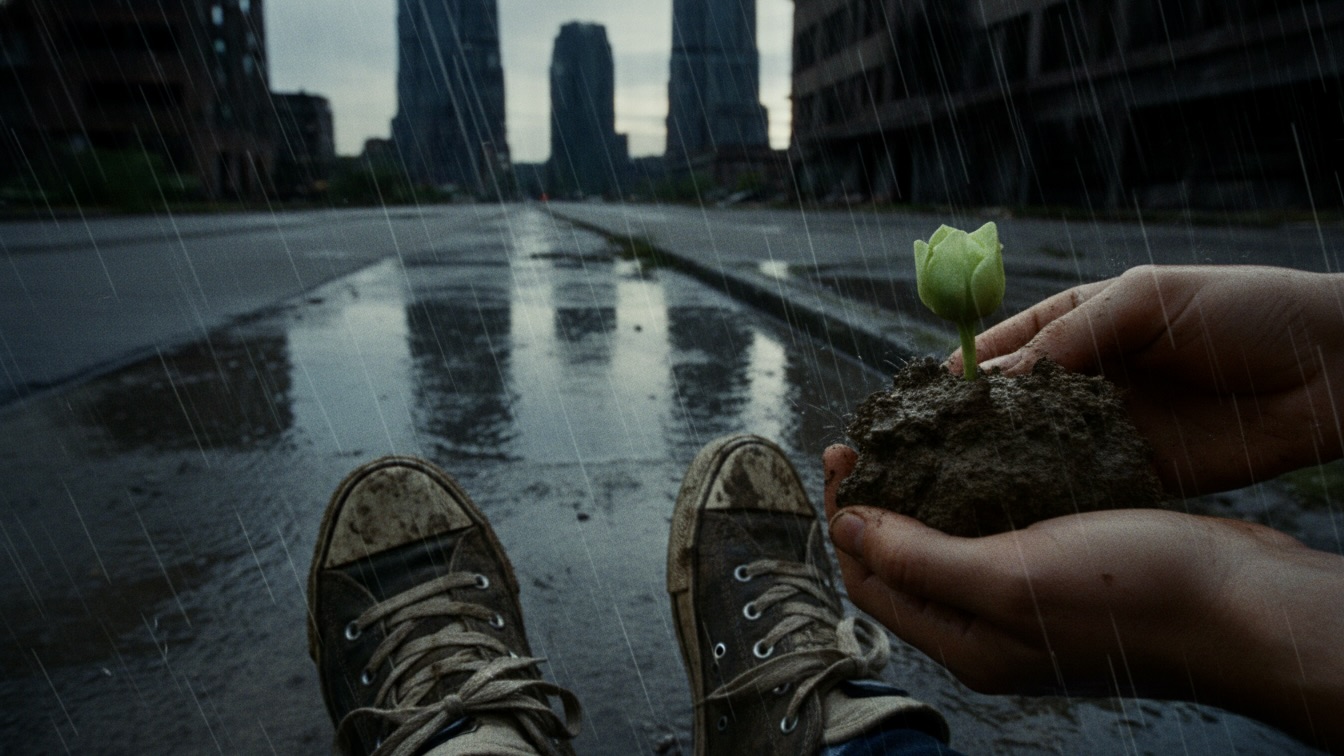
The atmosphere shifts from "mid" to terrifying as the Cube’s seals break and the Great Brightness screeches toward a total power failure. Toby rescues the bud, scooping it up in a hunk of mud as the city plunges into a darkness the citizens have never experienced. They navigate the cooling, shadowed streets as real rain begins to fall for the first time in decades. Reaching home, they prepare to face an uncertain, wild future, realizing that while the lemon-scented dream is over, something real is finally waking up.
Toby: A young boy characterized by wide-eyed wonder and a lack of fear regarding the "old world." He starts the story in a state of sensory deprivation, satisfied with the plastic world, but ends as a protector of life, having felt the "prick" of a real thorn and the cold of real rain.
Leo: A cynical nineteen-year-old who uses the word "mid" to mask his anxiety about the decaying world. He begins as a detached observer of the collapse, but ends as a proactive guardian, trading his obsession with his appearance for the practical necessity of guiding his brother through the dark.
Beat 1: Toby pokes at the mud in the lemon-scented Green Cube while Leo leans against a plastic tree, complaining about the flickering sky-mesh and the "mid" quality of their artificial life. The tension is established through the contrast between Toby’s fascination with the snot-colored bud and Leo’s cracked wrist-link bleeding green light across his skin.
Beat 2: Leo explains the concept of "mid" and the history of real grass and bugs to a skeptical Toby, while a robotic bee malfunctions nearby, sounding like a broken hair dryer. The atmosphere thickens as the Great Brightness begins to hum with a low, tooth-vibrating frequency, signaling the imminent failure of the city's power grid.
Beat 3: A massive glass panel in the ceiling cracks, letting in a draft of cold, metallic-smelling air that disrupts the lemon-scented peace of the Cube. Leo realizes the "seals are breaking" and attempts to flee, but Toby refuses to leave without the bud, digging it out of the ground with his bare hands.
Beat 4: The brothers sprint across the bio-turf as the lights flicker and die, plunging the Cube into a terrifying, absolute darkness before the dim orange emergency lights kick in. They reach the airlock doors just as the city’s constant hum falls into a deafening silence, marking the "end of the long afternoon."
Beat 5 (Climax): Outside, the brothers navigate a street of "statue-like" people paralyzed by their dark devices as the first real rain in years begins to fall. Toby feels the bud prick his thumb with a thorn—a sign of its wild nature—and Leo guides him toward their dark apartment building, embracing the arrival of the stars and the cold, real world.
The episode begins with a sense of sterile boredom and "mid" apathy, quickly transitioning into a low-level dread as the environment begins to glitch. The climax is a sensory explosion of cold air, darkness, and rain, moving the audience from the comfort of a "lemon-scented" cage to the frightening but exhilarating reality of a wild world.
If expanded, the season would follow Toby and Leo as they attempt to cultivate the snot-colored bud in a world without artificial heat, eventually discovering a community of "re-wilders" living in the dark zones. The thematic escalation would focus on the struggle between those trying to reboot the Grid and those who believe the collapse is a necessary rebirth for the planet.
The overarching narrative would culminate in the "Great Brightness" being permanently disabled by a grassroots movement. Characters from various episodes would converge in a newly greened city, learning to live with the "bugs" and the unpredictability of nature they once feared.
The visual style should contrast the flat, over-saturated, "soft-box" lighting of the Utopia with the high-contrast, shadow-heavy, and textured look of the world after the power failure. The camera work starts with static, clinical shots and transitions into handheld, immersive movements as the environment becomes chaotic.
The tone is "Speculative Melancholy" meets "Amblinesque Adventure," drawing comparisons to the quiet desolation of Children of Men mixed with the youthful perspective of Stranger Things. It is a world that feels both futuristic and decaying, where the most high-tech objects are the most useless.
This episode targets fans of high-concept sci-fi anthologies (e.g., Black Mirror, Love, Death & Robots) and young adult audiences interested in environmental themes and "solarpunk" or "cyberpunk" aesthetics. It appeals to viewers who enjoy character-driven stories set against the backdrop of societal collapse.
The pacing is a slow-burn build-up that occupies the first six minutes, establishing the "mid" atmosphere, followed by a rapid-fire escalation in the final four minutes as the systems fail. The structure follows a classic three-act arc: the Discovery (Act 1), the Breach (Act 2), and the Descent into Reality (Act 3).
The "Great Brightness" failure requires sophisticated sound design—moving from a constant, unnoticed hum to a mechanical screech and then absolute silence. The contrast between the "lemon-soap" smell (conveyed through clean, white visuals) and the "wet stone" smell (conveyed through dark, gritty textures) is crucial for the sensory storytelling.
Practical effects should be prioritized for the mud and the "snot-colored bud" to emphasize their tactile, organic nature against the CGI-enhanced, sterile environment of the Green Cube. The transition to the rain-soaked finale should be filmed with practical water effects to heighten the realism of the world "waking up."


