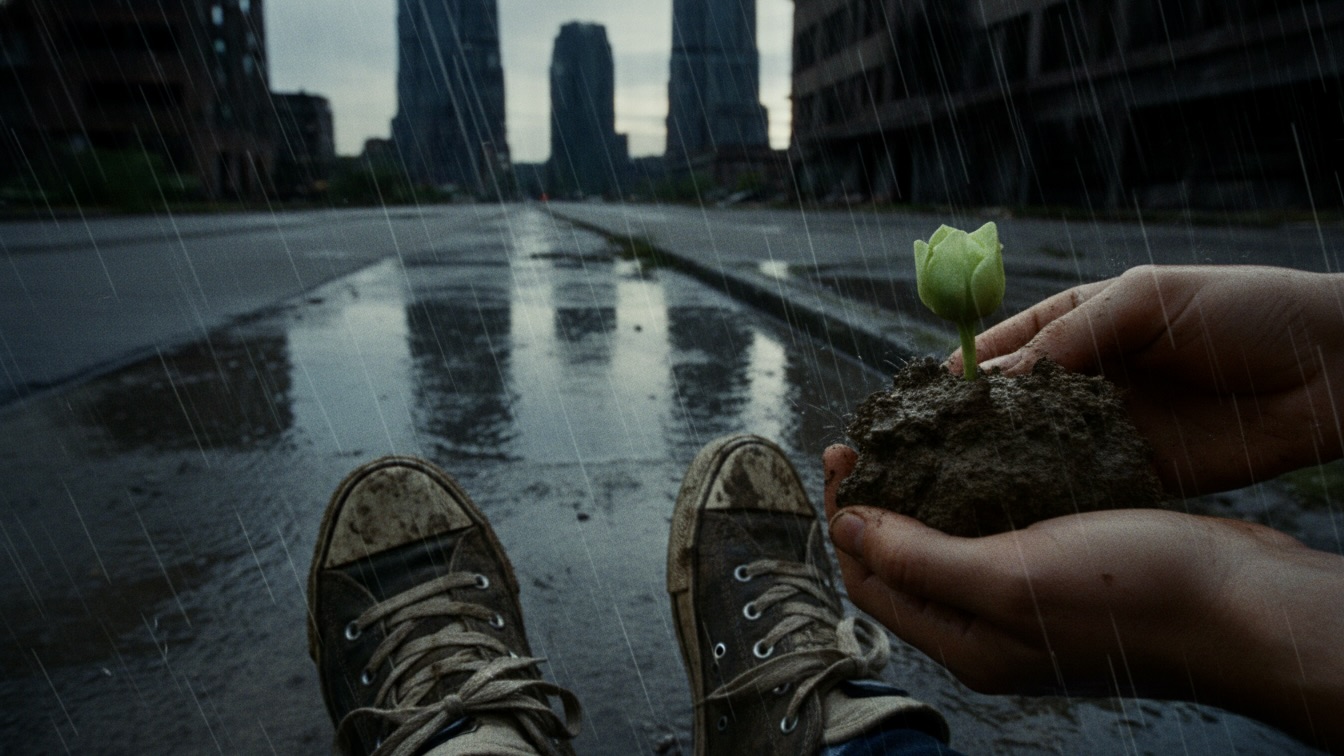
The story takes place in the year 2026 within a controlled, artificial environment known as the Green Cube. Toby, a young boy, and his older brother Leo navigate a world where nature has been replaced by bio-turf, plastic trees, and a lemon-scented atmosphere. While Leo laments the decaying state of their supposed "Utopia," Toby becomes fascinated by a small, unattractive flower bud growing in actual mud.
As the brothers converse, it becomes clear that the city’s infrastructure is failing. The "Great Brightness," an artificial sun, begins to flicker, and rumors of power failures in the Outer Zones suggest a systemic collapse. Leo shares stories of a past world filled with real grass and stars, contrasting the sterile safety of their current lives with the messy reality of the past. The tension peaks when the sky-mesh fails and the glass ceiling of the Cube begins to crack, signaling the end of the artificial era.
Panic ensues as the lights fail and the city falls into an unaccustomed darkness. Toby insists on saving the flower bud, scooping it up along with a handful of mud as they flee the crumbling structure. Outside, the boys experience real wind and rain for the first time. The story concludes with the brothers returning home in the dark, where the "snot-colored" bud finally receives the natural water it needs to survive, symbolizing a harsh but authentic new beginning.
The primary theme of the narrative is the inherent conflict between artificial perfection and organic reality. The setting of 2026 is described as a "Utopia" that has become stagnant and "mid," a slang term used by Leo to describe a state of mediocre safety. This world has traded the "bugs" and unpredictability of nature for a sanitized, lemon-scented existence that ultimately feels hollow. The failure of the Great Brightness serves as a metaphor for the unsustainable nature of a life lived entirely behind filters and glass.
Another significant theme is the reclamation of sensory experience. Throughout the text, the characters transition from the artificial scents of lemon soap and the feel of "itchy carpet" bio-turf to the raw, metallic tang of rain and the sharp prick of a thorn. Toby’s preference for the "snot-colored" bud over plastic trees suggests that beauty is found in authenticity, even when that authenticity is ugly or painful. The story posits that a world with thorns and darkness is preferable to a world that is perfectly lit but fundamentally dead.
The narrative also explores the loss of innocence and the necessity of struggle. Toby begins the story as a child who likes the safety of the lights, while Leo acts as a cynical guide to the crumbling world. By the end, Toby must face his fear of the dark to protect the only real thing he has found. The thorn on the bud symbolizes the "price" of reality; the plant must have defenses to survive in a world that is no longer curated for comfort. This transition from a "long afternoon" to a stormy night represents the brothers' forced maturation.
Toby functions as the emotional heart of the story, representing a generation born into a world of screens and filters. His perspective is defined by a curious blend of innocence and a latent hunger for something real. While he initially claims to like the bug-free turf, his fixation on the mud and the "ugly" bud reveals an instinctive pull toward the earth. He does not view the bud through an aesthetic lens but through a biological one, recognizing its struggle as something meaningful.
Psychologically, Toby experiences a profound shift from dependency to agency. At the start, he is a passive observer, but when the ceiling cracks, he takes a stand to "save" the plant. This act of preservation shows his developing empathy and his rejection of the disposable culture of Utopia. His fear of the dark is palpable, yet he prioritizes the life of the bud over his own comfort. By the end of the chapter, he has moved from a state of artificial safety to one of vulnerable, real-world engagement.
Leo serves as the jaded adolescent archetype, acting as a bridge between the old world of his mother’s stories and the failing world of the present. He uses humor and cynicism, such as his obsession with the word "mid," as a defense mechanism against the anxiety of societal collapse. His preoccupation with his hair and his "wrist-link" shows a lingering attachment to the status symbols of the dying Utopia. However, his willingness to sit in the mud with Toby indicates that he is beginning to let go of these superficial concerns.
Underneath his witty exterior, Leo harbors a deep longing for the sublime, specifically the "fire" of the stars. He is more aware of the danger than Toby, yet he is also more excited by the prospect of the world "waking up." His role is protective, but he does not coddle Toby; instead, he prepares him for a world where they will need to be "explorers." Leo’s smirk at the end suggests a grim acceptance of their new reality, showing a resilience that his silver-jumpsuit-wearing neighbors lack.
The author employs a sensory-rich prose style that emphasizes the contrast between the synthetic and the natural. Descriptions of the "Great Brightness" as a "soft-box light" and the robotic bee sounding like a "broken hair dryer" create a sense of a world that is fundamentally mechanical. This is sharply contrasted with the description of the rain as a "tiny electric shock" and the wind smelling of "dirt and distance." These sensory shifts mirror the narrative's movement from the controlled interior of the Cube to the wild exterior of the city.
The pacing of the chapter is masterfully handled, beginning with a slow, contemplative dialogue in the mud and accelerating into a frantic escape. The use of short, punchy sentences during the power failure conveys the disorientation and panic of the characters. This rhythmic shift mimics the "cracking" of the Utopia itself, moving from the "long afternoon" of the status quo to the sudden, sharp reality of the storm. The silence that follows the city's hum is described as a physical presence, marking a definitive break in the timeline of the world.
The tone of the story is bittersweet and atmospheric, blending elements of dystopian fiction with a coming-of-age narrative. The narrative voice is grounded in Toby’s limited but perceptive point of view, which allows the reader to feel the "rock" in his stomach and the "sharp prick" of the thorn. By ending the chapter with the image of the bud "drinking the rain," the author provides a sense of hope that is not based on the restoration of the old order, but on the survival of life in its most rugged and honest form.


