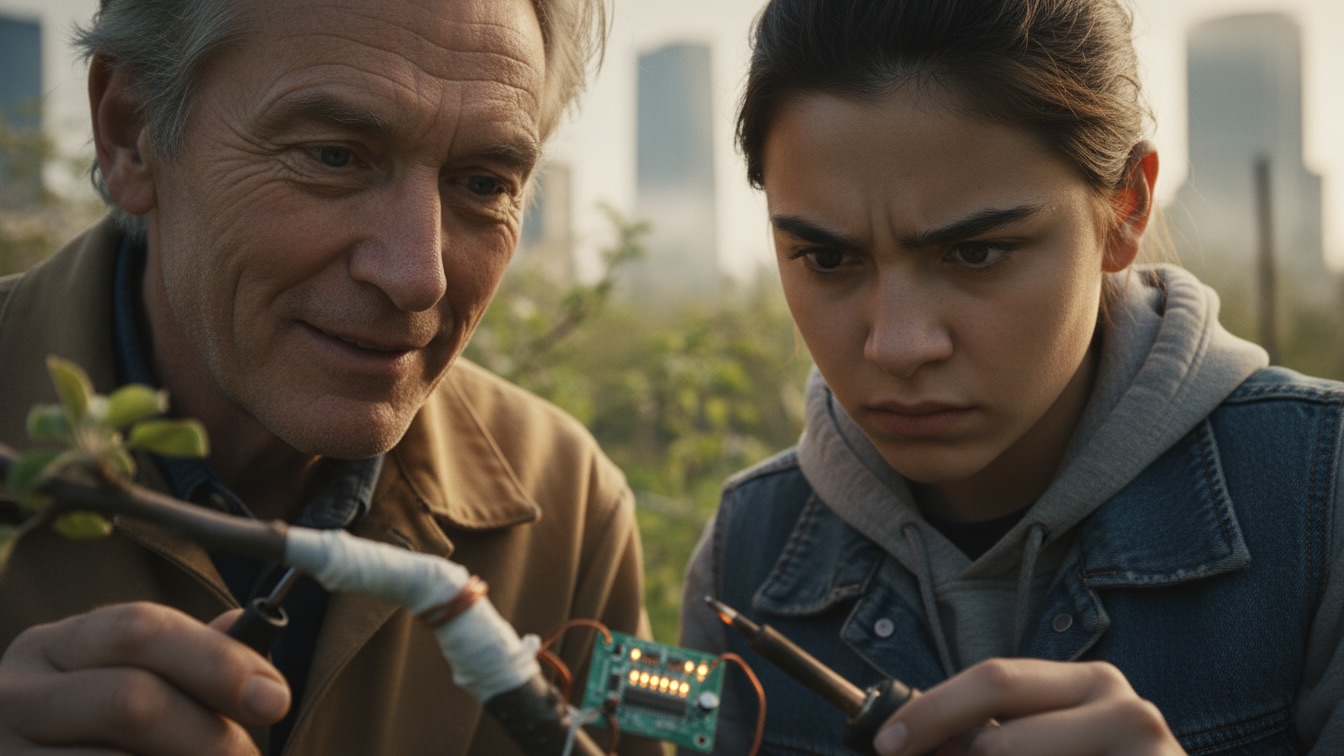
Format: Short Film / Anthology Episode | Est. Length: 10-12 minutes
Imagine a series titled The Analog Patch, a high-concept anthology that explores the friction between hyper-digital futures and the stubborn persistence of biological life. Each episode functions as a "node" in a larger narrative of human resistance, where "legacy" individuals use forgotten skills to bypass corporate-controlled algorithms. Time-Bank Garden serves as the pilot, establishing a world where the most radical act of rebellion is not a cyber-attack, but the slow, patient cultivation of a living orchard within a city of glass and code.
Pete, a retired software architect, sits in a silent apartment where the ticking clock sounds like a hammer hitting a nail, until he realizes he is a "legacy system" that needs to boot up one last time to save a dying garden.
A retired engineer and a burnt-out digital native must bridge the gap between legacy code and living soil to protect a struggling orchard from a lethal frost. Their success creates a rogue energy signature that alerts a predatory corporate surveillance state to their off-grid sanctuary.
The narrative explores the intersection of intergenerational mentorship and the "cyber-pastoral" struggle against digital obsolescence. It highlights how technical logic and biological growth are not opposites but parallel systems requiring the same fundamental protocols of connection, precision, and patience.
The second theme focuses on the cost of "optimization" in a society that views time as a currency to be spent at 2x speed. By choosing the "stubbornly slow" path of gardening, the characters reclaim their humanity from a world that treats them as legacy hardware or over-clocked processors.
For Pete, the stakes are existential; failure to save the trees confirms his obsolescence and consigns him to a "ghostly" retirement. For Jae, the orchard represents his only tether to sanity and the physical world. If the frost claims the garden, both men lose their hard-won connection to reality, and the community loses its only patch of non-digital hope.
The primary external conflict is the "executioner" frost, a natural force that threatens to shatter the delicate biological grafts the duo has created. Internally, Pete battles the crushing weight of his own perceived uselessness, while Jae fights a "DDoS attack" of anxiety and sensory overload. A secondary, looming antagonistic force is the corporate city, represented by the "black sedan" and the agent who views their unauthorized, off-grid engineering as a threat to the established digital order.
Pete is a sixty-five-year-old retired engineer living in a world that has moved to a new architecture, leaving him feeling like a legacy system running in an empty room. Seeking a reason to "boot up," he joins the Sky-Root Collective, a garden wedged between glass towers, where he is tasked by the leader, Linda, with saving a struggling apple orchard. There, he meets Jae, a young man suffering from digital burnout who is struggling to navigate a new decentralized web. Pete proposes a trade: he will teach Jae the biological "handshake" of tree grafting if Jae helps him navigate the hidden layers of the modern mesh.
As they work, they discover that the logic of the old protocols and the growth of the trees are remarkably similar, allowing Jae’s anxiety to settle into the soil. However, a sudden, lethal spring frost threatens to destroy their work and kill the budding trees. Using salvaged e-waste and Jae’s decentralized network, they build a makeshift, sensor-controlled heating system to keep the orchard alive through the night. They succeed in saving the trees, finding a deep sense of mutual purpose, but their unauthorized use of technology draws the attention of a corporate agent, signaling that their sanctuary is now a target.
Pete is a "god of the monolithic era" who enters the story as a man paralyzed by the silence of his own obsolescence. By the end of the episode, he has transitioned from a "ghost in his own living room" to a vital engineer of biological and digital bridges, rediscovering his worth through mentorship. He represents the "Legacy System" that still possesses the foundational logic necessary to stabilize the modern world.
Jae is a hyper-connected "digital native" whose high-performance brain has outpaced his nervous system’s ability to cope. Initially vibrating with frantic energy and "unbearable latency," he finds a grounding frequency in the dirt and the slow pace of the orchard. By the climax, his twitchy fingers have become steady enough for fine grafting, showing an arc from fractured anxiety to focused, purposeful action.
Linda is the "iron wire" guardian of the Sky-Root Collective, serving as the catalyst for Pete’s transformation. She possesses a theatrical gravity and a deep understanding of long-term investment, acting as the moral compass of the garden. While she doesn't participate in the technical "hack," she provides the "sector" where the union of old and new can take place.
Pete sits in his sterile apartment, where the silence is a high-pitched hum and his calendar is a "desert" of inactivity. He realizes he is a legacy system in need of a reason to boot up before he fades away entirely. He decides to leave his digital tomb and enters the Sky-Root Collective, seeking a connection to something that doesn't run at 2x speed.
Linda assigns Pete to the struggling apple trees, where he encounters Jae, a young man vibrating with digital anxiety over a handheld terminal. Pete recognizes the "muscle memory" of a coder in Jae and approaches him, attempting to bridge the gap between their eras. They form a "pact" to trade Pete's ancient wisdom of the branch for Jae's knowledge of the decentralized mesh.
The duo spends days in a rhythmic labor, with Pete teaching Jae that grafting a tree is identical to a handshake protocol where timing and alignment are everything. As Jae’s hands steady and Pete’s mind sharpens, they successfully join the biological scions to the host trees. This midpoint represents their peak harmony, as they realize they are building a biological bridge that satisfies both their needs for connection.
The weather report shifts, announcing a "blue screen of death" in the form of a lethal spring frost that will shatter the trees' cell walls. Pete’s engineering instincts spin up, and he realizes they must build a sanctuary using the corpses of the old world. They scavenge the collective's shed for discarded servers, coffee makers, and lithium batteries to create a makeshift heating grid.
Through a night of freezing wind, Pete and Jae solder a sensor network together, fighting the atmosphere to keep the orchard at a stable five degrees. Pete commands the power routing while Jae manages the decentralized mesh, their skills merging perfectly to defy the "executioner" frost. As the sun rises, the frost melts to reveal intact buds, marking a hard-won victory over both nature and their own limitations.
In the quiet aftermath, Pete and Jae sit among the steaming trees, acknowledging that they have taught each other how to connect to something real. Pete realizes that his skills aren't obsolete, just in need of a new application, while Jae finds peace in the dirt. However, the final moment reveals a corporate agent in a black sedan watching them, proving that their off-grid "spring" has triggered a silent alarm in the city above.
The episode begins with a cold, sterile sense of "systemic" depression and isolation, characterized by the high-pitched hum of Pete's apartment. As the story moves into the garden, the mood shifts to a "cyber-pastoral" warmth, blending the smell of rot and potential with the blue glow of terminals. The climax is a high-octane, desperate burst of adrenaline and mechanical purring, ending on a note of quiet, profound connection that is immediately undercut by a chilling sense of surveillance and dread.
If expanded, the season would follow Pete and Jae as they realize their "Time-Bank Garden" is just one node in a larger, hidden network of analog-digital hybrids. They begin to recruit other "obsolete" specialists—radio operators, mechanical engineers, and botanists—to expand their sanctuary into a city-wide underground grid. This escalation leads to a direct confrontation with the "Sky-Tower" corporations that control the city’s resources and data.
The thematic arc of the season would explore the concept of "Biological Sovereignty," as the characters fight to keep their garden off the official map. As the corporate surveillance tightens, Pete must decide if he is willing to crash the entire city's system to save the small, green world he has built. The season concludes with the garden becoming a literal "backbone protocol" for a new, decentralized society living in the shadows of the glass towers.
The visual style is "Industrial-Organic," utilizing a color palette that transitions from the clinical, desaturated blues of the city to the deep, saturated umbers and greens of the garden. Cinematography should favor macro shots of grafting—knives cutting wood, wires being soldered—to emphasize the tactile nature of their work. The lighting during the frost battle should be a chaotic mix of orange heater glows and the harsh, flickering blue of terminal screens against the pitch-black night.
The tone is a blend of "Lo-Fi Sci-Fi" and "Quiet Drama," comparable to Tales from the Loop or Children of Men. It avoids the slickness of traditional cyberpunk in favor of a "used future" aesthetic where technology is dirty, salvaged, and integrated with nature. The sound design is crucial, contrasting the "hammer-on-nail" ticking of the clock with the low, mechanical purr of the makeshift heaters.
The target audience includes fans of "Hopepunk" and thoughtful science fiction who appreciate character-driven narratives over spectacle. It appeals to a multi-generational demographic, specifically Gen X and Boomers who resonate with Pete’s struggle for relevance, and Gen Z viewers who identify with Jae’s digital burnout. The episode is designed for a prestige streaming environment where atmospheric storytelling and thematic depth are prioritized.
The 10-12 minute runtime follows a classic three-act structure with a compressed timeline. Act I (0-3 min) establishes Pete’s isolation and the meeting with Jae. Act II (3-8 min) focuses on the "training" and the sudden arrival of the frost threat. Act III (8-12 min) is the high-tempo engineering battle and the bittersweet resolution. The pacing is deliberate and "slow-grown" initially, mirroring the garden, before accelerating into a frantic, tech-thriller tempo during the night of the frost.
Production will require a mix of a sterile, high-end apartment set and an outdoor community garden location nestled between tall buildings. The "e-waste" props must be carefully designed to look functional yet scavenged, using real internal components from servers and laptops to maintain authenticity. Practical effects should be used for the "steaming" garden and the frost-covered plants to ground the sci-fi elements in reality.
The grafting scenes require specialized training for the actors to ensure the "fine work" looks legitimate on camera. The "black sedan" in the final shot should be a modern, electric vehicle with a silent, predatory presence to contrast with the noisy, purring heaters of the garden. Minimal CGI should be used, primarily for the "mesh" visualizations on Jae’s terminal, keeping the focus on the physical interaction between the characters and their environment.


