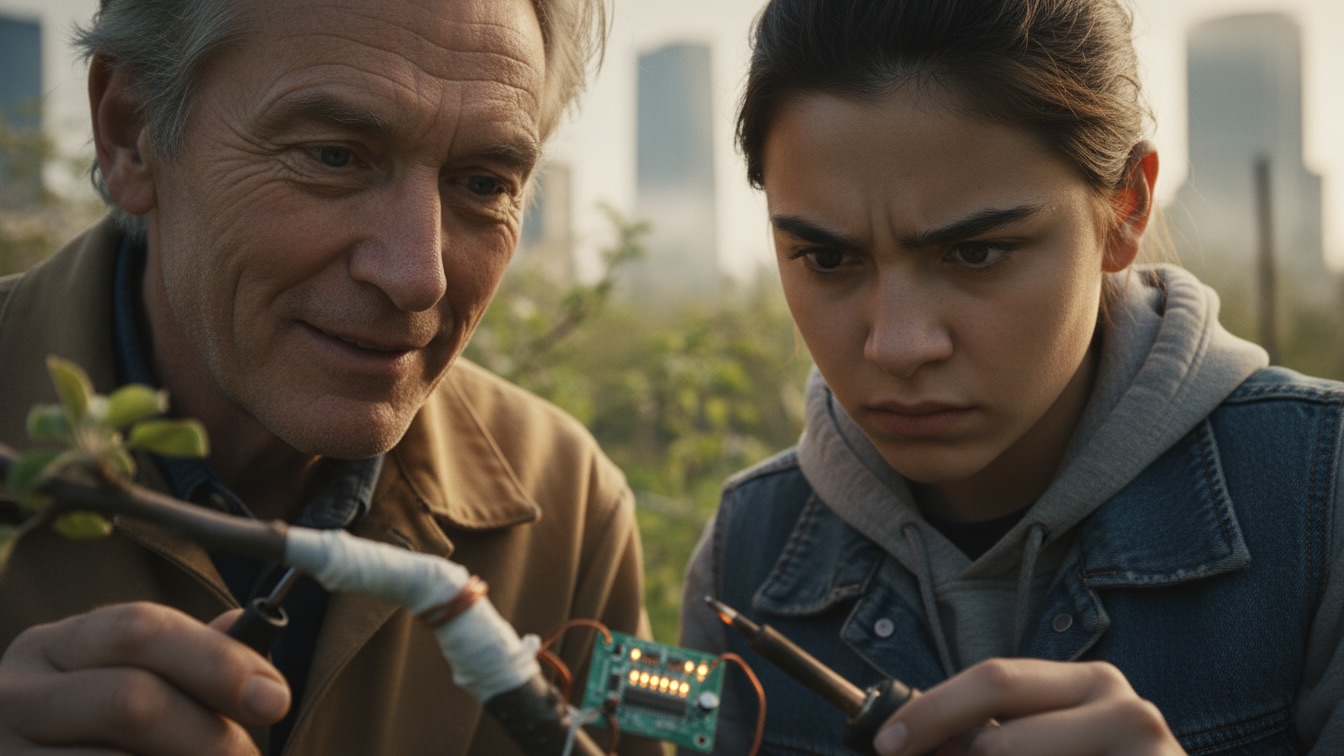
The story follows Pete, a sixty-five-year-old retired engineer who feels obsolete and disconnected in a fast-paced, digital world. Seeking a sense of purpose, he joins the Sky-Root Collective, a community garden where he is tasked by the leader, Linda, to care for struggling apple trees. There, he meets Jae, a young man overwhelmed by digital anxiety who is struggling to navigate a new decentralized web protocol. Pete and Jae form a symbiotic partnership, trading Pete’s "ancient" engineering wisdom for Jae’s modern technical navigation while working together to graft the trees.
Their newfound peace is threatened by a sudden spring frost that puts the delicate grafts at risk of destruction. Combining their skills, they scavenge e-waste and use a decentralized sensor network to build a localized heating system for the orchard. They successfully save the trees through an intense night of technical and physical labor, finding a deep sense of connection to each other and the earth. However, the chapter ends on an ominous note as a mysterious man in a black sedan watches them from the curb. This suggests that their attempt to build an independent, "off-grid" system has attracted unwanted attention from the powers that govern the city.
The central theme of the story is the search for utility and meaning in an era of rapid technological obsolescence. Pete views his own life through the lens of a "legacy system," suggesting a psychological state where human value is tied strictly to technical relevance. The garden serves as a sanctuary where the "slow" logic of nature provides a necessary counterpoint to the "2x speed" of the digital world. By caring for the trees, Pete moves from being a "ghost" in his living room to a "guardian" of a living system, proving that his foundational knowledge still has vital applications.
Another prominent theme is the synthesis of nature and technology. Rather than presenting the two as diametrically opposed, the narrative suggests that they can be integrated to foster resilience. Pete and Jae do not save the trees by abandoning technology, but by repurposing "the corpses of the old world"—discarded electronics—to protect biological life. This "biological bridge" reflects a middle ground where human ingenuity serves the environment rather than just exploiting it for data or speed.
The story also explores the concept of intergenerational connection as a remedy for isolation. Both Pete and Jae are outcasts in their own way; Pete is discarded by the past and Jae is overwhelmed by the future. Their "pact" creates a cross-generational "handshake protocol" that allows them to find stability. Through their collaboration, the "ancient wisdom" of the engineer and the "modern navigation" of the digital native become a singular, effective force.
Finally, the narrative touches upon the tension between individual autonomy and systemic control. The garden is described as a place where time is managed differently, and the duo’s makeshift heating grid is an act of defiance against the city’s standard infrastructure. The appearance of the man in the black sedan at the end underscores the idea that true independence is often viewed as a threat. The world "doesn't like it when you find a way to step out of the stream," suggesting that their small victory may have larger, more dangerous consequences.
Pete is a man struggling with the psychological weight of retirement, which he perceives as a terminal "empty space." He is deeply analytical, frequently using computer metaphors to describe his internal state and his surroundings. This suggests that his identity is inextricably linked to his former career as a systems engineer. He feels a sense of profound displacement, moving through a world that has moved to a "new architecture" where he no longer fits.
His motivation for joining the garden is a desperate need to "boot up" and find a reason to exist beyond mere survival. While he initially feels his hands are too shaky for fine work, his confidence returns when he finds a way to apply his logical mind to a physical problem. Pete’s arc in this chapter is one of reclamation. He moves from a state of passive obsolescence to active leadership, rediscovering that his "ancient" skills are the foundation upon which the new world is built.
Jae is a representation of the "digital native" who has been broken by the very technology he masters. He is described as having a "high-performance brain" but a "low-bandwidth nervous system," indicating a disconnect between his cognitive abilities and his emotional regulation. His physical manifestations of anxiety—the vibrating limbs and bloodshot eyes—show a youth who is drowning in a "sea of data." He is a character who has lost his "soul" to the screen and seeks the garden as a "wellness mandate."
Through his interaction with Pete, Jae finds a way to ground his frantic energy into something tangible. The act of grafting trees requires a level of focus and stillness that his digital life lacks. When he holds the grafting knife, his hands stop shaking, suggesting that the physical labor acts as a "patch" for his fractured focus. Jae’s theatrical language serves as a defensive shield, but by the end of the night, he drops the persona, revealing a vulnerable young man who has finally found a real connection.
Linda serves as the gatekeeper and the "architect" of the social environment within the Sky-Root Collective. She is described with rugged, elemental imagery—"sun-dried leather and iron wire"—which positions her as a person who has successfully integrated with the natural world. She possesses a keen psychological insight, recognizing exactly what Pete and Jae need before they realize it themselves. By assigning Pete to the "struggling" trees, she gives him a mission that requires the very patience he claims is his only remaining currency.
Her theatrical gravity is a tool she uses to imbue the act of gardening with a sense of high-stakes importance. She understands that for men like Pete, who are used to "emergency deployments," gardening must feel like a mission of critical significance. Linda represents the steady, unyielding force of the collective. She provides the "sector" and the opportunity, but she allows the characters to find their own way to solve the problems she presents.
The narrative voice is heavily colored by technological jargon, creating a unique "cyber-pastoral" tone. By using terms like "DDoS attack," "latency," and "hotfix" to describe biological and emotional processes, the author bridges the gap between the mechanical and the organic. This stylistic choice reflects Pete’s perspective, showing how his professional background limits and defines his worldview. It creates a sharp contrast between the "high-pitched hum" of the digital world and the "dark rot" of the soil.
The pacing of the chapter follows a classic arc of tension, starting with the slow, depressive atmosphere of Pete’s apartment. The rhythm picks up as Pete and Jae begin their collaboration, eventually reaching a frantic peak during the "executioner" frost. The urgency of the night-time operation is conveyed through short, punchy dialogue and sensory details like the "screaming" wind and the "stinging" eyes. This shift in pace mirrors the characters' internal transition from stagnation to vital action.
Sensory details are used effectively to highlight the differences between the city and the garden. The "harsh blue glare" of Jae’s terminal is contrasted with the "green life" of the cambium layer and the "pink sparks" of the apple blossoms. The soundscape is also vital, moving from the "ticking of a clock" that sounds like a hammer to the "low, mechanical purr" of the heaters. These details anchor the reader in a world that feels both futuristic and ancient, emphasizing the story's focus on the intersection of different eras.
The narrative voice is intimate and reflective, providing deep access to Pete’s internal monologue. This allows the reader to feel the "physical weight" of his anxiety and the "lead" in his body after the hard work is done. The ending, however, shifts the tone from a personal triumph to a broader, more systemic threat. The introduction of the "black sedan" and the "cold light" of the man’s tablet creates a chilling cliffhanger that disrupts the warmth of the sunrise, leaving the reader with a sense of impending conflict.


