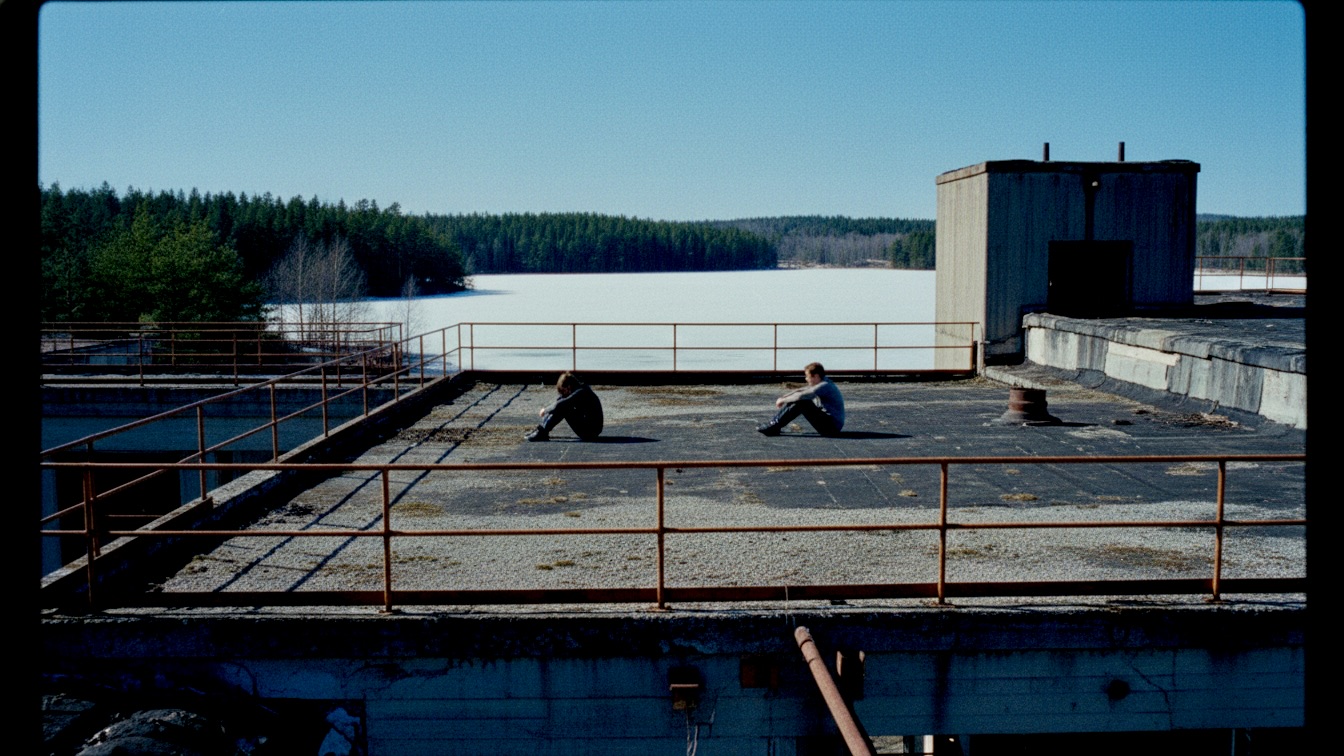
Format: Short Film / Anthology Episode | Est. Length: 10-12 minutes
Imagine this as a haunting entry in a gritty northern anthology series, where the landscape is as much a character as the people, capturing the slow-burn dissolution of rural identity in the face of urban migration.
Set in the fictionalized "Rust Belt" of Northern Ontario, the series The Great Divide explores the lives of those left behind after the collapse of the timber and paper industries. Each episode follows a different resident of "Blackwood Bay," weaving a tapestry of economic despair, generational trauma, and the desperate hope of the youth. The overarching narrative tracks the town's literal and metaphorical erosion as the environment reclaims the industrial ruins.
Two young men trespass into a skeletal, abandoned paper mill, climbing a rusted fire escape as the "candle ice" on the lake below begins to rot and moan.
A guilt-ridden teenager must confront his resentful best friend atop a decaying paper mill to reveal he has secured a ticket out of their dying hometown. Their confrontation mirrors the breaking ice below, shattering a lifelong bond in the shadow of industrial ruin.
The primary theme is the "Geography of Ambition"—the friction between the desire for self-improvement and the loyalty to one's roots. It explores the "Brain Drain" phenomenon where rural communities lose their vitality to urban centers, leaving behind a vacuum of resentment and a perceived poverty of imagination among those who stay.
The secondary theme is "Environmental Decay as Psychological Mirror." The rotting candle ice and the sulfur-soaked concrete of the mill serve as physical manifestations of the characters' internal states: Sam is the surging water beneath the surface, while Will is the stagnant, porous ice waiting to be swallowed by a changing season.
For Sam, the stake is his future and his sanity; staying means intellectual and economic death, but leaving means being branded a traitor by the only family and community he has ever known. For Will, the stake is his last tether to a shared reality; if Sam leaves, Will is forced to face his own stagnation alone in a town that no longer has a pulse, effectively erasing his sense of belonging.
The external conflict is the economic collapse of the town, represented by the "dead" mill and the lack of opportunity. Internally, the conflict is Sam’s guilt versus his ambition, and Will’s pride versus his fear of abandonment. The antagonistic force is the "Ghost of the Mill"—the lingering social and chemical rot that makes staying impossible but leaving feel like a betrayal.
In the damp, sulfur-scented spring of Northwestern Ontario, Sam and Will trespass into the skeletal remains of the paper mill that once anchored their community. As they climb to the roof of the digester building, the physical decay of the site serves as a backdrop for a long-simmering tension between the two nineteen-year-olds. Sam carries a secret that feels like a betrayal: an admission email from the University of Toronto, a digital lifeline that promises an escape from the "rotting corpse" of their town.
When Sam finally breaks the silence, the revelation sparks a vicious ideological war on the edge of a sixty-foot drop. Will, trapped by poverty and a sense of noble stagnation, lashes out at Sam’s perceived elitism, while Sam counters by exposing Will’s fear of the future. As a massive shelf of "candle ice" shatters on the lake below, the two realize that their friendship has become as porous and unstable as the ice itself, ending in a cold, silent departure that marks the true obituary of their shared youth.
Sam (19): Intelligent, observant, and deeply anxious. At the start, he is paralyzed by the "cognitive static" of his secret admission; by the end, he has found a cold, sharp clarity, accepting that his departure is a necessary survival tactic regardless of the social cost.
Will (19): Hardened, defensive, and prematurely aged by labor and loss. He begins the episode masking his insecurity with casual cynicism; he ends it as a hollowed-out "ghost," his defensive armor shattered by Sam’s brutal honesty about the town's—and his own—lack of a future.
Beat 1: Sam and Will trespass into the skeletal remains of a liquidated paper mill, their footsteps echoing through a parking lot that feels heavy with the absence of the town's former life. They ascend a rusted fire escape that clings to the boiler building like a spine, navigating the literal and metaphorical hazards of their decaying environment. Will’s warning about a rusted step highlights the lingering, instinctive care in their friendship even as the "cognitive static" in Sam’s mind reaches a deafening pitch.
Beat 2: Reaching the roof of the digester building, the two men sit on the edge of a sixty-foot drop as the harsh sunset illuminates the scavenged ruins of their fathers' workplace. Sam finally reveals his acceptance to the University of Toronto, a digital "ticket out" that he has kept hidden like a betrayal. The news shatters the silence, triggering a vitriolic response from Will that exposes the deep-seated resentment and class-based anxiety simmering beneath his stoic exterior.
Beat 3: The confrontation turns brutal as Sam strips away Will’s romanticized view of their "rotting corpse" of a town, forcing him to face the reality of his own stagnation. A thunderous crack of "candle ice" on the lake below punctuates the finality of their argument, mirroring the irreversible breaking of their lifelong bond. Will stands and walks away toward the exit, leaving Sam alone on the precipice with his phone—a glowing beacon of a future that requires him to leave everything behind.
The episode begins with a sense of "Dreadful Nostalgia," a heavy, damp cold that permeates the setting and the dialogue. It transitions into "Sharp Resentment" during the rooftop confrontation, where the heat of the argument contrasts with the freezing wind. The final mood is "Numb Finality," leaving the audience with a sense of mourning for a friendship that has "rotted from the inside out" like the candle ice.
If expanded, the season would follow Sam’s first semester in Toronto, juxtaposed with Will’s deepening spiral into the town's underground economy. The narrative would use split-screen or intercut sequences to show the "Two Ontarios"—the gleaming, indifferent glass of the city versus the rusted, decaying iron of the North.
The seasonal climax would involve a crisis back home—perhaps a mill fire or a family emergency—that forces Sam to return. This return would test whether his new identity can survive the "chemical ghost" of his past, or if the gravity of the "rotting corpse" town will pull him back down for good.
The visual style is "Industrial Gothic," characterized by desaturated blues, grays, and the muddy browns of an Ontario spring. Handheld camerawork should be used to create an intimate, uneasy feeling, with wide shots emphasizing the scale of the abandoned machinery compared to the two teenagers.
The tone is somber and naturalistic, drawing influence from the "Winter’s Bone" or "Manchester by the Sea" aesthetic. The sound design is crucial, focusing on the "screaming" metal, the "gunshot" of breaking ice, and the whistling wind to fill the void left by the missing industrial hum.
This is intended for a "Prestige Drama" audience, specifically viewers aged 18-45 who gravitate toward character-driven narratives, regional realism, and themes of social mobility. It appeals to those interested in the "New North" subgenre of Canadian or American rural storytelling.
The pacing is "Deliberately Stagnant" in the first half to mimic the feeling of being trapped in the town, followed by an "Accelerated Fracture" during the argument. The 10-12 minute runtime follows a two-act structure: The Ascent (Atmosphere/Secret) and The Precipice (Confrontation/Resolution).
The primary production challenge is the "Candle Ice" effect; while some can be captured practically on location, the specific "gunshot" collapse of the ice shelf will likely require a blend of practical water disruption and CGI to ensure safety and visual impact.
The location is the "Third Character"; finding a decommissioned mill with safe rooftop access is paramount. The wardrobe must look "lived-in," with the Carhartt jacket and the cracked phone screen serving as essential tactile props that ground the characters in their economic reality.


