Format: Short Film / Anthology Episode | Est. Length: 10-12 minutes
Imagine a world where humanity is preserved in sterile, hyper-regulated bio-domes, unaware of the evolving world outside. This story serves as a pilot or standalone entry in an anthology series titled The Last Terrarium, exploring the cracks in a manufactured utopia and the terrifying beauty of "real" nature. Each episode focuses on a different sector or inhabitant of the University Dome, slowly peeling back the layers of corporate control and environmental lies through the lens of ecological horror.
Harper and Tom, two students on maintenance duty in a hyper-sterile bio-dome, discover a patch of "bleeding" black saplings that defy every law of their engineered environment. As the plants begin to consume the sector, they realize the "Dead Zone" outside might be more alive than they were ever told.
When a rebellious student plants forbidden seeds from the "Dead Zone," a sterile bio-dome is overtaken by a violent, rapidly evolving predator. Two students must decide whether to uphold the system that keeps them safe or embrace the chaotic destruction of the outside world.
The primary themes are Nature vs. Nurture (Engineered vs. Wild) and Control vs. Chaos. The story explores the psychological cost of living in a "perfect" environment where every emotion and plant is regulated, examining the inherent human desire for something authentic, even if it is inherently dangerous.
The narrative also functions as a critique of hyper-curated existence and institutional indoctrination. It pits the safety of a predictable, synthetic life against the terrifying, unpredictable freedom of a world that refuses to be pruned or measured.
For Harper, her academic future and "memory matrix" are at risk if she fails to report the anomaly, representing the loss of her identity within the only society she knows. For Tom, his very existence is threatened by a Class A felony charge for biological contraband. Ultimately, the physical survival of the entire sector and the structural integrity of the dome itself are on the line as the black pine grows out of control.
The primary external antagonist is the Black Pine, a biological invasive species that consumes everything in its path with mechanical aggression. Internally, Harper battles her indoctrinated need for order against her survival instincts and her loyalty to Tom. The secondary antagonist is the "Custodians" and the invisible system of the University Dome, which prioritizes containment and memory wipes over the lives of the students.
Harper and Tom are performing a routine Spring Assessment in the hyper-controlled Sector Seven of a university bio-dome. While Harper obsessively prunes to maintain her grades and avoid "nutrient paste duty," Tom reveals he has planted "contraband" seeds found during a perimeter repair in the forbidden Dead Zone. These seeds grow into monstrous, black, bleeding pines that rapidly consume the engineered flora, drain the irrigation systems, and destroy the dome’s climate control.
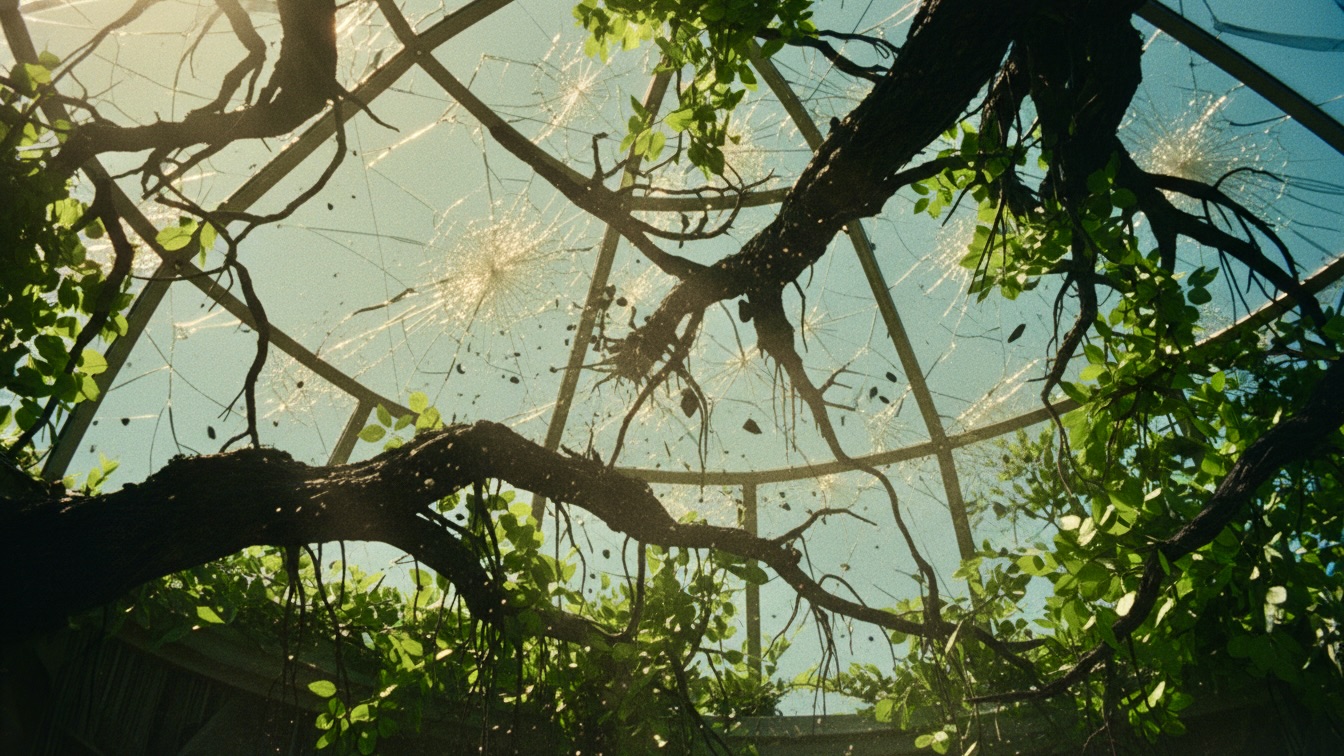
The situation escalates as the pines reach the dome's ceiling, threatening to shatter the glass and expose the students to the supposedly toxic atmosphere outside. Harper tries to call for help, but Tom disables her communication, fearing the Custodians' retribution and harboring a manic desire to see the "real" world. As the dome begins to fail and the sharp, unfiltered wind from outside rushes in, the two are forced to face the possibility that everything they were told about the outside world was a lie.
Harper: A high-achieving, anxiety-ridden student who finds comfort in the dome's rigid rules and synthetic "peace." She starts as a loyalist to the system, terrified of losing her clearance, but ends the story paralyzed by the realization that her "safe" world is fragile and built on lies. Her psychological arc moves from obsessive control to a forced acceptance of chaos.
Tom: A disillusioned rebel who craves authenticity in a world of synthetic lavender and mood-regulated water. He begins as a reckless provocateur who underestimates the danger of his actions, but ends in a state of manic awe. He represents the human impulse to touch the "wild," even if that contact is self-destructive.
The episode opens with the "Spring Assessment," where Harper’s nervous tics and Tom’s apathy establish the high-pressure, sterile environment of the bio-dome. As they reach the perimeter, they discover the "bleeding" black saplings, marking the first intrusion of the wild into their curated reality. The tension spikes when Tom confesses to planting the seeds, shifting the conflict from a biological anomaly to a criminal act of rebellion that threatens their lives.
The midpoint features the "Consumption," where the black pine aggressively absorbs a Ficus perfectus, demonstrating its role as an apex predator against engineered life. Harper attempts to trigger a quarantine, but Tom breaks her comms just as the dome’s automated security traps them inside the failing sector. The climax occurs as the pine shatters the reinforced glass, allowing the "toxic" wind of the outside world to rush in while the students brace for a world they were never meant to see.
The episode begins with a sense of clinical sterility and low-level, grinding anxiety, shifting into visceral dread as the black pine appears. The midpoint is marked by a frantic, claustrophobic panic as the characters realize they are trapped by the very security systems meant to protect them. The climax delivers a sense of awe-inspiring destruction, ending on a note of terrifying liberation as the dome finally breaks.
If expanded, the season would follow Harper and Tom as they navigate the "Dead Zone," discovering that the outside world is not a wasteland but a vibrant, albeit dangerous, new ecosystem that has reclaimed the ruins of the old world. They would be hunted by Custodian retrieval teams while trying to find other "cracks" in the global network of domes to liberate more inhabitants.
The series would eventually reveal that the domes are not lifeboats for humanity, but cages designed by a corporate elite to prevent humans from interfering with the planet's natural, post-human recovery. Character arcs would focus on the de-programming of the dome-dwellers and their struggle to adapt to a world that doesn't care about their metrics or "merit points."
The visual style contrasts the "Surgical Spring" of the dome—bright, over-saturated, and overly clean—with the "Gothic Organic" look of the black pine. Cinematic influences include the sterile futurism of Gattaca clashing with the body-horror flora of Annihilation. The camera work should move from steady, tripod-based shots in the beginning to frantic, handheld movements as the environment disintegrates.
The tone is one of escalating psychological horror, using sharp, metallic sound design and jarring transitions to mirror the breakdown of the environment. Lighting transitions from the harsh, artificial "sunlight" of the dome to the moody, ash-filtered, and unpredictable light of the breach.
This content is aimed at young adults and fans of speculative sci-fi (ages 16-35). It appeals to viewers who enjoy "cli-fi" (climate fiction), dystopian thrillers, and anthology series like Black Mirror or Love, Death & Robots that explore the intersection of technology and nature.
The pacing follows an "Accelerated Decay" model, starting slow and rhythmic to establish the dome's routine before rapidly speeding up as the pine grows. The 10-12 minute runtime follows a classic three-act structure: the discovery (0-3m), the escalation/conflict (3-8m), and the catastrophic failure/breach (8-12m).
The black pine requires a mix of practical "bleeding" props for close-ups and CGI for its rapid, jerky growth movements. The "bleeding" effect should look viscous and metallic to contrast with the dry, synthetic plants of the dome.
Soundscape is critical to the production; the "mechanical screech" of the tree and the transition from the synthetic lavender hum to the raw, howling wind must be visceral. The set design for Sector Seven should emphasize the "uncanny valley" of the engineered plants to make the arrival of the black pine feel more grounded and "real" by comparison.


