The chapter begins with Harper and Tom, two students at a high-tech university housed within a climate-controlled bio-dome, performing a routine maintenance assessment in Sector Seven. Harper is deeply anxious about her performance and the potential of being reassigned to menial labor, while Tom appears detached and dismissive of the dome’s artificial perfection. Their mundane task takes a dark turn when Tom reveals he has secretly planted "wild" seeds he recovered from a breach in the perimeter wall.
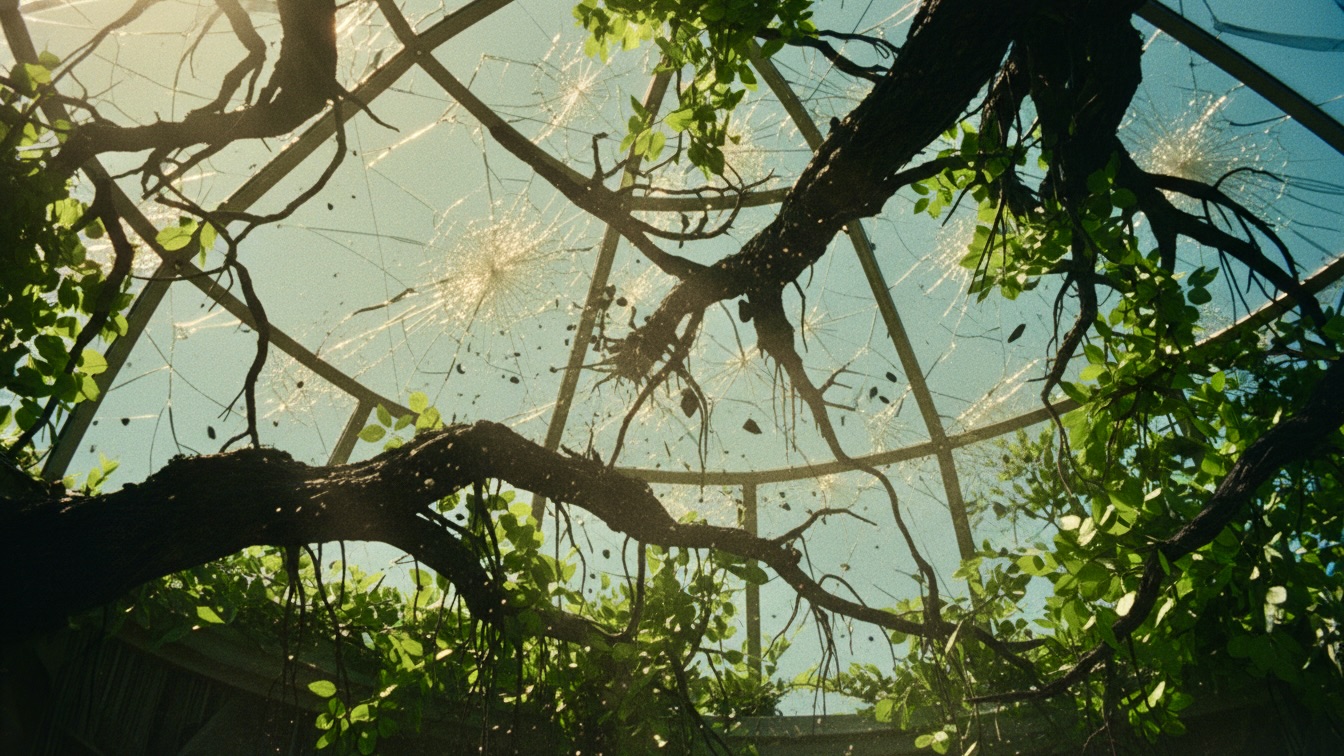
These seeds quickly sprout into aggressive, black, wire-like pines that defy the dome’s genetic regulations and begin to consume the engineered flora around them. As the plants grow at an impossible rate, they destroy the irrigation systems and the surrounding "perfect" trees, eventually reaching the ceiling of the dome. The chapter concludes with the structural failure of the bio-dome as the massive, bleeding tree shatters the reinforced glass. Harper and Tom are left facing the unknown, toxic atmosphere of the "dead zone" as the barrier between their curated world and reality collapses.
The central theme of the narrative is the irrepressible nature of reality versus the fragility of a curated utopia. The bio-dome represents a society that has traded its freedom and the "messiness" of nature for a sterile, predictable safety. By engineering plants that never drop leaves and regulating the mood of the inhabitants through the water supply, the system attempts to eliminate the very concept of decay or conflict. However, the emergence of the black pine suggests that life cannot be indefinitely suppressed or simulated without eventually inviting a violent correction.
Another prominent theme is the psychological cost of total institutional control. Harper’s physical manifestations of anxiety, such as her clicking jaw and tapping foot, illustrate how the pressure to maintain "perfection" and follow strict metrics erodes the human spirit. The dome provides safety from the "dead zone," but it does so by creating a high-stakes environment where a single mistake leads to social exile or "memory matrix" wiping. This suggests that the "peace" Tom mentions is merely a thin veneer over a foundation of systemic fear and constant surveillance.
Finally, the story explores the concept of "The Return of the Repressed" through the biological invasion of the black pine. The tree is described in visceral, almost animalistic terms—it bleeds, it screams, and it consumes. It acts as a physical manifestation of everything the dome has tried to exclude: rot, unpredictable growth, and raw power. The fact that the tree is fueled by the very water and sunlight provided by the dome highlights the irony that the system’s own resources are ultimately used to facilitate its destruction.
Harper serves as the psychological anchor for the reader, embodying the internalized stress of a meritocratic, authoritarian society. She is hyper-fixated on rules and assessments, not because she loves the system, but because she is terrified of the consequences of failure. Her anxiety is somatic, manifesting in her body before she even acknowledges it consciously. She views the world through the lens of "maintenance clearance" and "point deductions," showing how deeply the university’s metrics have colonized her mind.
Despite her rigid adherence to the rules, Harper possesses a sharp survival instinct that allows her to recognize the danger of the black pine before Tom does. Her initial reaction to the anomaly is to report it and trigger a quarantine, reflecting her belief that the system is the only thing capable of protecting her. However, when the system fails and the lockdown traps her, she undergoes a rapid shift from institutional reliance to human connection. By the end of the chapter, she finds grounding not in her "wrist-comm" or her grades, but in the physical reality of Tom’s hand.
Tom acts as the foil to Harper’s neuroticism, representing the subversive element inherent in any overly controlled environment. He uses sarcasm and a feigned lack of interest as a defense mechanism against the oppressive atmosphere of the dome. His decision to plant the "wild" seeds was not an act of malice, but a desperate search for something "real" in a world of "fake bushes" and "mood-water." He is a character driven by a dangerous curiosity, willing to risk a Class A felony just to see if life can exist outside the prescribed boundaries.
As the situation escalates, Tom’s bravado is replaced by a hollowed-out shock as he realizes the magnitude of the destruction he has unleashed. He is forced to confront the fact that "real nature" is not the gentle, romanticized ideal he likely imagined, but a violent and indifferent force. Yet, even in his terror, he maintains a sense of manic wonder when the dome begins to break. He chooses to believe that the authorities lied about the toxicity of the outside world, showcasing a fundamental need for hope that transcends his fear of death.
The author employs a stark contrast in sensory details to emphasize the shift from the artificial to the organic. In the beginning, the descriptions are clinical and synthetic, focusing on "manufactured hums," "synthetic cobblestones," and "chemically synthesized lavender." This creates a sense of uncanny perfection that feels claustrophobic to the reader. As the black pine takes over, the language becomes more visceral and grotesque, utilizing words like "bleeding," "raw meat," and "mechanical screech."
The pacing of the chapter is masterfully handled, beginning with a slow, tense dialogue that builds into a frantic, high-stakes disaster. The initial focus on Harper’s jaw clicking sets a rhythmic, ticking-clock tone that mirrors the underlying pressure of the Spring Assessment. Once the "wild" seeds are revealed, the narrative acceleration mimics the exponential growth of the plant itself. The sentences become shorter and more action-oriented as the dome’s structural integrity begins to fail, pulling the reader into the characters' panic.
The narrative voice is third-person limited, staying close to Harper’s internal state, which allows the reader to feel the weight of the dome’s societal pressure. The use of technical jargon like "memory matrix," "sector boundaries," and "Custodians" provides world-building without the need for heavy exposition. This clinical terminology creates a cold, detached atmosphere that makes the eventual "unfiltered wind" of the dead zone feel like a necessary, albeit terrifying, release of tension.


