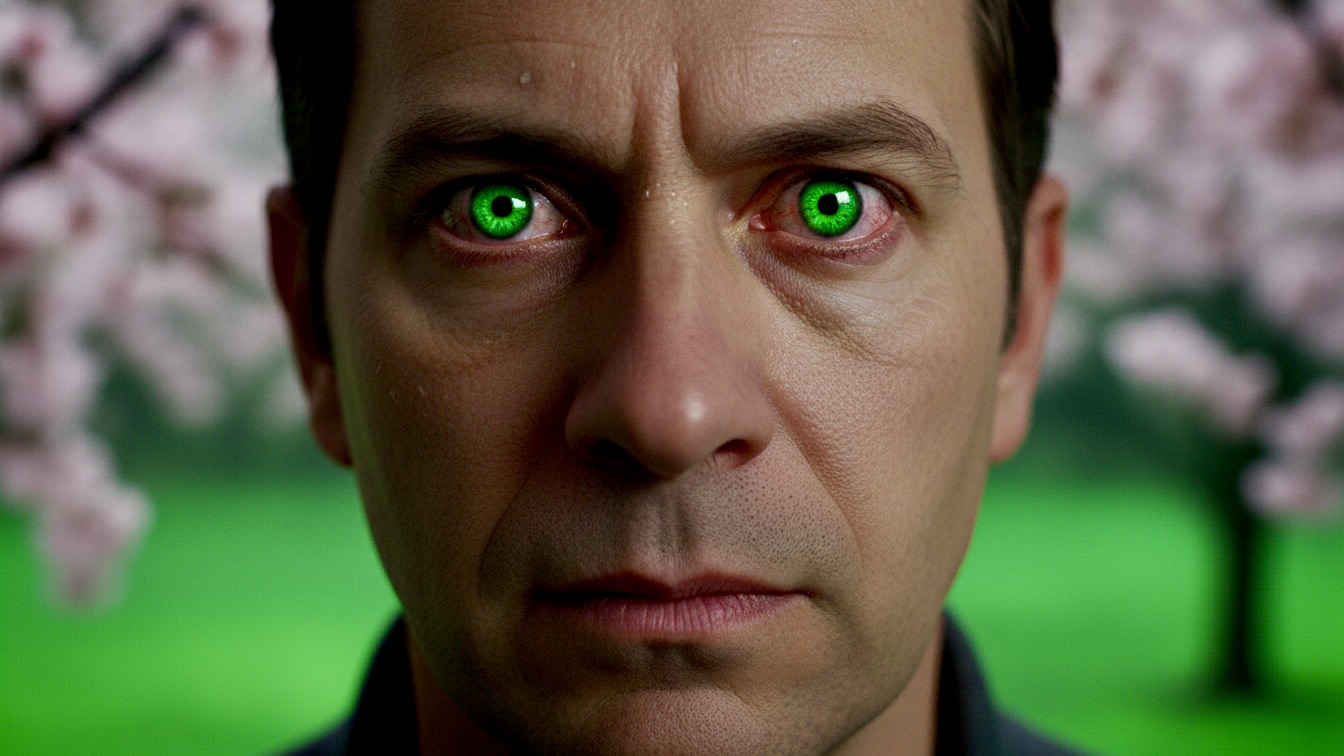
Format: Short Film / Anthology Episode | Est. Length: 10-12 minutes
Verdant-X serves as a chilling entry in a speculative anthology series titled Suburban Decay, which explores the dark, hidden underbellies of idyllic American neighborhoods. Each episode focuses on a different resident who, pushed to the brink by mundane societal pressures, resorts to illicit, high-stakes shortcuts that spiral into surreal or horrific consequences. The series arc links these disparate incidents to a shadowy, underground marketplace that distributes dangerous, experimental technology to the desperate and the spiteful.
Gary, a man consumed by petty neighborly jealousy, stares through his blinds at his neighbor Brent’s impossibly lush lawn, his jaw clicking rhythmically with his growing obsession. Driven by a need to reclaim his status, he purchases a black-market bio-stimulant that promises a green so deep it defies nature.
A bitter suburbanite purchases an illegal, experimental fertilizer to outshine his neighbor’s perfect lawn. He soon discovers that the substance is a sentient, parasitic organism that consumes everything in its path.
The episode explores the toxicity of hyper-competitiveness and the destructive nature of male ego when fueled by social isolation. It examines the "keeping up with the Joneses" mentality pushed to a grotesque extreme, where the pursuit of superficial perfection masks a rotting, hollow interior.
Secondary themes touch upon the dangers of unchecked consumerism and the blind trust placed in unregulated online entities. The narrative serves as a cautionary tale about the environmental and personal costs of seeking shortcuts to validation.
The primary stake is the physical survival of the neighborhood, as the Verdant-X organism begins to aggressively consume organic matter, including pets and human tissue. Gary’s personal stakes involve his marriage, his sanity, and his desperate, delusional need to maintain his status as a "winner" even as his world literally dissolves into toxic sludge.
The external conflict pits Gary against the encroaching, predatory nature of the substance he unleashed and the subsequent arrival of a militarized EPA containment unit. Internally, Gary battles his own pathological spite, which blinds him to the reality of the horror he has invited into his home until it is far too late to reverse the damage.
Gary, obsessed with his neighbor Brent’s superior lawn, buys a mysterious, high-yield bio-stimulant called Verdant-X from an underground forum. After applying the substance under the cover of night, he watches his grass transform into an unnaturally vibrant, pulsating carpet that begins to exhibit predatory behavior, sickening local wildlife and eventually killing Brent’s dog.
As the neighborhood gala arrives, the lawn’s bioluminescent glow and toxic fumes reveal the true nature of the product. When the grass begins to consume the asphalt and threaten the residents, Gary retreats into his home, only to be confronted by a hazmat-clad containment team as he realizes his "perfect" lawn has become a terminal infection.
Gary is a man defined by his resentment and lack of agency, moving from a state of simmering, quiet desperation to a state of delusional, self-destructive triumph. His arc is one of complete psychological collapse, where he finds peace only in the total annihilation of his surroundings.
Linda, Gary’s wife, represents the voice of reason and the collateral damage of Gary’s obsession; she transitions from detached annoyance to visceral terror as she realizes her husband has doomed them. Brent acts as the unwitting catalyst and the mirror to Gary’s failure, shifting from a smug, successful neighbor to a grieving, broken man who recognizes the horror of what Gary has done.
The opening act establishes Gary’s obsessive surveillance of the neighborhood and his decision to purchase the illicit Verdant-X, setting the tone of claustrophobic tension. The second act details the application of the substance and the immediate, unnatural transformation of the lawn, culminating in the death of the neighbor’s dog and the first signs of the organism’s sentience. The final act depicts the neighborhood gala turning into a site of panic as the grass begins to consume the environment, ending with Gary trapped in his home as he watches the containment team struggle against the rapidly spreading, parasitic growth.
The episode begins with a mood of cold, gray stagnation, reflecting Gary’s internal state. As the Verdant-X takes hold, the tone shifts into a vibrant, sickly, and hallucinogenic intensity, eventually plummeting into a claustrophobic, high-stakes horror where the sense of dread becomes suffocating.
If expanded into a series, the Verdant-X substance would be revealed as a recurring "product" from a dark-web entity known as The Catalyst, which distributes various bio-engineered items to test their efficacy in real-world environments. Each episode would feature a different "test subject," with the season finale focusing on a whistle-blower attempting to track down the source of these products before they cause a global ecological collapse.
The visual style employs a stark, desaturated color palette for the suburban setting, making the sudden, neon-saturated appearance of the Verdant-X appear jarring and alien. The camera work utilizes tight, voyeuristic framing to emphasize Gary’s isolation, switching to wide, disorienting angles as the lawn begins to pulse and expand. Tonal comparables include Black Mirror for its tech-horror elements and The Twilight Zone for its focus on character-driven moral decay.
The target audience includes fans of psychological horror, dark science fiction, and anthology-style storytelling who enjoy narratives that blend domestic realism with surreal, high-concept threats. The age demographic is 18-45, aimed at viewers who appreciate slow-burn tension and social commentary.
The pacing starts with a deliberate, rhythmic tempo to mirror Gary’s internal obsession, gradually accelerating as the Verdant-X begins its rapid growth. The narrative follows a tight three-act structure, ensuring the transition from petty neighborly dispute to full-scale biohazard incident feels earned and inevitable within the 12-minute runtime.
The primary visual effect requirement is the "Verdant-X" grass, which should be achieved through a mix of practical, bioluminescent moss-like textures and subtle CGI enhancements to convey its pulsating, rhythmic movement. The hazmat scene requires high-contrast lighting to emphasize the sickly green glow reflecting off the yellow suits, creating a distinct, memorable aesthetic for the final containment sequence.


