Format: Short Film / Anthology Episode | Est. Length: 10-12 minutes
This episode serves as a foundational entry in an anthology series titled Static Liminal, which explores the decaying edges of modern reality in mid-sized, forgotten urban centers. Each episode focuses on different characters who perceive the "glitches" in their environment—anomalies in light, sound, and physics—suggesting that the world is a fraying simulation or a reality losing its structural integrity.
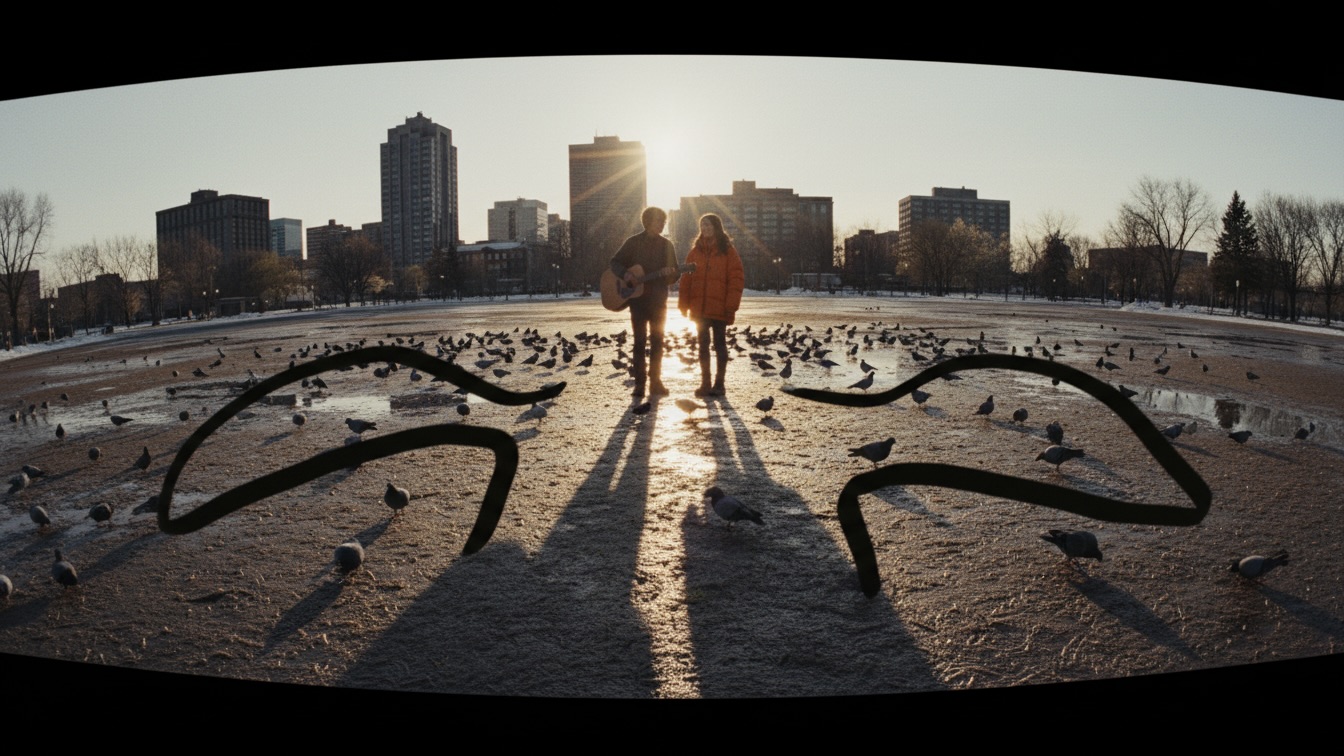
Lenny, a struggling musician, plays his out-of-tune guitar in a slush-filled Winnipeg park, only to realize the surrounding pigeons have frozen in a synchronized, unnatural state of tremor. As the ambient city noise vanishes, he and his friend Hanna witness the shadows beneath the trees detach from their objects, forming pools of absolute, light-consuming darkness.
When a musician and his friend encounter a reality-bending anomaly in a desolate city park, they must confront the encroaching void. They discover that their only defense against the erasure of their world is the raw, dissonant noise of their own creative expression.
The narrative explores the existential dread of the digital age, specifically the feeling that modern life has become a repetitive, hollow loop that lacks authenticity. It juxtaposes the "glitch" of the physical world against the internal numbness of the characters, using the city’s decay as a metaphor for the erosion of human connection and purpose.
The episode also delves into the redemptive power of art, positing that creation is an act of rebellion against a collapsing reality. By transforming their fear into music and writing, the protagonists attempt to anchor themselves to a world that seems increasingly eager to discard them.
At risk is not only the protagonists' physical survival as the "shadow mass" threatens to consume them, but also their grasp on objective reality. If they succumb to the silence and the "glitch," they face the prospect of being erased or absorbed into the void, losing their agency and their ability to define their own existence.
The primary antagonist is the "shadow mass," an enigmatic, entropic force that manifests as silence and physical anomalies, representing the breakdown of the world's underlying architecture. Internally, Lenny struggles with his own nihilism and the fear that his artistic efforts are meaningless, while the city itself acts as a hostile, indifferent environment that reinforces their isolation.
Lenny and Hanna are idling in a bleak Winnipeg park when they notice the environment shifting; the birds stop moving, the light flattens, and shadows begin to behave like predatory, physical holes in space. After narrowly escaping the park as the anomaly peaks, they retreat to the safety of a coffee shop, attempting to process the terrifying realization that the world they inhabit is fundamentally broken.
Despite their attempt to return to normalcy, the shadow follows them, appearing in the corners of their vision and the silences between their words. Lenny eventually finds solace by composing a song that captures the dissonance of the event, realizing that by documenting the "glitch" through his music, he can temporarily push back the encroaching void and assert his presence in a thinning reality.
Lenny is a disillusioned, struggling musician who feels trapped in a cycle of mid-tier existence and digital distraction. He begins the episode feeling powerless and cynical, but ends with a renewed, albeit fragile, sense of purpose as he uses his art to confront the void.
Hanna is a weary, pragmatic observer who masks her anxiety with dry, fatalistic humor about the "NPC" nature of their lives. She serves as Lenny’s anchor, moving from a state of skeptical detachment to a terrifying realization of the world's fragility, ultimately encouraging Lenny to document their experience.
The episode opens with the park sequence, establishing the mundane, gray atmosphere before the sudden, jarring shift into the supernatural silence. The tension escalates as the shadow mass touches Hanna, forcing a frantic, wordless escape that leaves a permanent mark on her boot and a psychological scar on both characters. The climax occurs in Lenny's apartment, where he confronts the lingering presence of the void by playing a dissonant, honest melody that pushes back the darkness, effectively reclaiming his space from the glitch.
The mood begins with a dull, melancholic stagnation, shifts into sharp, high-frequency terror during the park anomaly, and settles into a tense, introspective resolve. The audience is taken from the boredom of urban decay to the existential horror of a breaking reality, finally landing on a note of defiant, fragile hope.
If expanded, the season would follow Lenny and Hanna as they realize they are not the only ones witnessing the "glitches," leading them to search for others who have experienced the shadow mass. The overarching narrative would escalate as the anomalies become more frequent and public, forcing the characters to decide whether to hide from the truth or attempt to "patch" the reality they live in.
The season would explore the origins of the shadow mass, questioning whether it is a natural phenomenon, a technological error, or a consequence of human collective consciousness. As the characters evolve, they would transition from passive observers to active investigators, uncovering a hidden history of their city that suggests it has been a "testing ground" for reality shifts for decades.
The visual style is characterized by a "dirty realism" aesthetic, utilizing desaturated colors, natural lighting, and handheld camera work to emphasize the grit of a Winnipeg winter. The "glitch" moments are rendered with subtle, unsettling practical effects—stuttering movement, light-absorbing shadows, and distorted sound design—to create a sense of uncanny, low-fi horror.
The tone is comparable to the atmospheric dread of It Follows mixed with the surreal, mundane existentialism of Severance. It avoids high-budget spectacle in favor of intimate, claustrophobic tension, ensuring that the supernatural elements feel grounded and deeply personal.
The target audience includes young adults and adults (18-35) who enjoy speculative fiction, psychological horror, and character-driven indie dramas. It is specifically tailored for viewers who appreciate slow-burn narratives, urban exploration themes, and stories that challenge the nature of reality.
The pacing is deliberate and rhythmic, mimicking the slow, decaying feel of the city before accelerating during the "glitch" sequences. The 10-12 minute runtime is structured as a single, tight act that prioritizes mood and character development over complex exposition, ensuring the audience remains immersed in the immediate experience of the characters.
Practical effects should be prioritized for the shadow mass to maintain a tactile, grounded feel; the use of high-contrast lighting and negative fill will be essential to create the "void" effect without relying heavily on CGI. Sound design is a critical production element, requiring a stark contrast between the heavy, muffled silence of the anomalies and the sharp, dissonant, and "real" sounds of the city and the guitar.


